Svennis AI
9 min read

Claude in Microsoft 365 and Teams: how to connect it to the systems behind it

The Microsoft 365 connector lets Claude read your mail, files and Teams chats. This guide covers the admin settings, the limits and how to wire Teams to your help desk.

Abstract lines flowing from several separate blocks into one shared channel, suggesting connected systems

Claude in Microsoft 365 and Teams works best as a front end to your help desk and CRM

Claude in Microsoft 365 and Teams is Claude working with your Outlook mail, calendar, SharePoint and OneDrive files and Teams chats through Anthropic's Microsoft 365 connector. On its own, the connector searches, summarises and drafts. It does real work when Teams becomes the front end to the systems behind it, such as a help desk or a CRM.

The connector gives Claude your team's conversations and documents. It does not give Claude your ticket queue, your customer records or your prices. Those live in systems such as Zoho Desk or Zoho CRM. A request typed into Teams that ends as a chat reply leaves no ticket, no owner and no history.

This guide covers five things in order:

  • what the connector reads and what it can change;
  • what your Microsoft administrator has to set;
  • a worked example you can follow;
  • how to make Teams the front end to a help desk;
  • what to leave alone, and what it means for a UK company.

The same principle runs through our guide to putting Claude inside the tools you already use: the assistant is only as useful as the systems it can reach.
The Microsoft 365 connector reads mail, calendar, files and Teams with each user's own permissions

The Microsoft 365 connector is available on every Claude plan: Free, Pro, Max, Team and Enterprise. It needs a work account tied to a Microsoft Entra tenant on a Microsoft Business plan. Personal accounts such as @outlook.com, @hotmail.com or @live.com addresses cannot connect.

The connector uses delegated permissions, which means Claude acts on behalf of each individual user. Claude can only see what that user can already see in Microsoft 365. A junior member of staff gets no view of the finance director's inbox through Claude.

Claude also reaches into Microsoft 365 only when a question needs it. According to Anthropic's help centre, it does not run background searches. Nothing is indexed on a schedule while nobody is asking.

File formats Claude can read

From SharePoint and OneDrive, Claude reads these formats:

  • Word, Excel and PowerPoint, including older .doc, .xls and .ppt files;
  • PDF;
  • plain text such as .txt, .md and .csv.

Other formats, OneNote included, cannot be read. OneNote notebooks appear in search results, but opening one returns a mime type error.

How far SharePoint search reaches

SharePoint search covers the entire tenant, limited only by the user's permissions. You cannot restrict the connector to chosen sites. If a site is shared more widely than it should be, Claude will find it for anyone who has access.

Write tools let Claude send and change content, and they are off by default

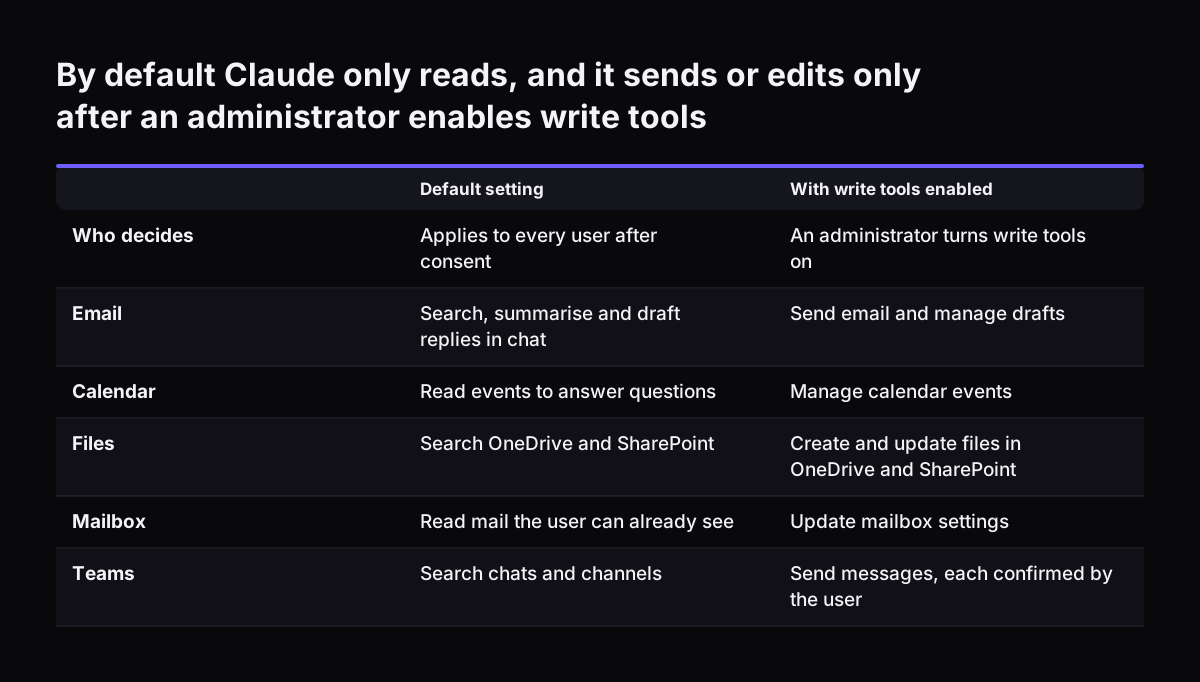
Write tools are admin-enabled capabilities that let Claude act rather than only read. Permissions are read-only by default. Claude can send, create or update content only after an administrator enables write tools.

With write tools on, the setup article lists what Claude can do:

  • send email and manage drafts;
  • manage calendar events;
  • update mailbox settings;
  • create and update files in OneDrive and SharePoint;
  • send messages in Microsoft Teams.

Teams messages always need the user's confirmation

Sending a Teams chat message, or posting or replying in a channel, always requires the user to confirm. Your administrator cannot set these to send automatically. Check the current help article before you plan around Teams writes. When write tools launched in July 2026, the release notes said Teams remained read-only.

Which writes are labelled, and which are not

Emails that Claude sends carry a message header identifying them as agent-initiated. File writes, calendar writes and Teams messages are not currently tagged. That gap matters for audit: a changed spreadsheet looks like any other change by that user.

Attachments are not supported in write tools. Sending, forwarding and drafting all reject messages with attachments. Any process that depends on sending a quote or a contract as a file still needs a person or another system.

By default Claude only reads, and it sends or edits only after an administrator enables write tools. Default setting / With write tools enabled. Who decides: Applies to every user after consent / An administrator turns write tools on; Email: Search,

Admin setup: tenant consent, Conditional Access and the settings to decide first

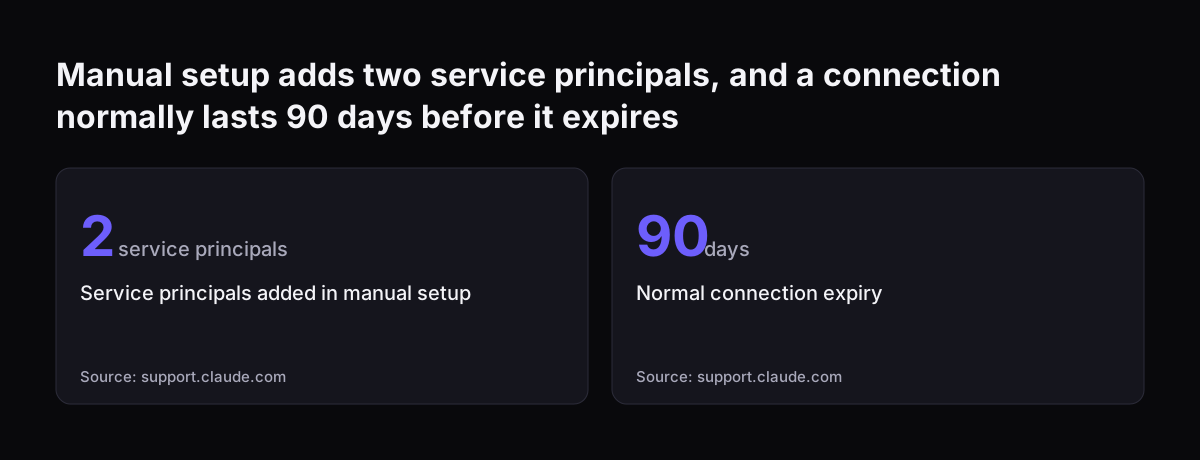
A Microsoft Entra Global Administrator must grant a one-time consent before anyone in the tenant can connect. The consent authorises the integration for the whole tenant. If you choose the manual setup route, the process adds two service principals to your tenant.

Your Conditional Access policies also apply. Entra evaluates the connector's server-side requests as coming from Anthropic's IP range, 160.79.104.0/21. Two error codes point to a policy problem. AADSTS53003 means a Conditional Access policy blocked access. AADSTS70043 means a sign-in frequency policy blocked the request.

The table sets out each setting, what Anthropic's documentation says, and the starting choice we suggest for a first rollout.

SettingWhat the documentation saysSuggested starting choice
Tenant consentOne-time consent by an Entra Global Administrator, in every tenantGrant it once the pilot group and use case are agreed
Write toolsOff; read-only by defaultLeave off until a named process needs them
Conditional AccessRequests evaluated as coming from 160.79.104.0/21Review existing policies before users connect
SharePoint scopeWhole tenant under the user's permissions; site allowlists not supportedFix over-shared sites before rollout
Memory on Team and EnterpriseOff by defaultDecide as a written policy, not user by user
Connection expiryNormal expiry is 90 daysTell users they will need to reconnect

Sign-in frequency policies can make connections expire far more often than the normal 90 days. If users complain that Claude keeps asking them to reconnect, check those policies first.

Manual setup adds two service principals, and a connection normally lasts 90 days before it expires: Service principals added in manual setup 2 service principals, Normal connection expiry 90 days
Source: support.claude.com

Worked example: an office manager connects Claude to Outlook, SharePoint and Teams

Take a small professional services firm on a Microsoft Business plan. The office manager wants Claude to help with new starters. Here is the sequence, using the settings from Anthropic's help centre.

  1. The Global Administrator grants the one-time tenant consent.
  2. The administrator leaves write tools off.
  3. IT confirms that no Conditional Access policy blocks requests from 160.79.104.0/21.
  4. The office manager connects her work account from Claude. Her personal Hotmail address would be refused.
  5. She asks: "Find the Teams thread about the new starter's laptop, check my calendar for the IT induction, and list what is still open."

Claude searches her Teams chats, her calendar and the SharePoint files she can open. It returns a short list of open items. It sees nothing she could not see herself.

Next she asks Claude to email IT. With write tools off, Claude drafts the text in the chat and she sends it from Outlook. With write tools on, Claude could send it, and the email would carry the agent-initiated header. If she asks Claude to attach the laptop policy PDF, the request is rejected, because write tools do not support attachments.

One gap remains. The laptop request now exists in a Teams thread and an email. It is not a ticket anywhere, so nobody owns it and nobody measures how long it takes. That gap is the reason to connect Teams to a help desk.

Claude as the front end in Teams, with the help desk as the system of record

An assistant inside Teams should take the request, not keep it. The help desk remains the system of record: it holds the queue, the owner, the service levels and the history. Claude's job is to understand the request, route it and report back in the same chat.

In practice this is a separate build from the Microsoft 365 connector. The assistant calls Claude through the API and uses tool use, which lets the model call functions you define. All current Claude models support tool use.

A typical flow has three steps. It reads the Teams message and classifies it. It opens a ticket in Zoho Desk with the right category and team. It then posts the ticket reference back to the user.

For a Microsoft shop, one practical detail helps. Anthropic's models are available through Microsoft Foundry as well as the Claude API. Anthropic's models page suggests starting with Claude Opus 5.5 for most workloads if you are unsure which model to use.

At Svennis we connect the help desk before we switch on any write tool. That way every request typed into Teams lands as a ticket with an owner, not as an untracked chat reply. We also keep the assistant's permissions in the help desk narrower than a human agent's until the routing has been checked against real tickets.

The connection to the help desk usually runs through an MCP server, a small service that exposes the help desk's actions to Claude. Our guide to scoping an MCP server for your own internal system covers that step. Your staff may work in Slack rather than Teams. The pattern is then the same as in our post on Claude in Slack for internal support.

What to leave alone: archive search, attachments, OneNote and SharePoint site limits

Several jobs look like a fit for Claude in Microsoft 365 but fall outside what the connector does today. Planning around them saves a failed pilot.

These are the limits Anthropic documents:

  • Archived mail. Claude does not search the separate Online Archive mailbox, also called the In-Place Archive. Messages a retention policy moved there will not appear.
  • Attachments. Claude cannot send, forward or draft emails with attachments.
  • OneNote. Notebooks show up in search, but Claude cannot read them.
  • Site scoping. Sites.Selected is not supported, so you cannot limit the connector to an allowlist of SharePoint sites.
  • Audit tags. File, calendar and Teams writes are not tagged as agent-initiated.

Two decisions follow. First, do not use the connector for historic email research if your retention policy moves mail to the archive. Second, do not enable write tools for files where an untagged change would be hard to trace, such as price lists or contract templates. Keep those edits in the system that owns the data, where changes are logged.

A tidy permission model matters more than any Claude setting. Because search reaches the whole tenant, an over-shared HR or finance site becomes visible to Claude for everyone who can already open it.

What Claude in Microsoft 365 and Teams means for a UK company

A UK company deploying Claude in Microsoft 365 needs a clear record of what data the assistant touches and who checks its output. The Information Commissioner's Office offers a useful model. It publishes a privacy notice for its own use of Microsoft 365 Copilot, a different assistant, and the controls it describes translate well.

The ICO states these practices for its own use:

  • data used with Copilot stays in its UK Microsoft 365 and Azure tenants and is not used to train foundation models;
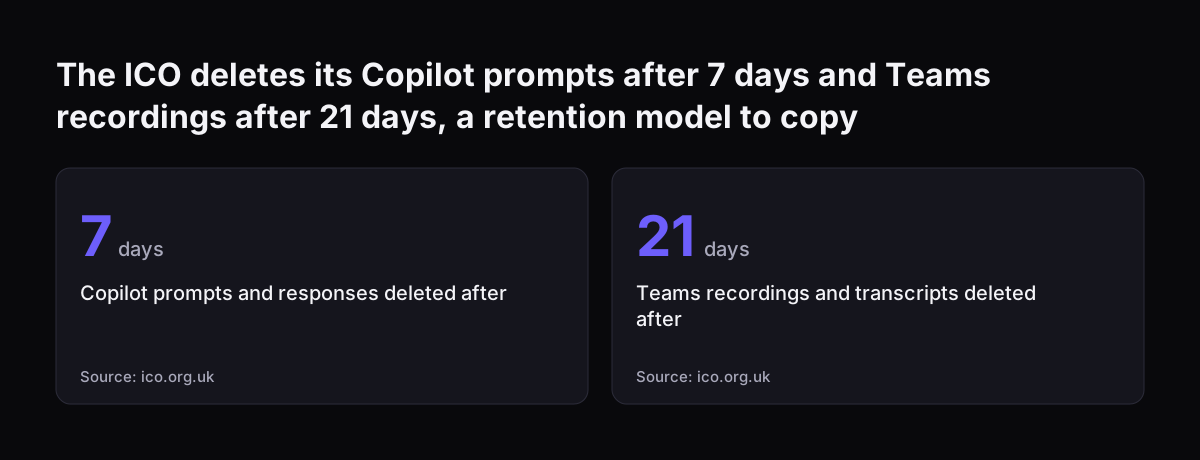
  • all Copilot prompts and responses are deleted after 7 days;
  • Teams recordings and transcripts are deleted after 21 days;
  • no decision affecting a customer is taken solely on Copilot output;
  • human oversight is always required to verify outputs.

Claude's data flow differs in one important way. The connector's requests reach your tenant from Anthropic's IP range, so data leaves Microsoft's boundary when a user asks a question. Record that in your data protection documentation, and decide retention for Claude conversations as deliberately as the ICO did for Copilot.

The "no decision solely on AI output" rule fits the help desk design well. Claude routes the ticket and a person resolves it. For the legal side, see our overview of AI law in the UK for businesses and our GDPR checklist for Claude.

The ICO deletes its Copilot prompts after 7 days and Teams recordings after 21 days, a retention model to copy: Copilot prompts and responses deleted after 7 days, Teams recordings and transcripts deleted after 21 days
Source: ico.org.uk

Next steps: connect read-only, then wire in one business system

Start small and read-only, then connect the one system where requests most often go missing. This order keeps risk low and shows value early.

  1. Check eligibility. Confirm your users have work accounts on an Entra tenant tied to a Microsoft Business plan.
  2. Clean up SharePoint sharing. Review over-shared sites before anyone connects, because search covers the whole tenant.
  3. Grant consent for a pilot. Have the Global Administrator grant tenant consent, with write tools left off.
  4. Test Conditional Access. Watch for AADSTS53003 and AADSTS70043 errors in the first week.
  5. Write down the limits. Tell users about archived mail, attachments and OneNote before they find out the hard way.
  6. Pick one system to connect. Choose the help desk or CRM where Teams requests most often go untracked.
  7. Decide on write tools last. Enable them only for a named process with a clear owner.

For step six, our post on running a Teams service desk on Claude and Zoho Desk shows the full pattern from Teams message to routed ticket.

Sources

  1. 1. Set up the Microsoft 365 connector (Claude Help Center)
  2. 2. Connect to Microsoft 365 (Claude Help Center)
  3. 3. Release notes, Claude apps (Anthropic)
  4. 4. Models overview (Anthropic)
  5. 5. Claude Platform release notes (Anthropic)
  6. 6. Microsoft 365 Copilot privacy notice (ICO)

Related articles