
Svennis AI
10 min read

Daily KPI briefings from Claude for middle management built on your Zoho data

Part 2 of our Zoho CRM reporting series covers which numbers belong in a daily briefing, how Claude should word them, how the run is scheduled and why every figure names its report.

Abstract cover of stacked horizontal bands, one shifting sideways to signal a daily change in figures

What a daily KPI briefing is, and where this guide fits

This guide explains how to set up daily KPI briefings from Claude for middle management, using the figures your Zoho CRM already holds. A briefing here means a short note, readable in about two minutes, that tells one team leader how their numbers stand this morning and what changed since yesterday. Zoho CRM calculates the figures. Claude reads them, compares them and explains in plain words why a change matters.

This is part 2 of a three-part series on reporting from Zoho CRM with Claude. Part 1, Claude connected to Zoho CRM for reporting, covers the connection itself: how Claude gets read access to your CRM data and which reports it may open. This part covers the daily note. Part 3, still to be published, covers the longer weekly and monthly review for directors.

If you have not connected Claude to Zoho CRM yet, start with part 1. Everything below assumes that connection exists, and that Claude can read saved reports but cannot change records.
The terms used in this guide

A few words recur throughout, so it helps to fix their meaning before going further.

  • KPI (key performance indicator): a number the business has agreed to watch because it predicts or measures results, such as open pipeline value or overdue follow-up tasks.
  • Middle manager: anyone who runs a team but does not set company targets. In practice that means a sales team leader, a service desk supervisor or a branch manager.
  • Report: a saved report in Zoho CRM. It has a name, filters and a result. This is the only place a figure in the briefing may come from.
  • Run: one scheduled execution of the job that fetches the reports, passes them to Claude and delivers the note.
  • Project: in Claude's own words, projects are "self-contained workspaces with their own chat histories and knowledge bases". You can upload files to a project's knowledge base and write project instructions that shape how Claude answers.
  • Delta: the change between today's value and the comparison value, usually yesterday or the same weekday last week.

Keep these definitions in the project instructions as well. Claude then uses the same vocabulary every morning, and so do your team leaders.

The system calculates, Claude explains

The central rule of this setup is simple. Every number in the briefing is produced by Zoho CRM, in a named report. Claude never adds, averages or estimates a figure of its own. Its job is to put the numbers side by side, say which moved, and explain in a sentence why that matters to this particular team.

There are two reasons for this split. The first is trust. A team leader who doubts a figure must be able to open one report and see the same number, without asking how it was worked out. The second is maintenance. When the definition of a KPI changes, you change the report in the CRM, and the briefing follows automatically. The prompt stays the same.

So the instructions you give Claude say, in so many words: use only the values supplied; if a value is missing, say it is missing; do not compute new totals or percentages. If you want a percentage change in the note, build it into the report or into the script that prepares the data, not into Claude's reply.

At Svennis we write this rule into the project instructions before anything else. When we review a first week of briefings with a client, the usual fault we find is a figure Claude has derived itself, and we move that calculation back into the report.

Which five or six numbers belong in the note

A two-minute note has room for five or six figures. More than that and the leader skims, and the one number that needed attention gets lost. The test for each candidate is whether the leader can act on it today. A figure that only changes monthly, or that the leader cannot influence, belongs in the weekly review from part 3.

Candidate figureIn the daily note?Reason
Overdue follow-up tasks by ownerYesThe leader can reassign or chase today
New leads not yet contactedYesSpeed of first contact is in the team's hands
Deals moved to a later stage since yesterdayYesShows momentum and who needs support
Deals with a closing date that has passedYesA clean-up job for the morning
Open pipeline value for the teamYes, one lineContext for the other figures
Month-to-date revenue against targetOnly near month endMoves slowly; daily repetition becomes noise
Win rate over the quarterNoChanges too slowly to act on daily
Company-wide totalsNoNot this leader's to influence

Choose the list with each team leader, not for them. A service desk supervisor will want different rows from a sales leader, and each gets their own set of reports. If you are working on lead handling specifically, our page on AI for lead management explains which lead figures are worth watching.

What good wording looks like when a number moved, and when it did not

The note has one job per figure: state the value, name the report, and say whether anything needs doing. The wording should be flat and specific. Adjectives such as "great" or "worrying" add nothing the number does not already say.

When a number moved

Claude states the new value, the comparison value and the likely reason, only if the report data supports a reason. A good template looks like this:

Overdue follow-ups: {today} (yesterday {previous}). Most of the rise sits with {owner}, whose tasks from {date} were not closed. Source: Zoho CRM report "Overdue tasks by owner".

Note that the reason points to rows in the report. If the data does not show why a figure moved, Claude says the cause is not visible in the report and leaves it there.

When a number did not move

Stable figures get one short line, and they still name their source. Silence would leave the leader unsure whether the figure was checked.

Open pipeline: {today}, unchanged from yesterday. Source: Zoho CRM report "Team pipeline by stage".

When data is missing

If a report returns nothing or fails, the note says so at the top. It never fills the gap from yesterday's value. A briefing that is openly incomplete is better than one that looks complete and is not.

A worked example: one sales team leader

Take the leader of an inside sales team. With them, you agree five figures: overdue follow-ups, uncontacted new leads, deals moved forward, deals past their closing date and open pipeline. Each has a saved report in Zoho CRM, filtered to their team, with a name that says exactly what it contains.

Next, you set up a Claude project for the briefings. In the project instructions you write the rules from this guide: use only supplied values, name the report after every figure, one line for unchanged figures, a flag at the top for missing data, and no more than about 150 words. In the knowledge base you upload a one-page glossary of the team's KPIs, so Claude uses the same definitions as the reports.

If you are on a Team or Enterprise plan, projects "can be shared with other members of your organization". Give the team leader Can view access. According to Anthropic's help centre, members with that permission can see the project contents, knowledge and instructions and chat within the project, but cannot edit it. The leader can then ask follow-up questions about the morning's note without being able to change the rules. Keep Can edit for whoever owns the KPI definitions.

Each morning the run pulls the five reports, adds yesterday's values from the previous run, and sends both sets to Claude with the instructions. Claude returns the note, the run delivers it, and the leader reads it before the team stand-up.

How the run is scheduled and where the note is delivered

A daily briefing should arrive without anyone having to ask for it. That means an automated run calling Claude through the API, triggered by the scheduler your team already uses, rather than someone opening a chat window each morning. The chat plans are also a poor fit for fixed daily jobs: Anthropic states that "every plan has usage limits that reset on a rolling five-hour session window", with weekly limits on paid plans.

The credential

Use a key that does not depend on one person staying at the company. Anthropic's Admin API documentation says personal keys "stop working when their user is removed from the organization", while service account keys continue to work even if the user who created them is removed. API keys themselves are created in the Claude Console, not through the Admin API.

The timing

Briefings do not need an instant reply, so they suit the batch tier, which Anthropic describes as a tier for asynchronous workloads that can be processed together. The pricing page states that batch processing saves 50% on API pricing. Start the run early enough overnight that the note is ready before the working day begins.

The destination

Deliver the note where the leader already starts the day: a direct message in Zoho Cliq, a chat in Microsoft Teams, or an email. We describe a Claude setup inside Teams in our Teams service desk post. One note per leader, in one place, at the same time every day.

Choosing the model and estimating the cost

Anthropic's own advice is: "If you're unsure which model to use, start with Claude Opus 5.5 for most workloads." For a short note that compares figures and writes a few sentences, a smaller model may be enough, and you can test that against a week of real briefings. All current models support tool use and multilingual output, which matters if your team leaders read in different languages.

ModelInput, USD per million tokensOutput, USD per million tokensNote
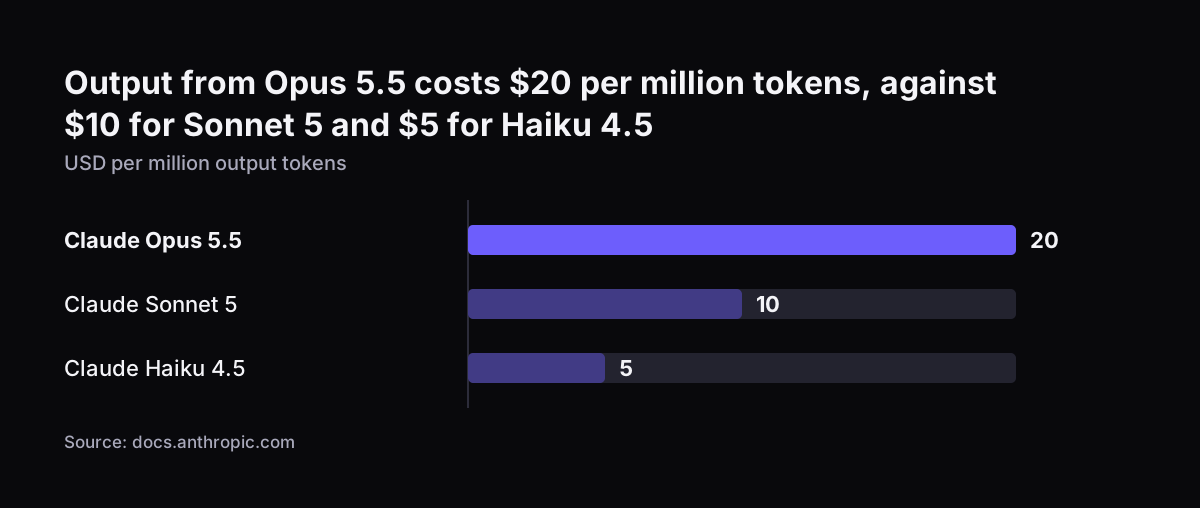
Claude Opus 5.5420Anthropic's suggested starting point
Claude Sonnet 5210Worth testing for short notes
Claude Haiku 4.515Cheapest; retirement not sooner than 15 October 2026

To estimate your own cost, count the tokens in one run: the instructions, the report data for both days, and the note itself. Multiply by the number of leaders and working days, apply the price above, then halve it if you use batch processing. Because the report data is small and the note is short, the model price is rarely the deciding factor. The cost of building and maintaining the run is.

If your leaders also want to ask follow-up questions in a shared project, they need Claude seats. The Team plan is for teams of 2 to 150, at $20 per standard seat per month billed annually, or $25 billed monthly.

Output from Opus 5.5 costs $20 per million tokens, against $10 for Sonnet 5 and $5 for Haiku 4.5: Claude Opus 5.5 20, Claude Sonnet 5 10, Claude Haiku 4.5 5 (USD per million output tokens)
Source: docs.anthropic.com

What the team leader is expected to do with the note

A briefing only earns its place if it changes what happens that morning. Agree the expected response with each leader when you choose their figures, and write it down next to the list.

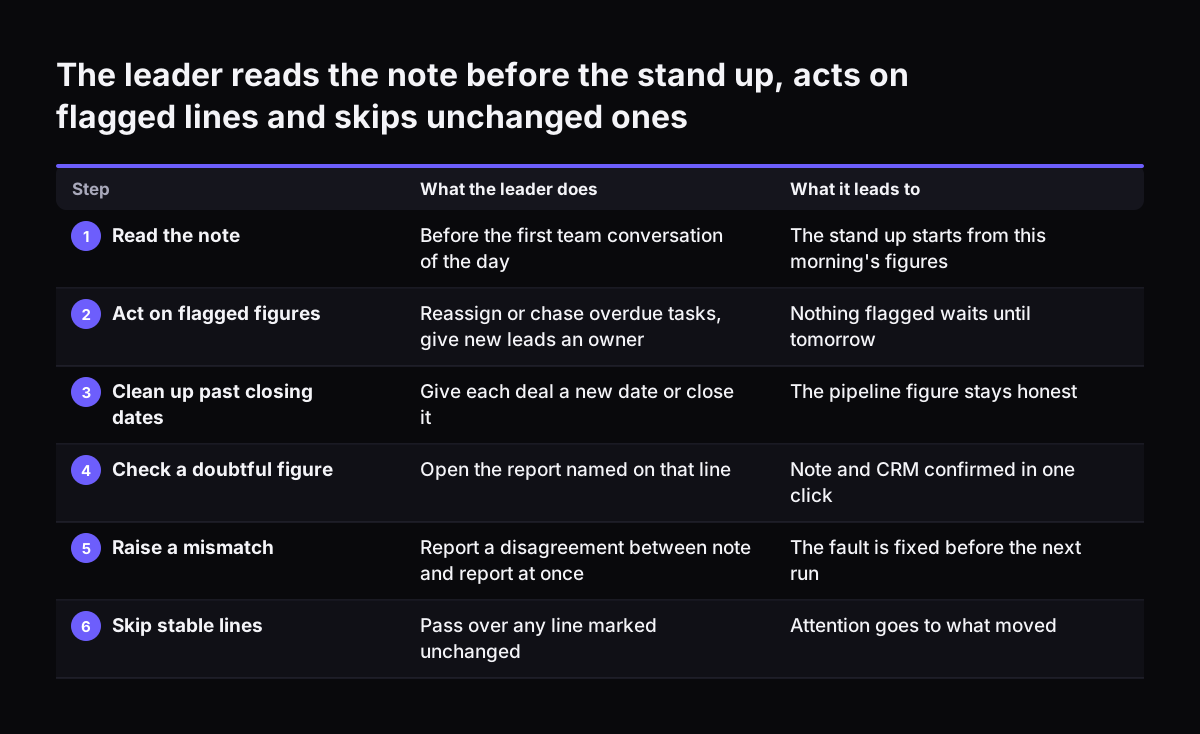
  1. Read it before the first team conversation. The note is designed for the minutes before a stand-up, not for the end of the day.
  2. Act on flagged figures. Overdue tasks get reassigned or chased. Uncontacted leads get an owner. Deals past their closing date get a new date or get closed.
  3. Check any figure that looks wrong in its report. Because every line names its source, this takes one click. If the report and the note disagree, that is a fault to raise at once.
  4. Ignore stable lines. A figure marked unchanged needs no action. Its presence confirms it was checked.
  5. Suggest changes monthly, not daily. If a figure is never useful, drop it at the monthly review rather than editing the setup on the fly.

The standing rule applies throughout: every figure names the Zoho CRM report it came from. A leader who cannot trace a number should not act on it.

The leader reads the note before the stand up, acts on flagged lines and skips unchanged ones. What the leader does / What it leads to. 1. Read the note: Before the first team conversation of the day / The stand up starts from this morning's figures;

What this means for a company in the UK

For a British business the practical questions are about data and contracts rather than technology. The briefing carries CRM data, which often includes names of staff, customers and prospects. Keep the reports to what the note needs. Figures by owner are usually enough, and customer names can stay out of the data sent to Claude unless a line truly depends on them.

Before you schedule the first run, check where the data is processed. Sending CRM data to a provider outside the UK is usually a restricted transfer under the UK GDPR, so confirm which transfer safeguard covers it. Our GDPR checklist covers the questions to ask, and our data security page explains how we approach UK data residency.

On contracts, check the cancellation and refund terms for the plan you buy before you start. The 14-day withdrawal right in the UK protects consumers, not businesses, so a Team plan bought by your company may not include it. Start with a small number of seats for one or two leaders, and decide on scale after the pilot. Enterprise plans are billed annually, so make that decision only once the pilot has shown which figures your leaders actually use.

Practical next steps

You can have a first briefing running for one team leader without changing anything else in your CRM. Work through these steps in order.

  1. Confirm the connection. Make sure Claude can read Zoho CRM reports with read-only access, as set out in part 1. If you are starting from nothing, our guide to connecting Claude to Zoho CRM with MCP walks through it.
  2. Pick one leader and five figures. Use the table in this guide as a starting point and agree the list with the leader.
  3. Build or rename the reports. One saved report per figure, with a name a leader would recognise in the note.
  4. Write the instructions. Only supplied values, the report named after every figure, one line for unchanged figures, missing data flagged at the top.
  5. Run it by hand for a week. Compare every note with its reports before you automate anything.
  6. Schedule it. Use a service account key, the batch tier and one delivery channel per leader.

After a month, review which lines the leader acted on and drop the rest. Then add the next team.

Sources

  1. 1. Plans & Pricing, Claude by Anthropic
  2. 2. What are projects?, Claude Help Center
  3. 3. Models overview, Claude Platform Docs
  4. 4. Admin API, Claude Platform Docs

Related articles