
Svennis AI
9 min read

AI consultancy UK: how to judge a supplier by results in production

Company names, rankings and day rates say little about delivery. Here is how to judge a UK AI consultancy by the one thing that counts: a working system with measured results.

Abstract shapes converging from scattered outlines into one steady, flowing line that moves forward

Judge an AI consultancy by what runs, not what it promises

If you are choosing an AI consultancy in the UK, the useful question is not who has the best slides. It is who can put a working system into your business and show you a number that moved. An AI consultancy UK buyers can trust should be judged on that basis: what runs, who uses it, and what it measurably changed.

That sounds obvious. But most of the signals you meet while shopping measure something else. Company names, rankings, day rates and discovery workshops all tell you something, and none of them tells you whether the firm has shipped a system that staff rely on every day.

Each of those signals is weighed below, with a view on what it is worth. After that comes a description of what real evidence of production results looks like. The final sections cover the data protection duties that stay with you whoever you hire, and a short list of steps to take before you sign.

The aim is practical. You should finish with a set of written requests to send to every supplier on your shortlist, and a clear way to compare the answers you get back.
What a company name and the public register tell you

Anyone can register a company with "AI consultancy" in its name. The Companies House register shows two examples. One such company was incorporated on 15 December 2011, with its nature of business recorded as SIC 62020, information technology consultancy activities. Another was incorporated on 16 December 2024 and lists SIC codes 58290 (other software publishing), 62012 (business and domestic software development) and 62020.

The register is worth checking. It confirms that a supplier exists as a legal entity, shows its status and filing history, and tells you when accounts are due. When we checked the register in September 2026, the older of the two companies was active, its last accounts were made up to 31 December 2024, and its next accounts were due by 30 September 2026.

But the register has limits, and it says so. Companies House states that it "does not check the accuracy of the information filed". A SIC code is self-declared, so it describes what a company says it does, not what it has delivered.

Use the register to rule suppliers out, not in. A dissolved or overdue company is a warning sign. An active, tidy filing record is the minimum you should expect, and it tells you nothing about whether any AI work ever reached production.

What industry rankings measure, and what they miss

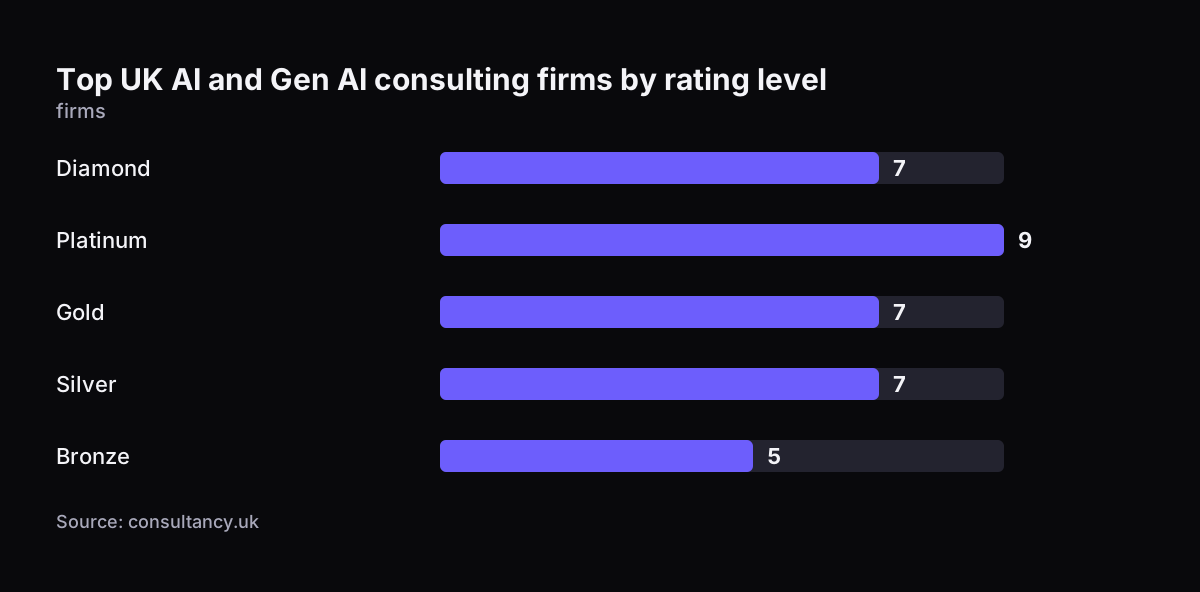
Industry rankings are the next signal buyers reach for. Consultancy.uk's ranking of AI and Gen AI consulting firms in the UK assessed more than 500 firms, and 35 qualified as top players. They are sorted into five levels from Diamond to Bronze, as the chart below shows.

The method matters more than the result. The ranking rests on two pillars, a survey of clients and consultants and a capabilities assessment, each weighted at 50%. The capabilities assessment looks at five factors: firm capabilities, industry awards, prestige, thought leadership, and popularity on Consultancy.org. The ranking charges no fees at any stage, which is to its credit.

Read that list again with your own project in mind. Prestige, awards and thought leadership are reputational. Survey scores reflect how clients and peers feel about a firm. None of the five factors is a measured outcome from a system running inside a client's business.

The top tier is also dominated by large global firms, which suits a different kind of buyer. If you run a business with a few dozen or a few hundred staff, a place in a ranking says little about whether a firm will build something your team uses on Monday morning. Treat rankings as a way to find names, then ask each name for production evidence.

Top UK AI and Gen AI consulting firms by rating level
Top UK AI and Gen AI consulting firms by rating level: Diamond 7, Platinum 9, Gold 7, Silver 7, Bronze 5 (firms)
Indicatorfirms
Diamond7
Platinum9
Gold7
Silver7
Bronze5
Source: consultancy.uk

Day rates and framework listings: useful, but they price effort

Price is easier to compare, and the government's G-Cloud 14 framework makes some of it public. One AI consultancy service listed there is priced at £995 a unit a day. The same listing records Cyber Essentials certification but not ISO/IEC 27001 or Cyber Essentials Plus. It also shows phone support from 9 to 5 UK time on weekdays, no web chat, and a promise of initial responses on the same day or the next day.

That level of detail is useful. Ask any supplier for the same facts, whether or not they sell through G-Cloud. Security certification, support hours and response times all shape what happens once a system is live and your staff depend on it.

A day rate on its own, though, prices effort, not outcome. A day of workshops and a day of building a working integration cost the same on an invoice. The difference shows up months later, when one has left you with a report and the other has left you with a system handling real requests.

When you compare quotes, convert them into what you get at the end. Ask how many days go to discovery, how many to building and testing, and how many to running the system alongside your staff before handover. A proposal that cannot answer the last part has not planned for production.

Discovery or delivery: be clear which one you are buying

Many engagements start with discovery. Some consultancies sell a fixed-fee diagnostic workshop, others offer a free readiness questionnaire, and some report how many AI and automation use cases a discovery exercise found. There is nothing wrong with that as a first step, because a clear view of where AI could help is worth having.

The risk is that the engagement stops there. A long list of use cases is an input, not a result. Each one still needs data access, integration with the tools your staff already use, testing on real cases, and someone who owns it afterwards. That is where most of the effort sits, and most of the value.

The table below sets out the difference between an engagement that ends in advice and one that ends in a working system. Both can be the right purchase. Just be clear which one you are paying for, and do not pay delivery prices for advice.

If you already have a list of ideas from earlier work, you may not need another discovery phase. Pick the one or two use cases with the clearest measure and ask for a build proposal against them.

Advice engagement versus a working system in production
Advice and discoveryWorking system in production
What you receiveA report, roadmap or use case listA system your staff use every day
How success is measuredQuality of the analysisA metric agreed before the build
Integration with your toolsUsually out of scopeThe core of the work
Data protection workOften left as a later taskAssessed before building starts
Ownership afterwardsOften not definedNamed owner and support terms
Evidence you can checkWorkshop outputsLive usage and measured results

What evidence of production results looks like

Evidence of production results has four parts. The client is named. The metric is defined, so you know what was counted. The result was measured in live use, not in a demo, and the client has approved publication, ideally with a named person on the record.

Here is an example built to that standard. Svennis built an IT service desk on Claude inside Microsoft Teams for Asset Services Group (Message Direct), fronting Zoho Desk, and the published case study records 99.7% first-time-right routing and a 40% efficiency gain, quoted on the record by their Head of Technology with the client's written approval.

The shape of that evidence is what you should look for from any supplier. Routing accuracy is a narrow, countable measure: a request either lands with the right team first time or it does not. The assistant sits inside a tool staff already use, which removes one common reason for people to ignore a new system. And the figures are quoted by the client, not written by the supplier's marketing team.

Ask every shortlisted firm for one example of this kind. If a firm cannot name a client, define a metric and point to a live system, you are being asked to fund its first attempt.

Agree the measure before anyone builds anything

The most reliable way to get production results is to agree the measure first. Pick one process, write down how it performs today, and agree what the system must change. That baseline becomes the test the supplier is judged against.

Good measures are specific and already countable in your existing tools. Some examples:

  • share of requests routed to the right team first time
  • time from a request arriving to the first useful response
  • number of manual touches per case
  • hours of staff time a week spent on the task

Avoid measures that only the supplier can see, such as model scores or counts of prompts handled. They may matter technically, but they do not tell you whether the business runs better.

Keep the first scope small enough to reach production in weeks, not quarters. A single workflow that runs every day, such as triaging support requests or drafting routine replies, gives you a clear before and after. Our overview of AI by business task lists common starting points, and the page on AI automation for growing businesses covers how these pieces connect to the systems you already run.

Once the first system is live and measured, the second is easier to justify. You will be working from your own numbers rather than a supplier's promise.

Your data protection duties stay with you

Hiring a consultancy does not move your legal duties. The ICO's guidance on policies and procedures for explaining AI decisions is explicit. When you procure an AI system from a vendor, you are still the data controller for the decisions it makes, and it is your responsibility to ensure the vendor has taken the necessary steps.

The same guidance sets out practical expectations. Explainability should sit within your impact assessment methodology, which is likely to be a legally required assessment such as a Data Protection Impact Assessment. That assessment should be done before work begins on an AI decision-support system, not added at the end.

The level of detail in your policies is likely to be proportionate to the risk. The more impactful and less expected the processing, the more detail you need. You should also consult relevant staff when drafting policies and procedures, so that they make sense and work in practice. Note that the ICO says this guidance is under review because of changes made by the Data (Use and Access) Act, so check the current version before relying on it.

This gives you a simple test. A consultancy that plans for production will raise the impact assessment early and help you write procedures staff can follow. Our annotated guide to UK GDPR for AI and the wider overview of AI law in the UK set out what applies.

Seven written requests to send every shortlisted firm

Before you shortlist, send each firm the same set of requests. Written answers make comparison easier and show you quickly who can be specific.

  1. A named production example. Ask for one client, one system, one metric, and confirmation that the client approved publication.
  2. The measure for your project. Ask them to propose the metric they would be judged on, and how it will be counted in your own tools.
  3. The split of days. Ask how the quote divides between discovery, build, testing and supported live running.
  4. The integration plan. Ask which of your existing systems the solution reads from and writes to, and who sets up access.
  5. Data protection. Ask how they will support your impact assessment and what they need from you before building starts.
  6. Security and support. Ask for certifications held, support hours and response times once the system is live.
  7. Ownership after handover. Ask who fixes faults, who changes prompts or rules, and what that costs.

The answers will sort the field. Firms that build and run systems answer with examples and numbers. Firms that mainly advise answer with frameworks and methods. Both have their place, but only one should get a delivery budget.

Practical next steps

You can turn all of this into a short plan and run it over the next few weeks. Each step produces something you can put in front of a supplier.

  1. Choose one process that runs every day and already produces countable data, such as support requests, enquiries or routine documents.
  2. Record how it performs now: volume, time taken, and error or rework rate. This is your baseline.
  3. Check each shortlisted supplier on Companies House, and ask for security certifications and support terms in writing.
  4. Send the seven requests above and compare the written answers, giving most weight to named production examples.
  5. Start your impact assessment before the build begins, and involve the staff who will use the system.
  6. Agree a contract where the first milestone is a live system measured against your baseline, not a report. If the supplier will handle personal data for you, the contract must also include the data processing terms UK GDPR Article 28 requires, such as acting only on your written instructions, keeping the data secure, and deleting or returning it at the end.

If you are still working out where AI fits, the guide on how any company can use AI is a practical place to begin. Sector pages such as AI for manufacturers show how the same approach applies to specific processes. Whichever supplier you choose, hold them to the number you agreed at the start.

Sources

  1. 1. Companies House: company 07883075 overview
  2. 2. Companies House: company 16138782 overview
  3. 3. Digital Marketplace: AI Consultancy service on G-Cloud 14
  4. 4. ICO: Policies and procedures for explaining AI decisions
  5. 5. Consultancy.uk: Top AI and Gen AI consulting firms in the UK

Related articles