

Skip to content
SVENNISAIWe speak Claude.
Blog · AI in finance

AI in finance, part 1: what Claude takes over in the finance team and for whom

Claude drafts and prepares the work around the numbers. People keep the arithmetic, the judgement and the sign-off. This guide sets out which finance tasks and roles benefit.

9 min read

Book a 30-minute call · with a Claude Certified Architect from our team.

Article · 9 min read
Abstract cover of stacked blocks splitting into two lanes, one moving forward and one held at a checkpoint

AI in finance: Claude drafts and prepares, people decide and sign

AI in the finance team: what Claude takes over and for whom has a short answer. Claude takes over the drafting and preparation around the numbers: invoice queries, reconciliation prep, payment-chasing drafts and variance commentary. People keep the arithmetic, the judgement and the sign-off. The roles that spend their week on documents and repeat work gain the most.

AI in finance, as this guide uses the term, is Claude working inside the finance team's own systems on defined, repeatable tasks, with a named person checking every output. Claude is Anthropic's AI model. Our plain guide to what Claude is and how businesses use it covers the basics.

This post is part 1 of 3 in our series on Department Activation, and it covers what the work is and who it fits. Part 2, "Activating AI in one department: how it is done, from HR to sales", covers the method. Part 3, "Why AI works department by department: measured results in marketing and beyond", covers the results.

The research gives you a realistic ceiling. A CFO Connect report on Anthropic's own finance team cites McKinsey (2025): about 30% of finance tasks are automatable with current technology. The same report cites Gartner (2025): 63% of finance AI initiatives fail to meet expectations. The difference usually lies in choosing the right tasks and keeping a person in charge of each one.
A finance skill: one routine Claude repeats the same way every time

A skill is a routine Claude carries out the same way every time, with test cases, written instructions and a colleague who owns it. That is the definition on our Department Activation service page. The CFO Connect report adds detail. A skill encodes a procedure once in plain language: the inputs, the output format, the calculation rules and what to flag when something is missing.

Skills matter in finance because finance work repeats. A month-end task runs twelve times a year in the same shape. A good skill makes Claude follow your method, not a generic one. A skill also makes the output checkable, because the person reviewing it knows what Claude was told to do.

Anthropic's own finance team shows the scale this can reach. According to CFO Connect, the team uses approximately 150 shared Claude skills for reconciliations, financial analysis, reporting and governance. Finance professionals maintain those skills, not the IT team. The skills sit in a version-controlled repository and show up automatically in Cowork and Claude.ai, with no setup per user.

The report separates two kinds:

  • Foundational skills explain how to query specific data tables, what the column names mean and how the general ledger (GL) is structured.
  • Workflow skills are step-by-step procedures for one recurring task, such as an accounts receivable reconciliation.

A small finance team does not need 150 skills. It needs a handful that cover its most repetitive work, each with an owner.

Finance tasks Claude takes over reliably: queries, reconciliation prep and chasing drafts

Claude reliably takes over finance tasks where it reads, matches or drafts, and a person checks the result. Five tasks have clear support in the sources.

Invoice reading and invoice queries

Anthropic's Claude for Financial Services overview says Claude can extract financial data from PDFs and documents into structured Excel formats. One finance lead in a mid-size private company, posting on Reddit's r/CFO forum, reports starting to use Claude to read lengthy PDF invoices and suggest GL mapping. They describe that work as at a very early stage.

Reconciliation prep

In a bank reconciliation demo by AI Finance Club, Cowork matched invoices to bank transactions with about 70 to 80% accuracy. A person still clears the rest. In Anthropic's accounts receivable demo on synthetic data, the skill identified a $33k discrepancy, according to CFO Connect.

Payment-chasing drafts

In the r/CFO poster's Cowork setup, Claude schedules daily report runs and drafts emails to recipients. It can only create drafts, not send them. For credit control, that is the right split: Claude drafts the chaser, and a person reads and sends it.

Recurring reports and commentary

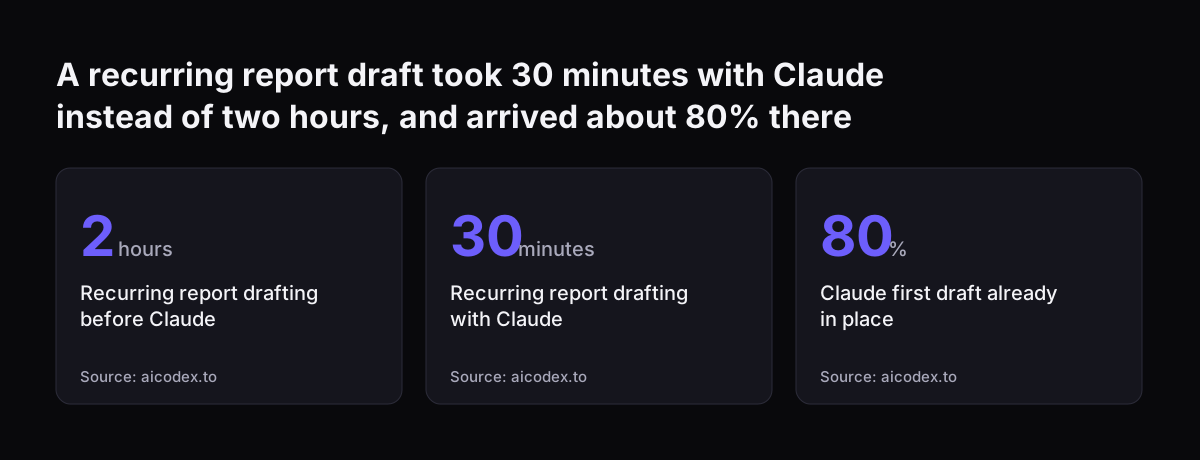
AI Codex's guide for finance teams says Claude can produce a first draft of a recurring report that is "80% there". In its example, two hours of work becomes thirty minutes.

Policy questions

The same guide says a team can upload its finance policies to a Project and ask questions in plain language, with answers sourced from its own documents.

Finance tasks that stay with people: arithmetic, judgement and sign-off

Three kinds of finance work stay with people: producing the figures, deciding the accounting treatment and signing off. Every source in this guide agrees on that line.

Arithmetic stays in your spreadsheet or BI tool. AI Codex warns that Claude does not crunch spreadsheets reliably. It can appear to, but its calculation errors are hard to spot. The guide's advice is to use Claude downstream of the numbers, not to produce them. Anthropic's overview adds that Excel models may need manual review for complex formulas.

Accounting judgement stays with a qualified person. Claude can state what a general accounting standard says. AI Codex notes that it cannot tell you the right treatment for your specific situation. No AI output should be the final word on compliance.

Sign-off stays with the owner. Anthropic's finance team puts it plainly, in the CFO Connect report: "You need to verify everything that comes out and take ownership of what comes out of it."

Consistency is a further limit. The r/CFO poster found that Claude does not always repeat a report in exactly the same format, more so in scheduled runs. While that happens, they find it hard to replace existing reports entirely. A parallel run deals with this. Alex Altman at Coram AI ran his Claude revenue recognition workflow beside the manual process for two to three months before relying on it, according to CFO Connect.

Which finance roles gain most from Claude

The finance roles that gain most from Claude are those whose week is mostly reading, matching and writing around figures that already exist. Anthropic's overview lists its main users as corporate finance teams, investment and investment banking analysts, and portfolio and asset managers. In a smaller company, the same pattern maps onto familiar roles.

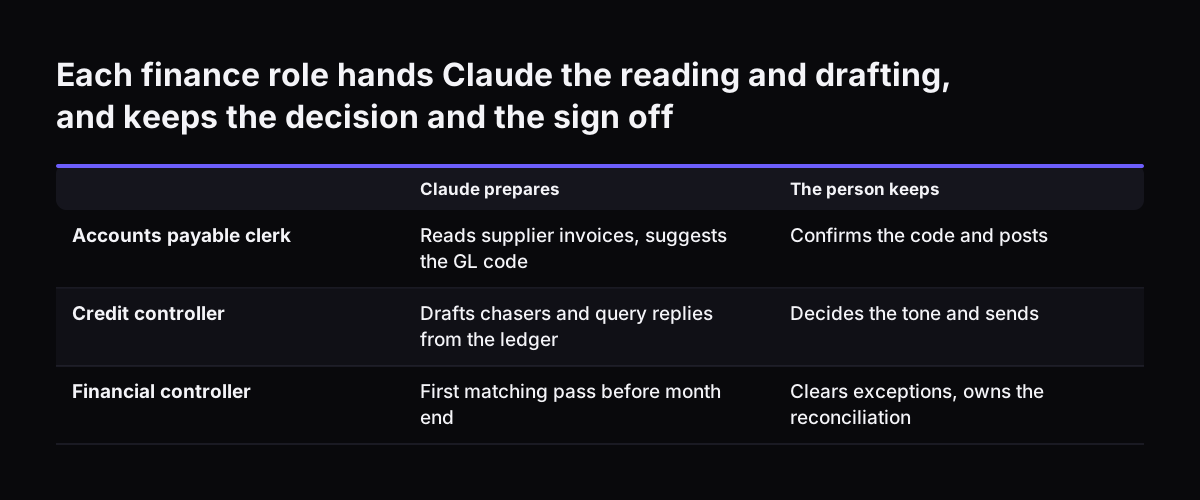
  • Accounts payable clerk: Claude reads supplier invoices and suggests the GL code; the clerk confirms and posts.
  • Credit controller: Claude drafts chasers and query replies from the ledger; the controller decides tone and sends.
  • Financial controller: Claude does the first matching pass before month-end; the controller clears exceptions and owns the reconciliation.
  • Management accountant or FP&A analyst: Claude drafts variance commentary and reviews models for formula errors; the analyst owns the interpretation.
  • Finance director or CFO: Claude drafts board pack narrative and runs compliance checks on a schedule; the director reviews and signs.

The CFO role has a concrete example. Spendesk CFO Pauline Babell's travel compliance workflow runs automatically on the fifth of every month, according to CFO Connect. Checking time fell from four hours to three minutes and thirty seconds.

The role that gains least is the one whose core output is the figure itself, such as statutory accounts or a tax computation. There Claude can help around the edges, but the work stays with the person.

Each finance role hands Claude the reading and drafting, and keeps the decision and the sign off. Claude prepares / The person keeps. Accounts payable clerk: Reads supplier invoices, suggests the GL code / Confirms the code and posts; Credit controll

Decision table: finance tasks by Claude's share and the person's share

The table below sets out common finance tasks by what Claude does, what the person keeps and the role that owns the skill. Use it to pick your first task.

Finance taskClaude's sharePerson's shareSkill owner
Invoice queriesReads the invoice, extracts fields, drafts the replyChecks the facts, sends the replyAccounts payable
GL mappingSuggests a code from the chart of accountsConfirms and posts in the accounting systemAccounts payable
Reconciliation prepFirst matching pass, lists unmatched itemsClears exceptions, owns the reconciliationFinancial controller
Payment chasingDrafts chasers from the overdue listChooses tone, sends, handles disputesCredit control
Variance commentaryDrafts prose from figures you supplyOwns the interpretation, checks every figureManagement accountant
Policy questionsAnswers from your uploaded policiesDecides edge casesFinance manager
Accounting treatment, filed figuresStates the general standard at mostDecides, produces, signsFinance director

The pattern is consistent. Claude's share grows where the input is a document and the output is a draft. The person's share grows where the output is a figure of record or a decision.

Worked example: monthly variance commentary from a finance Project

A monthly variance commentary is a good first task because it repeats, it is mostly writing, and the figures already exist. AI Codex recommends one finance Project. A Project is a Claude feature that keeps related documents as a knowledge base across conversations, as Anthropic's overview defines it.

  1. Create one Project for finance. Upload your chart of accounts and key definitions, reporting templates and prior period examples, finance policies and procedures, and key metrics definitions.
  2. Write the instructions. Tell Claude to flag uncertainty explicitly. AI Codex calls this the most important instruction. A Claude that says "I'm not certain about this figure, please verify" is safer than one that is confidently wrong.
  3. Produce the figures elsewhere. The management accountant runs the month's numbers in the spreadsheet or BI tool, as usual.
  4. Ask for the draft. Give Claude the figures and last month's commentary, and ask for this month's draft in the same structure.
  5. Check and own it. The accountant checks every figure in the draft against the source and rewrites the interpretation where needed.

After two or three months, the steps will have settled. That is the moment to turn them into a skill: fixed inputs, a fixed output format, the rules and what to flag when something is missing. The Claude for Excel, PowerPoint and Word add-ins are generally available, according to Anthropic's financial services announcement, so the draft can move into your existing board pack.

A recurring report draft took 30 minutes with Claude instead of two hours, and arrived about 80% there: Recurring report drafting before Claude 2 hours, Recurring report drafting with Claude 30 minutes, Claude first draft already in place 80 %
Source: aicodex.to

How Claude reaches your accounting and CRM data

Claude reaches finance data through governed connections, and each connection should give it read access to what the task needs and nothing more. Anthropic's finance agent templates package three things: skills, connectors for governed access to data, and subagents. Run as Managed Agents, they add per-tool permissions, managed credential vaults and a full audit log in the Claude Console.

For a small or mid-size company, the systems are usually an accounting package such as Zoho Books and a CRM such as Zoho CRM. Anthropic's own team, per CFO Connect, recommends routing large-scale analysis through a data warehouse rather than querying the ERP directly, for performance and data stability. The r/CFO poster's company did the same: its tech department connected Claude to the data warehouse.

For each connection, we build a connector, an MCP server, a plugin or a skill, show you the options with their cost, and you choose. At Svennis we keep postings and approvals inside the accounting system and run each finance skill beside the existing manual process, with its owner checking the output, before anyone relies on it.

The model matters less than the connection. High-volume classification and extraction, such as sorting incoming invoice queries, suits a small fast model: Anthropic's models overview positions Claude Haiku 5.5 for classification, extraction and routing. Anthropic suggests Claude Opus 5.5 for most workloads when you are unsure.

Finance teams this fits, and the ones it does not

Claude in the finance team fits companies whose finance work is document-heavy and repetitive, whose figures already sit in a system, and where someone can own each routine. AI Codex describes finance work as document-based, analytical and repetitive in structure, which is the kind of work Claude handles well.

The fit is good when:

  • the same tasks recur weekly or monthly, such as chasers, matching and commentary;
  • the figures come from an accounting system, warehouse or spreadsheet, not from Claude;
  • a colleague can give about an hour a week to each skill they own;
  • Claude accounts are already set up and secured for the team.

The fit is poor when nobody will own the output, or when the team expects Claude to produce figures of record. A skill without a named owner does not go into a Department Activation sprint, for that reason.

Svennis does this work as Department Activation: a two-week sprint per department. In week one we write 5 to 8 skills or one anchor workflow; in week two your team uses them with us beside them. A check on day 60 reviews who uses Claude and how, from the admin console. On day 90 your managing director, not Svennis, presents the results against the signed targets. Activation usually follows Pilot B, which sets up and secures the accounts.

What Claude in finance means for a UK company: billing, budgets and practices

For a UK company, the first practical point is that Claude costs arrive in two currencies. Claude seats are bought from Anthropic and billed in pounds. An agent's model usage is billed by Amazon Web Services in US dollars, on use, and is not capped unless you set a budget. A finance team should set that budget on day one, as it would for any metered service.

The second point is scope. Much of Anthropic's finance material targets banks and investment firms. It covers connectors to market data providers such as FactSet, S&P Capital IQ and Morningstar, and templates for pitchbooks and KYC screening. A UK trading company rarely needs those. It needs Claude connected to its accounting system and CRM, plus a few skills for its own month.

The third point is accountability. The rule from every source still applies: figures of record and compliance decisions stay with qualified people. Claude's draft goes through your normal review, as a junior's draft would.

If you run an accountancy practice rather than an in-house team, the tasks differ. Our page on AI for accountants in the UK walks through each practice process. If your team works mostly in files on their own computers, our explainer on Claude Cowork for UK firms covers plans, uses and data handling.

Next steps: pick one finance task with a named owner

Start with a single finance task, a named owner and a parallel run. That sequence keeps the risk small and gives you a fair test.

  1. List your repeat work. Write down the finance tasks that recur weekly or monthly and are mostly reading, matching or drafting.
  2. Pick one task from the decision table above. Payment-chasing drafts or variance commentary are good first choices.
  3. Name the owner. Choose the colleague who does the task today and can give about an hour a week.
  4. Write the routine down. Note the inputs, the output format, the rules and what Claude should flag when something is missing.
  5. Run it in parallel. Keep the manual process going until the owner trusts the output.

If you want help, our work runs in four steps. The Workshop comes first. Next is Pilot Claude A, an AI agent on Claude for one process, or Pilot Claude B, Claude Team for the whole team. The department Activation follows, then monthly operations.

For most finance teams, the natural start is Claude Pilot B, Claude Team set up in 30 days, before activating the finance department. The Department Activation service page linked above carries the published prices.

Sources

  1. Svennis AI: Department Activation
  2. Anthropic: Agents for financial services
  3. Anthropic: Models overview
  4. Claude Academy: Claude for financial services overview
  5. CFO Connect: How Anthropic's Finance Team Uses 150 Claude Skills
  6. Reddit r/CFO: What we use AI for in finance
  7. AI Codex: What AI actually looks like for a finance team
  8. AI Finance Club: 3 things Claude does better than ChatGPT
Free, 30 minutes

Pick a time. Bring the process this article made you think of.

You leave with a clear yes or no on putting Claude on it, and the step that fits from our published prices. You speak to someone who builds the agents, not a salesperson.

Prefer to call? +44 7588 772736 · Not ready to talk? See it on your business first.

30 minutes · video call · free
  1. 1Time
  2. 2Details
  3. 3Booked