
Skip to content
SVENNISAIWe speak Claude.
Blog · AI readiness assessment

AI readiness assessment: how a two-week workshop maps your processes

How a two-week AI readiness assessment maps the processes, systems and data an assistant or agent would touch: who takes part, what you prepare and how each finding is checked.

10 min read

Book a 30-minute call · with a Claude Certified Architect from our team.

Article · 10 min read
Abstract cover with linked nodes and arrows forming a process map that narrows towards a single highlighted path

An AI readiness assessment maps your processes, systems and data before you build

An AI readiness assessment is a structured look at the work you want an AI assistant or agent to do. It covers the process steps, the systems the assistant would read and write, the data in those systems and the person who checks the result. Our Claude Readiness Workshop maps all of this in two weeks, before anything is built on Claude.

This guide is part 2 of a three-part series on the workshop. Part 1, AI workshop for business: what it covers and who should attend, explains the scope. Part 3, Why a company AI policy comes before the first AI project, covers the rules your staff work under. Part 2 shows how the workshop runs: the stages, what you prepare, who takes part, what goes wrong and how each finding is checked.

The workshop produces a plan, not a slide deck. The plan answers one question for a company: which process is worth automating first, before you pay for a pilot. It also answers the data question for the UK: whose account Claude runs on, where the data goes and what UK GDPR asks of you.

A good assessment keeps one rule throughout. Every claim about a process must trace back to something the team showed, not something the team assumed.
A questionnaire score measures appetite, while an AI readiness assessment maps real work

A short online quiz tells you how keen your organisation is on AI, not whether a given process can take it. A typical free online quiz takes a few minutes and asks a short set of questions. It asks about your adoption stage and whether you have a written AI usage policy. It also asks how you train staff, how leadership views AI investment and how confident employees feel using AI tools safely.

Those are fair questions, and a quick score is a reasonable place to start. None of them reveals that your invoice approval step has an exception nobody wrote down. None of them shows that the customer field your support team relies on is empty half the time. None shows that a refund needs a manager's sign-off that lives only in someone's head.

Process mapping finds those things. Mapping means sitting with the people who do the work and following real cases from start to finish. Each step is recorded: what triggers it, what it reads, what it changes and who checks it. An assistant or agent touches exactly those steps. If the map is wrong, the build is wrong.

The difference matters for cost as well as quality. A pilot scoped from a questionnaire tends to discover the missing exceptions during the build, when changes cost the most. A pilot scoped from a process map starts with the exceptions already listed.

The two-week Claude Readiness Workshop, stage by stage

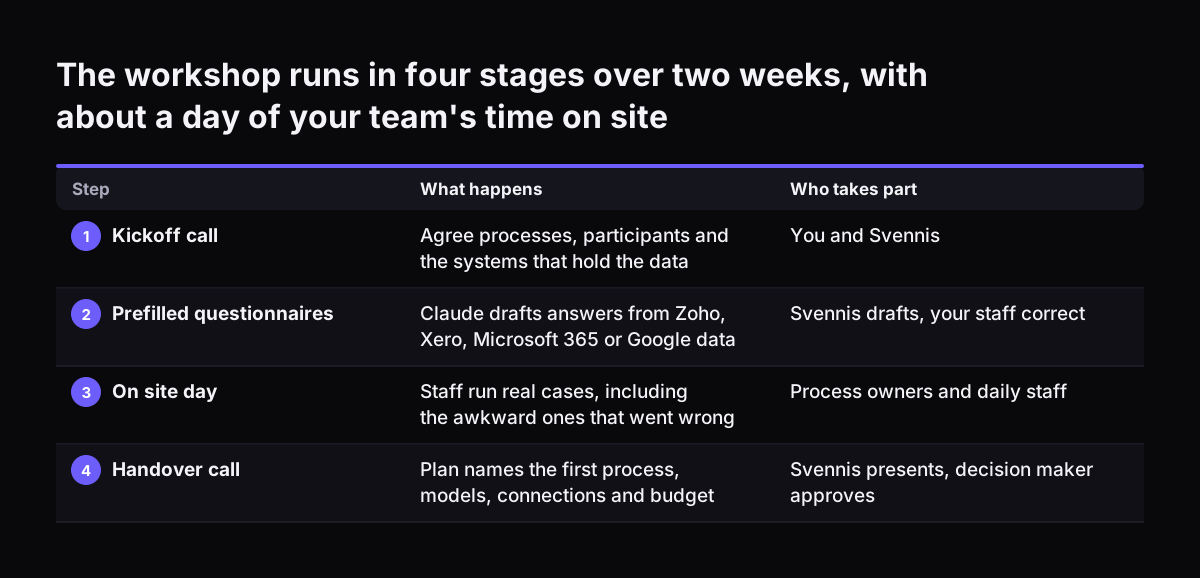
The Claude Readiness Workshop is the Svennis service that runs an AI readiness assessment on your own processes in two weeks. It asks for about a day of your team's time on site, plus two short calls: the kickoff and the handover. The work runs in four stages.

  1. Kickoff call. The kickoff is the first working session. You and Svennis agree which processes to look at, who should take part and which systems hold the data.
  2. Questionnaires, pre-filled from your data. If you work in Zoho CRM, Zoho Desk or Zoho Books, we pre-fill the questionnaires with Claude from your own data. Your people correct them. Without Zoho, we start from Xero, Microsoft 365 or Google Workspace, through their connectors.
  3. The day on site. The people who do each process walk through real cases. We record the steps, the systems, the data, the exceptions and the human checks.
  4. Handover call. You receive the plan: the process worth automating first, how Claude would connect to your systems, what it would cost to run and the data answer under UK GDPR.

Pre-filling the questionnaires saves your team the dullest part of the work. Correcting a draft is faster than writing from a blank page. It also surfaces disagreements early, because two people rarely correct the same draft in the same way.

The workshop runs in four stages over two weeks, with about a day of your team's time on site. What happens / Who takes part. 1. Kickoff call: Agree processes, participants and the systems that hold the data / You and Svennis; 2. Prefilled questionna

What your company prepares before the kickoff call

Your preparation for the workshop is light, but it decides how useful the on-site day becomes. Before the kickoff, gather the following:

  • A short list of the processes that eat the most staff time or cause the most rework.
  • The name of the person who owns each process and the people who do it daily.
  • Admin access, or the admin's agreement, for the systems involved, so the connectors can read your data, with whoever handles data protection confirming the processing terms with us before any personal data is read.
  • A handful of real cases per process, including the awkward ones that went wrong.
  • Any written procedure, approval rule or AI policy you already have, however rough.

You do not need Claude seats for the workshop. Claude seats are the per-person licences for Claude, and they come in with the pilot. Buying seats before you know which process comes first is the common mistake the workshop is designed to avoid.

The workshop is not for every company. If you already pay for Claude seats that nobody uses, the right offer is Claude Relaunch, which includes a short workshop. The full workshop suits a company that wants to know what is worth automating before it commits to a build.

Who takes part on each side, and how much of your team's time it takes

The workshop asks for about a day of your team's time on site, plus the two short calls. The total elapsed time is two weeks. Most of that time is preparation and analysis on the Svennis side, so your people are not pulled away from their work for long.

On your side

  • A decision maker who can say which process matters most and approve the pilot.
  • The owner of each process, who answers for how it should run.
  • The people who do the work daily, who know where it really breaks.
  • The administrator of the systems involved, whether Zoho, Xero, Microsoft 365 or Google Workspace.
  • Whoever handles data protection, for the UK GDPR answer.

On the Svennis side

Svennis runs the kickoff, prepares and pre-fills the questionnaires, leads the mapping on site and writes the plan you receive at handover. The same plan then becomes the scope for a pilot, if you choose one.

The people who do the work daily matter most. A manager can describe the intended process. Only the person at the keyboard can show the real one, including the workarounds that keep it going on a busy Monday.

What the process map records for each step an agent would touch

A process map for Claude records more than the order of the steps. It records what an assistant or agent would need to do each step safely, and who catches the result when it is wrong. The checklist below is the set of questions asked for every step during the on-site day.

ItemQuestion askedWhy it matters for the build
TriggerWhat starts the step: an email, a form, a date, a record change?Sets how the agent is started and how often it runs.
Systems readWhich programs hold the information the step needs?Decides which connections Claude needs.
Systems writtenWhat does the step change, and where?Write access carries more risk than read access.
DataIs the data there, complete and personal or not?Missing fields stop a build; personal data brings UK GDPR duties.
ExceptionsWhat happens when the case does not fit the rule?Unlisted exceptions are where agents fail.
Human checkWho reviews the output, and against what standard?Decides what Claude may do without approval.
OwnerWho answers for the step when it goes wrong?Someone must own the fix after go-live.

A step with no clear owner or no human check is not ready, however simple it looks. The plan either fixes the gap first or narrows the agent's job until the gap no longer matters.

A worked example: mapping a support inbox in Zoho Desk

Picture a small service company that runs customer support in Zoho Desk, keeps customers in Zoho CRM and invoices from Zoho Books. The managers want Claude to sort incoming support email. Here is how the workshop would map that process.

Before the on-site day, Claude pre-fills the support questionnaire from the company's own Desk data, such as the departments and ticket categories in use. The support lead corrects the draft. She deletes two categories nobody uses any more and adds a note that refund requests always go to finance.

On site, an agent works through real emails on her own screen. She reads each message, looks the customer up in Zoho CRM, picks a department and, for refunds, checks the invoice in Zoho Books before passing the case to finance. The map records each of those steps, the three systems read and the one system written, which is Desk.

The map then shows the finding. Sorting email by department is a classification task with a clear rule and a human who sees every ticket afterwards. The refund decision is different: it changes money, and the finance manager wants to approve every one.

The plan therefore proposes an agent that sorts and routes tickets in Desk, while refunds stay with a person. That is the shape of Pilot Claude A, an AI agent on Claude for one process.

Matching each mapped step to a Claude model and a type of connection

The plan matches each step to the Claude model that suits it, because a routing task and a reasoning task have different needs and costs. All current Claude models support text and image input, vision, multilingual work and tool use, according to Anthropic's models overview. The table shows how Anthropic positions each one and its published API price.

ModelAnthropic's stated usePrice per million tokens (USD)
Claude Haiku 5.5High-volume, latency-sensitive tasks such as classification, extraction and routingFrom 0.10 input, from 0.50 output
Claude Sonnet 5.5The best combination of speed and intelligence2 input, 10 output
Claude Opus 5.5Long-running agentic coding and knowledge work4 input, 20 output
Claude Fable 5.1Demanding reasoning and long-horizon agentic work10 input, 50 output

In the support example, ticket routing fits the small, fast model. A step that drafts a careful reply to a complaint might justify a larger one.

The plan also sets out how Claude reaches each system. For each connection, Svennis can build a connector, an MCP server, a plugin or a skill. An MCP server is a small service that gives Claude defined access to one of your programs. The plan shows the options with their cost, and you choose.

What goes wrong in an AI readiness assessment, and how each finding is checked

Most readiness assessments go wrong in the same few places. Each one has a check built into the workshop.

  • The written procedure replaces the real one. Checked by having staff run real cases rather than describe them.
  • Exceptions are missed. Checked by asking for the cases that went wrong, not only the typical ones.
  • Data is assumed to exist. Checked by pre-filling questionnaires from the live systems, so empty fields show up before the on-site day.
  • Nobody owns the human check. Checked by naming a reviewer for every step the agent would touch, or leaving that step out.
  • Too many processes compete for the first pilot. Checked by the plan naming one process first, with the reasons.

The most useful check is the simplest. At Svennis we ask the person who does the job to work real cases on their own screen while we watch, and we compare what they do with the written procedure. The gap between the two is usually where an agent would have failed.

The handover call is the final check. You read the plan with the people who took part, and anything they do not recognise is corrected before it becomes the scope of a pilot.

What the assessment means for a UK company: UK GDPR, pounds and dollars

For a UK company, the workshop's data answer covers three things: whose account Claude runs on, where the data goes and what UK GDPR asks of you. These questions come up in every process that touches customer or employee records, which is most of them. Answering them before the build avoids a pilot that stalls at the data protection review.

Billing is the second UK point, because two suppliers bill in two currencies. Claude seats are billed to you directly by Anthropic, in pounds. An agent's model usage is billed by Amazon Web Services, in US dollars, on use, and it is not capped unless you set a budget. The plan therefore names the budget an agent should run under, so a busy month cannot surprise your finance team.

The workshop's own prices are in GBP and exclude VAT; the service page carries them. If you are also weighing whether to build in house, buy a tool or use a partner, our guide on build, buy or partner for AI compares cost, ownership and exit.

Companies without Zoho are not at a disadvantage. The workshop starts from Xero, Microsoft 365 or Google Workspace through their connectors, which covers the systems most UK small firms already run.

Next steps: score yourself, list your processes, then book the workshop

You can start an AI readiness assessment today with three practical steps.

  1. Take a quick score. Our free AI readiness assessment for UK businesses gives you a first view of where you stand.
  2. List your candidate processes. Write down the three or four that cost the most time, with the owner of each. Our page on AI by business task can help you spot candidates.
  3. Book the workshop. Bring that list to the kickoff call.

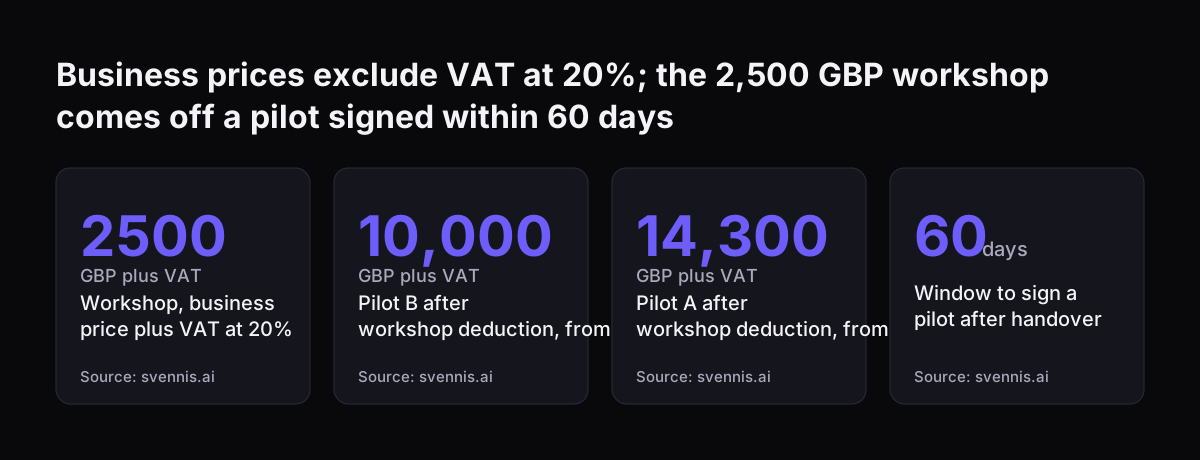
The workshop is the first of four steps in the Svennis offer: the Workshop, a pilot, the department Activation, then monthly operations. The pilot is either Pilot Claude A, an AI agent on Claude for one process, or Pilot Claude B, Claude Team for the whole team. The workshop fee is deducted in full if you sign Pilot A or B within 60 days of the handover.

If you already know which process to automate, you can skip ahead. Pilot A can also be bought directly, after a half-day scoping session. Our AI automation page explains how those agents are built.

Business prices exclude VAT at 20%; the 2,500 GBP workshop comes off a pilot signed within 60 days: Workshop, business price plus VAT at 20% 2500 GBP plus VAT, Pilot B after workshop deduction, from 10,000 GBP plus VAT, Pilot A after workshop deducti
Source: svennis.ai

Sources

  1. Claude Readiness Workshop: your plan in two weeks | Svennis AI
  2. Models overview - Claude Platform Docs
  3. AI Readiness Assessment: How AI-Ready Is Your Team? | OpenSkills AI
Free, 30 minutes

Pick a time. Bring the process this article made you think of.

You leave with a clear yes or no on putting Claude on it, and the step that fits from our published prices. You speak to someone who builds the agents, not a salesperson.

Prefer to call? +44 7588 772736 · Not ready to talk? See it on your business first.

30 minutes · video call · free
  1. 1Time
  2. 2Details
  3. 3Booked