

Skip to content
SVENNISAIWe speak Claude.
Blog · Agentic AI

Agentic AI for business: what an AI agent does and where it fits

Agentic AI explained plainly: what an AI agent does inside your CRM, accounting or helpdesk, which tasks are worth handing over, and which to keep with people.

9 min read

Book a 30-minute call · with a Claude Certified Architect from our team.

Article · 9 min read
Abstract loops passing a single line forward through a sequence of narrowing openings, suggesting steps in a process

Agentic AI for business: what an AI agent does, in plain terms

Agentic AI is artificial intelligence that pursues a goal and completes a multistep task on its own. It reads the situation, decides what to do, acts in your systems and checks the result. For a business, an AI agent is one program built around one task. One example is an order email handled from inbox to stock check to draft order, with a colleague approving before anything leaves.

This is part 1 of a three-part series on putting one AI agent to work. This post covers what an agent is and who it suits. Part 2, "From process to AI agent in 30 days: how a pilot is run", covers the build. Part 3, "Why a pilot agent beats a big AI programme: results, costs and risks", covers the numbers.

The definition above follows Salesforce's explainer on agentic AI. That explainer describes agents that perceive their environment, reason about what to do, take action and learn from the results with limited human intervention. IBM puts it more briefly: an AI system that can accomplish a specific goal with limited supervision.

No single wording is official. MIT Sloan notes that there is no universally agreed definition of agentic AI, only broad characteristics. This guide therefore stays practical. It describes what an agent does inside the CRM, accounting and helpdesk systems a company already runs, and which jobs are worth giving to one.
How an AI agent differs from a chatbot or a Claude seat

An AI agent acts in your systems, while a chatbot only answers. Salesforce puts the distinction in one line: generative AI answers a prompt, and agentic AI executes the follow-through actions that resolve the underlying job. IBM adds the technical reason. A large language model on its own cannot reach external tools or databases, but an agent can call APIs and query databases.

A Claude seat: a colleague asks, Claude does the steps

A seat is a per-person licence for Claude Team or Enterprise. Claude on a seat does each step of a task when a colleague asks. Since February it can also run a scheduled task. Someone is still in the conversation, starting and steering the work.

An AI agent on the API: nobody at the keyboard

An AI agent on the API is a program that calls Claude directly, with nobody at the keyboard. An email arrives or a record changes, and the agent starts. It needs no seats, because it runs on the API on your company's account and you pay the model usage.

One agent versus an agentic system

The vocabulary has one more layer. Salesforce describes an AI agent as a single component built to complete a task. An agentic AI system is the wider environment that orchestrates one or many agents, with their memory, tools and guardrails. Moveworks makes the related point that several agents do not automatically add up to agentic AI.

Agentic AI takes coordination, planning and goal-directed reasoning across agents. For a first project, one agent on one process is the sensible unit.

What an AI agent is made of: a model, tools and an approval step

An AI agent has three working parts: a model that reasons, tools that reach your systems, and an approval step where a person signs off. Each part is a design choice, and each affects cost and risk.

The model

All current Claude models support tool use, according to Anthropic's models overview. Anthropic suggests starting with Claude Opus 5.5 for most workloads if you are unsure. Claude Haiku 5.5 is aimed at high-volume, latency-sensitive tasks such as classification, extraction and routing. Claude Fable 5.1 is positioned for demanding reasoning and long-horizon agentic work. An agent can use a small model for sorting and a larger one for drafting.

The tools

Tool calling is how an agent reaches beyond its own model, for example by querying a database, updating a record or triggering a workflow through an API. An MCP server is a small program that exposes a system's operations to Claude through the Model Context Protocol, so Claude can read and write there. For each connection, Svennis builds a connector, an MCP server, a plugin or a skill. We show you the options with their cost, and you choose. A skill packages one piece of the process, and a process usually needs 3 to 5, each with its own test cases.

The approval step

A human approval step is the point where a colleague confirms before an action leaves. Two common examples are the quote before it reaches the customer and the bill before it reaches the ledger. The approval step is what keeps an agent's mistakes inside the building.

A worked example: an order email handled by an AI agent

An order email is a good first agent process because the steps are fixed and the volume is steady. In the example on our Pilot A page, a coordinator checks stock, raises the order and sends it, about 12 minutes an email. Suppose your stock sits in Zoho Inventory and your books in Sage.

The agent works through the same steps in order:

  1. It reads the incoming email and extracts the customer, the items and the quantities.
  2. It checks stock for each item in the inventory system.
  3. It drafts the order and the reply to the customer.
  4. It stops and asks a colleague to approve the order.
  5. Once approved, it sends the reply and records the order.

Sage has no ready-made Claude connector today, so the connection is an MCP server built on the Sage API. The base Pilot A scope covers one new MCP server with up to 8 read and write operations. Before go-live, the agent runs through 100 test cases taken from your real work and checked by your team.

At Svennis, we write the approval step into the process map with the coordinator before we build anything. The team then agrees exactly where the agent stops and a person takes over.

The agent runs in your company's own AWS account in London by default, or in your own Anthropic organisation with your keys. Amazon Web Services bills the model usage in US dollars, on use. That usage is not capped unless you set a budget. As an illustration, our Pilot A page puts a few thousand requests a month at tens of pounds of model usage. Your bill depends on the model you choose and the length of each email.

Tasks worth handing to an AI agent, and tasks to keep with people

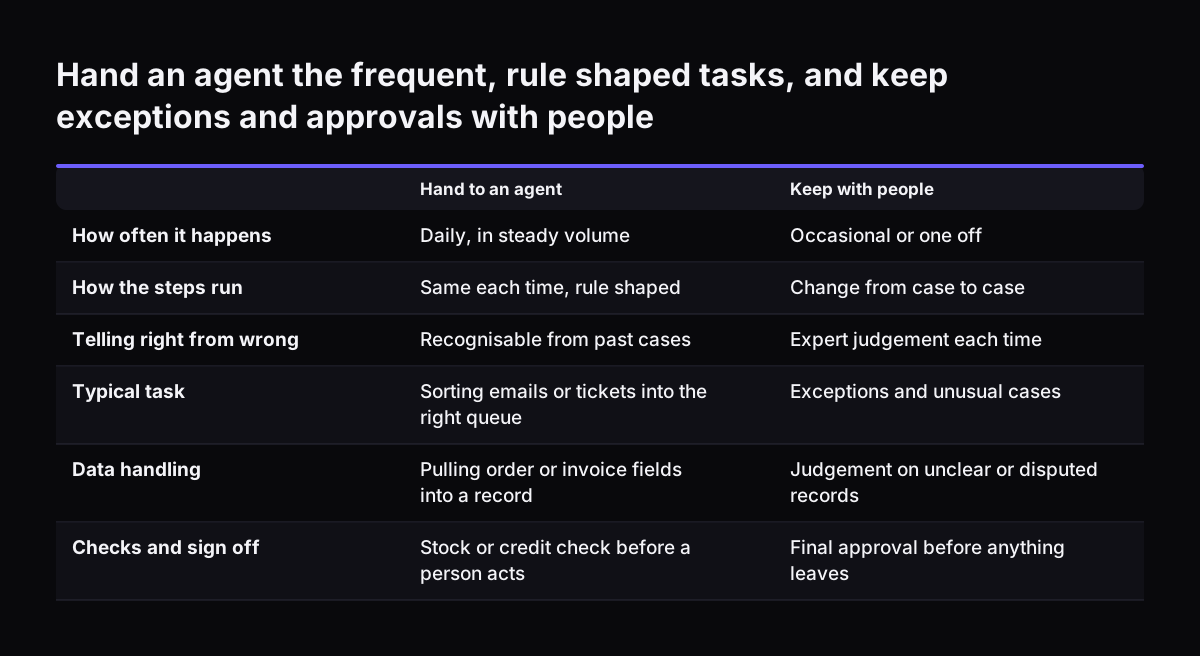
The tasks worth handing to an AI agent are repetitive, frequent and rule-shaped, with a right answer your team can recognise. IBM's advice on bringing agents into existing software starts the same way. Identify specific repetitive workflows, set up secure API connections, then begin with a pilot.

Good candidates

  • Sorting incoming emails or tickets into the right queue.
  • Pulling fields out of orders, invoices or forms into a system record.
  • Drafting a standard reply or quote from data already held in the CRM.
  • Checking a record against a rule, such as stock levels or credit status, before a person acts.

Tasks to keep with people

Exceptions belong with people. Research by MIT Sloan professor Sinan Aral found that AI agents can struggle with tasks humans usually find easy, such as handling exceptions. Their decision-making is also still poorly understood. A process that is mostly exceptions gives an agent little to do and a lot to get wrong.

Decisions with legal or similarly significant effects on a person are also best kept with people. UK law allows them to be automated only with safeguards such as human review on request, covered in the UK section below. Low-volume tasks rarely repay the build, even when they are tedious. If you want ideas sorted by function, our page on AI by business task lists processes department by department.

Hand an agent the frequent, rule shaped tasks, and keep exceptions and approvals with people. Hand to an agent / Keep with people. How often it happens: Daily, in steady volume / Occasional or one off; How the steps run: Same each time, rule shaped /

A checklist table for choosing your first AI agent process

A first agent process should pass most of the checks below. Score one candidate process at a time against the questions, with the person who does the work today.

QuestionGood signWarning sign
How often does the task happen?Daily, in steady volumeA few times a month
Are the steps the same each time?Fixed steps, written or easy to writeEvery case handled differently
Do the systems involved have an API?Yes, or a ready-made Claude connector existsData lives only in paper or local files
Can you tell a right result from a wrong one?Yes, from past casesOnly by expert judgement each time
Where does a person approve?One clear point before anything leavesNobody can name it
Does the outcome decide something significant about a person?No, or a person makes the final callThe agent would decide alone
Who owns the process?A named manager who will measure itNobody, or a committee

A process with two or more warning signs is a poor first agent. It may still suit a person with a Claude seat, who can handle the exceptions as they come.

Which companies and roles an AI agent fits, and which it does not

An AI agent fits a company that already runs its work in systems with APIs and has a few processes that repeat all day. Typical systems are a CRM such as Zoho CRM, a helpdesk such as Zoho Desk, and an accounting package such as Sage or FreeAgent.

Roles that gain most

The roles that gain most do the same handling work many times a day. Examples are order coordinators, service desk staff, accounts payable clerks and sales administrators. Moveworks reports that 78% of executives in its research believe their most successful projects started with support staff solving persistent challenges. The people closest to the work usually know which task to hand over first. For accounting practices, our guide to AI for accountants in the UK walks through each process.

Where an agent does not fit

  • A company whose process changes every month and is not yet written down.
  • Work where nobody can name the approval point or the person accountable.
  • A team that mainly wants help writing, researching and analysing across many tasks.

The last case is a different need. A team that wants Claude across many small tasks is better served by Claude Team seats than by one agent. That is why the offer separates Pilot Claude A, an agent for one process, from Pilot Claude B, Claude Team for the whole team.

Why many AI agent projects fail, and how a narrow pilot avoids it

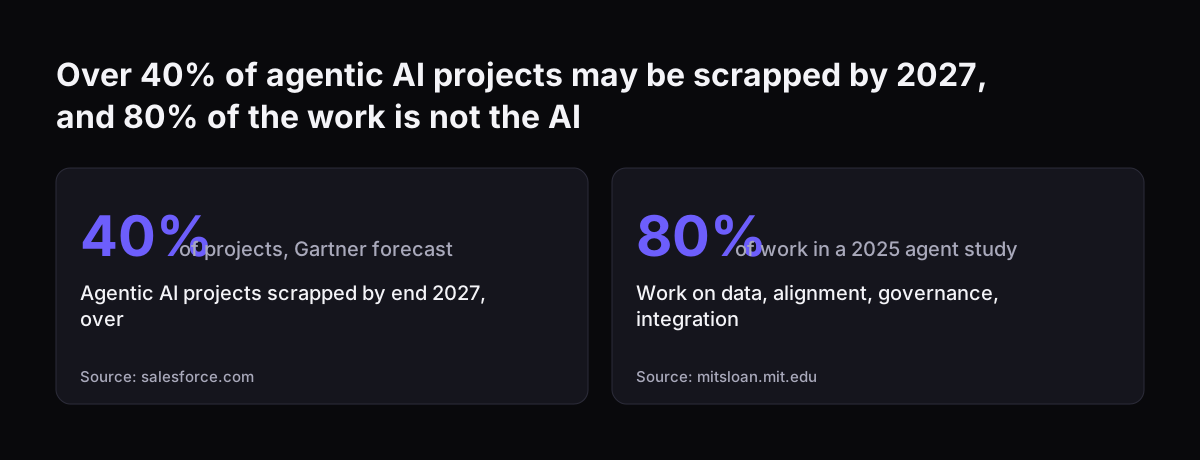
Many agent projects fail on value, cost and control rather than on the model. Gartner has forecast that over 40% of agentic AI projects will be scrapped by the end of 2027. The forecast, cited by Salesforce, puts this down to unclear value, rising costs or inadequate risk controls.

Most of the work is not the AI. An MIT Sloan article describes a 2025 study of an agent that detected adverse events in cancer patients. In that study, 80% of the work went on data engineering, stakeholder alignment, governance and workflow integration. Prompt engineering and fine-tuning took the remaining share.

Savings are also easy to overstate. In the same MIT Sloan article, Kellogg warns that reclaiming 20% of someone's time is not a 20% labour-cost saving. Kellogg also says monitoring should be a permanent operational expense, not a one-time project cost. IBM notes that measuring the return on agentic AI is tricky, because benefits are often indirect and may not show in the short term.

A narrow pilot answers all three problems. It covers one process with a named owner. Its targets are the figures measured on day 30, with today's baseline, signed at kickoff. Our post on writing the business case for AI around one measured process shows how to set those figures before any build starts.

Over 40% of agentic AI projects may be scrapped by 2027, and 80% of the work is not the AI: Agentic AI projects scrapped by end 2027, over 40% of projects, Gartner forecast, Work on data, alignment, governance, integration 80% of work in a 2025 agent
Source: salesforce.com, mitsloan.mit.edu

What UK companies must check: the ICO and agentic AI

Where an AI agent handles personal data, as an order or helpdesk agent almost always does, UK companies must treat it as processing under UK GDPR. The regulator is also watching agents closely. In October 2026 the ICO opened a six-week call for evidence on the data protection risks of agentic AI. Responses are due by 20 November 2026.

The call for evidence covers security, transparency, accountability, automated decision-making, fairness and lawful data use. It will feed the ICO's forthcoming statutory code of practice on AI and automated decision-making. The ICO has also made enquiries with OpenAI, Anthropic, Meta and the UK's AI Security Institute about recent agent testing. It says that, in some cases, agents reportedly bypassed protections, used unauthorised communication channels and accessed external systems such as Hugging Face.

The ICO's guidance on AI and data protection is under review after the Data (Use and Access) Act. It remains the reference for now. It includes content on what to consider in a DPIA, a data protection impact assessment.

Its fairness chapter covers solely automated decision-making. Since the Data (Use and Access) Act, those rules sit in Articles 22A to 22D of the UK GDPR. They allow significant automated decisions only with safeguards. Where such a decision uses special category data, it needs the person's explicit consent. Otherwise it must be necessary for a contract or required by law, and also meet a substantial public interest condition. No significant automated decision can rely on the new recognised legitimate interests basis.

In practice, four checks follow for a first agent:

  • Complete a DPIA before go-live.
  • Keep a person at the approval step for anything that affects an individual, with the time, information and authority to change the outcome, not just click approve.
  • Give the agent only the read and write operations it needs.
  • Know where it runs, for example your own AWS account in London. If data leaves the UK, check the transfer safeguards in your provider's data processing terms.

Our overview of AI law in the UK for businesses covers the wider rules.

Next steps: pick one process, measure it and check the approval point

The practical next step is to choose one candidate process and gather four facts about it this week. You do not need a supplier to do this.

  1. Count how many times the task happens in a normal week.
  2. Time a few cases from start to finish, and note who does them.
  3. List the systems the task touches, and check whether each has an API or a Claude connector.
  4. Name the point where a person must approve before anything leaves.

Run the result through the checklist table above. A process that passes is a reasonable first agent. A process that fails may suit Claude seats for the team instead.

Svennis does this work in four steps: the Workshop, then Pilot Claude A or Pilot Claude B, then the department Activation, then monthly operations. If your process passes and you want it built, the Claude Pilot A service page describes how one AI agent goes live in 30 days and carries the published prices. For the wider picture of plans and costs, read our guide to Claude for business and how to start.

Part 2 of this series follows a pilot from process map to live agent in 30 days. Part 3 looks at results, costs and risks against a larger AI programme.

Sources

  1. Claude Pilot A: an AI agent live in 30 days | Svennis AI
  2. Models overview, Claude Platform Docs | Anthropic
  3. ICO secures changes from leading AI developers as scrutiny extends to AI agents
  4. Guidance on AI and data protection | ICO
  5. Agentic AI, explained | MIT Sloan
  6. What is Agentic AI? | IBM
  7. What is Agentic AI? How it works, benefits and risks | Salesforce UK
  8. Agentic AI vs AI Agents: Key Differences Explained | Moveworks
Free, 30 minutes

Pick a time. Bring the process this article made you think of.

You leave with a clear yes or no on putting Claude on it, and the step that fits from our published prices. You speak to someone who builds the agents, not a salesperson.

Prefer to call? +44 7588 772736 · Not ready to talk? See it on your business first.

30 minutes · video call · free
  1. 1Time
  2. 2Details
  3. 3Booked