

Skip to content
SVENNISAIWe speak Claude.
Blog · AI automation

AI automation, from process to AI agent in 30 days: how a pilot is run

A step-by-step guide to a 30-day Claude pilot: choosing the process, signing targets, connecting your systems, testing 100 real cases and the checks made before go-live.

10 min read

Book a 30-minute call · with a Claude Certified Architect from our team.

Article · 10 min read
Abstract shapes moving from a loose cluster into one ordered line along a short, fixed path

AI automation in 30 days: how a pilot takes one process to a working agent

AI automation in a 30-day pilot follows a fixed path. You pick one real process, such as helpdesk triage or lead qualification. A Claude agent connected to your CRM or helpdesk then goes live inside a fixed window. Targets are signed at kickoff. 100 test cases from your real work are checked before go-live. Results are measured on day 30.

A pilot, in this guide, is a fixed 30-day project that puts one AI agent into production for one process. It is measured against agreed figures. An AI agent on the API is a program that calls Claude directly, with nobody at the keyboard. The agent reads from your systems, does the steps you agreed and writes results back. A colleague approves anything that leaves the business.

This post is part 2 of 3 in a series on Claude Pilot A. Part 1, Agentic AI for business: what an AI agent does and where it fits, explains the idea. Part 3, Why a pilot agent beats a big AI programme: results, costs and risks, weighs the outcome. This part covers how the work is done, stage by stage. It sets out what you prepare, who is involved, what can go wrong and how each risk is checked.

If you want the wider view first, see the page on AI automation built as working agents. It sets out what can be automated and how the steps fit together.
Choosing the process: narrow, frequent and easy to reverse

The process you choose decides whether a 30-day pilot succeeds. A good pilot process is narrow, happens often, uses data you already hold and produces results a person can check. Helpdesk triage and lead qualification fit well, because each case is small and the right answer is usually clear to an experienced colleague.

Fivetran's guide to building a first AI agent gives a useful filter. It recommends a narrow set of tools for a specific high-value workflow. It also lists what to avoid in a first agent:

  • ambiguous accountability
  • sparse data
  • adversarial users
  • high legal or safety stakes
  • long-horizon planning and execution
  • irreversible actions

Some processes do not need an agent at all. CopilotKit's guide makes the point plainly: if you already know every possible user action, code it directly, and if a task needs 100% accuracy, an agent is the wrong choice. A fixed booking flow with known steps is ordinary software. An agent earns its place where a ticket or a lead needs reading and judgement before it goes to the right person.

For ideas grouped by job rather than by technology, see AI matched to each business task.

The Workshop and kickoff: targets signed before anything is built

A Claude pilot starts with agreement on what success means, not with code. The offer runs in four steps: the Workshop, then Pilot Claude A (an AI agent on Claude for one process) or Pilot Claude B (Claude Team for the whole team), then the department Activation, then monthly operations. This post covers Pilot Claude A.

The Workshop is where the process is chosen and described step by step. You walk through how the work is done today, where the data sits and which steps need a person. The output is a scope narrow enough to finish in 30 days.

Kickoff is the first working session of the pilot. At kickoff both sides sign the targets. Targets are the figures to be measured on day 30, together with where they stand today. The baseline matters as much as the goal.

The service page gives an example of an order email where a coordinator checks stock, raises the order and sends it, at about 12 minutes an email. A figure like that is what the agent is measured against.

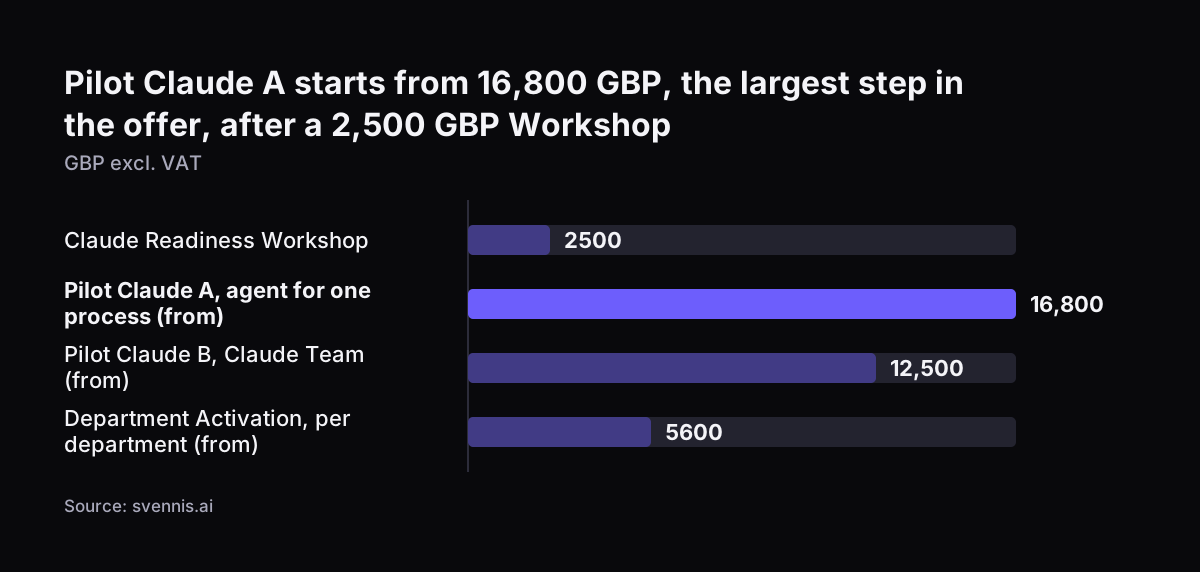
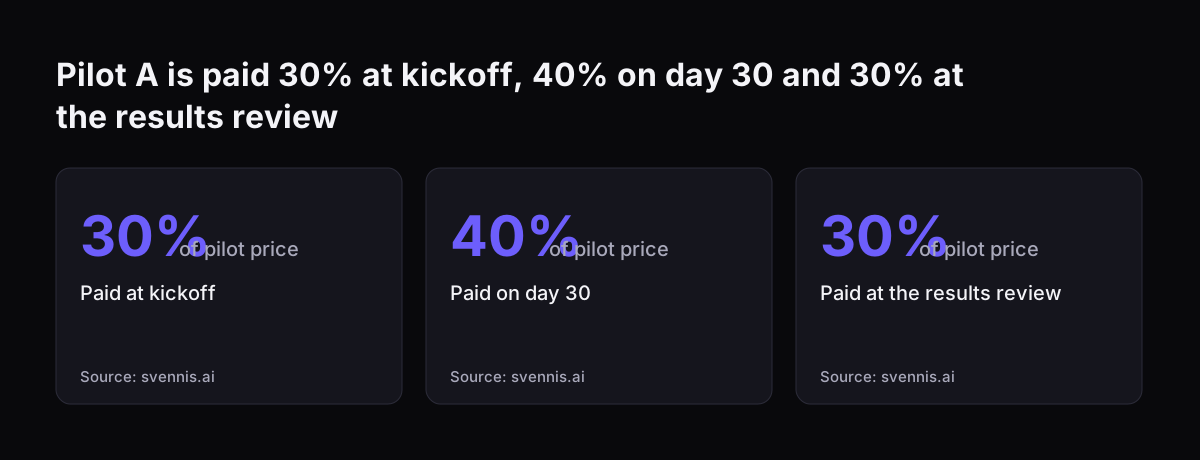
The pilot then has three fixed milestones: kickoff, day 30 and the results review. Payment follows the same milestones, so the money is tied to delivery and measurement rather than to activity.

Pilot Claude A starts from 16,800 GBP, the largest step in the offer, after a 2,500 GBP Workshop: Claude Readiness Workshop 2500, Pilot Claude A, agent for one process (from) 16,800, Pilot Claude B, Claude Team (from) 12,500, Department Activation, p
Source: svennis.ai

What your company prepares before the pilot starts

Your preparation for a 30-day pilot is mostly about people and access, not documents. The agent works inside your live systems, so the build can only move as fast as access is granted and questions are answered.

Before kickoff, have these ready:

  • A process owner. The person who runs the work today and can say what a correct result looks like.
  • A system administrator. Someone who can create API credentials and set permissions in your CRM or helpdesk.
  • Real past cases in the live system. Tickets or leads already handled, from which the test cases are drawn.
  • A named approver. The colleague who confirms actions before they leave the business.
  • A hosting decision. By default the agent runs in your company's own AWS account in London, or in your own Anthropic organisation, with your keys.
  • A budget on the cloud account. Model usage on AWS is not capped unless you set one.

On the delivery side, the team builds the connections, writes the agent's steps and runs the tests. On your side, expect most of the time to fall on the process owner, who reviews test results and explains edge cases. Plan their diary for the 30 days accordingly. A pilot that waits a week for an answer loses a quarter of its window.

Connecting Claude to your CRM or helpdesk: connector, MCP server, plugin or skill

Connecting Claude to your systems is the technical core of the pilot. For each system the agent needs, Svennis builds one of four things: a connector, an MCP server, a plugin or a skill. The options are shown with their cost, and you choose.

An MCP server is a small service that exposes a system's operations to Claude through the Model Context Protocol. Fivetran describes the role well. MCP servers and similar tool interfaces let agents retrieve data, query systems, call APIs and write results back into operational tools. All current Claude models support tool use, according to Anthropic's models overview.

Some systems have no ready-made option. The service page notes that neither Sage nor FreeAgent has a ready-made Claude connector today. In that case an MCP server is built on the system's API. The pilot's base scope covers one new MCP server, for a system with an API not connected before. That server can have up to 8 read and write operations.

Write access is granted in stages. Fivetran's maturity path is a sensible order. Start with read-only agents that retrieve and summarise. Then build drafting agents that prepare outputs for human review.

The third stage is bounded write-back agents that act within strict limits. In a 30-day pilot, each permission the agent holds should map to one operation agreed in the scope.

Building the agent: skills, model choice and the human approval step

A pilot agent is built from a small number of skills. A skill, in this context, is one defined step of the process with its own instructions and its own test cases. A process usually needs 3 to 5 skills, such as classify the request, look up the customer, choose the team and draft the reply.

Each skill runs on the model that suits it. Anthropic's models overview positions Claude Haiku 5.5 for high-volume, latency-sensitive tasks such as classification, extraction and routing. It describes Claude Sonnet 5.5 as the best combination of speed and intelligence. If you are unsure, Anthropic recommends starting with Claude Opus 5.5 for most workloads. Claude Fable 5.1 is for demanding reasoning and long-horizon agentic work, which a narrow pilot process rarely needs.

The human approval step is the point where a colleague confirms before an action leaves, for example the quote before it reaches the customer, or the bill before the ledger. It is built into the agent from day one, not added later.

This matches wider practice. Fivetran's guide states that sensitive, irreversible, regulated or safety-critical actions should remain prohibited from autonomous execution.

Worked example: helpdesk triage in Zoho Desk with a Claude agent

Helpdesk triage shows how the stages fit together in one process. Imagine a support team on Zoho Desk, with customer records in Zoho CRM. Tickets arrive by email and a coordinator reads each one, decides which team should handle it and sends an acknowledgement.

The pilot agent does the same work in this order:

  1. A new ticket arrives in Zoho Desk, and the agent reads it through the connection chosen for the helpdesk.
  2. A classification skill, running on Claude Haiku 5.5, decides the request type and urgency.
  3. A lookup skill finds the customer in Zoho CRM and reads their account details.
  4. A routing skill assigns the ticket to the right team inside the helpdesk.
  5. A drafting skill writes a reply, which waits for the coordinator to approve it before it is sent.

The targets signed at kickoff might be the share of tickets routed correctly first time and the minutes a coordinator spends per ticket, each with today's figure beside it. On day 30 the same measures are taken again.

Notice what the agent does not do. It does not close tickets, issue refunds or change account terms. Those actions stay with people, because they are hard to reverse. A later phase can widen the scope once the results justify it.

Testing before go-live: 100 test cases from your real work

Testing a pilot agent means running it against real cases with known answers before it touches live work. Each pilot uses 100 test cases drawn from your real work, checked before go-live, and each skill has its own test cases as well.

Fivetran calls these evaluations: mappings between inputs and expected outputs that the agent can be measured against. In helpdesk triage, an input is a past ticket and the expected output is the team that actually handled it. The process owner confirms the expected answers, because they know which past decisions were right.

At Svennis we run every skill in draft mode against its test cases first, so nothing writes back to the live system until the drafts match what the process owner would have done. Where a skill fails a case, we fix the instructions and rerun the whole set, not just the failed case.

Testing matters because agents make mistakes. CopilotKit's guide states plainly that agents can hallucinate and make errors. The measures signed at kickoff, taken during testing, show whether the agent is ready.

Go-live checklist: what is checked before the agent acts on live work

A go-live checklist turns the pilot's safeguards into items someone signs off. Every item below is confirmed before the agent handles a live case.

CheckWhat is confirmedWho confirms
Targets and baselineToday's figures recorded, day 30 targets signedProcess owner and delivery lead
Data protection impact assessmentDPIA screening done before real cases are used for testing, a DPIA completed where needed, or the reasons for not doing one recordedData protection lead
Test casesAll 100 real cases run, results reviewedProcess owner
SkillsEach of the 3 to 5 skills passes its own test casesDelivery lead
PermissionsThe agent can perform only the read and write operations in scopeSystem administrator
Approval stepAnything leaving the business waits for a named colleagueNamed approver
BudgetA spending budget is set on the cloud accountFinance or account owner
Data location and retentionHosting region, data processor and retention terms confirmedData protection lead
FallbackStaff know how to take a case back from the agentProcess owner

The budget item is easy to skip and costly to forget. Model usage on AWS is billed on use and is not capped unless you set a budget. The fallback item matters for trust: your team should know that any case can return to a person at once, with no workaround needed.

Running costs and data location after the agent goes live

Running costs for a pilot agent come from model usage, not from licences. An AI agent runs on the API, on your company's account, so it needs no Claude seats. Seats are the per-person licences for Claude Team or Enterprise, billed by Anthropic in pounds. The agent's model usage is billed by Amazon Web Services in US dollars, on use. The service page puts usage at a few thousand requests a month at usually tens of pounds.

Model choice affects both cost and data handling. Anthropic's API and data retention page sets out the terms worth checking:

  • Under zero data retention (ZDR), Anthropic does not store prompts or responses at rest after the API response is returned.
  • ZDR is enabled per organisation and does not extend automatically to other organisations under the same account.
  • On Amazon Bedrock, the cloud provider rather than Anthropic is the data processor.
  • Claude Fable 5.1 requires 30-day data retention and is not available under ZDR unless Anthropic expressly authorises it.

These points feed the data location item on the go-live checklist. A triage agent on Claude Haiku 5.5 rarely needs a model with stricter retention terms. The published prices for the pilot itself sit on the service page, linked in the next steps below.

What a 30-day AI agent pilot means for a UK company

For a UK company, a pilot agent can stay close to home. By default the agent runs in your own AWS account in the London region, and you hold the keys. That keeps the data in an account your company controls, with AWS acting as your data processor under its own terms. Check the region and inference settings to confirm where prompts are processed. If you choose your own Anthropic organisation instead, requests may be processed outside the UK, which is a restricted transfer your contracts need to cover.

A UK public body shows what a well-bounded pilot looks like. The London Borough of Hounslow published a privacy notice for its SpeakAI pilot, a voice assistant tested in Adult Social Care. The council set clear limits:

  • The pilot is time-limited and runs in two stages.
  • The service is in English only during the pilot.
  • Callers can ask to speak to a human adviser at any point.
  • Recording stops once a call is transferred to a human adviser.
  • Call logs are kept for up to 30 days, then securely deleted.
  • The pilot is judged on user satisfaction, practitioner feedback and resolution times.

The same principles apply to a private business: a fixed window, a narrow scope, a route back to a person and measures agreed in advance. Sector pages such as AI for accountants show which processes in one trade are good first candidates.

Next steps: choose one process and prepare for the Workshop

The next step towards a 30-day pilot is choosing the process, not choosing the technology. You can do most of the groundwork this week, before speaking to anyone.

  1. List three processes that happen often, use data in one system and have a clear right answer.
  2. Strike out any that involve irreversible actions or high legal stakes.
  3. For the one left, write down today's figures: volume per month and minutes per case.
  4. Name the process owner, the system administrator and the approver.
  5. Check which systems the agent would need, and whether each has an API.
  6. Decide whether the agent should run in your own AWS account in London or in your own Anthropic organisation.

With that list, the Workshop can move straight to scope and targets. Svennis runs this pilot as Claude Pilot A, an AI agent live in 30 days. The page sets out the stages, what is included and the published prices.

Pilot A is paid 30% at kickoff, 40% on day 30 and 30% at the results review: Paid at kickoff 30% of pilot price, Paid on day 30 40% of pilot price, Paid at the results review 30% of pilot price
Source: svennis.ai

Sources

  1. Claude Pilot A: an AI agent live in 30 days
  2. Anthropic: Models overview
  3. Anthropic: API and data retention
  4. Fivetran: How to build your first AI agent
  5. CopilotKit: Agents 101
  6. London Borough of Hounslow: Privacy notice, SpeakAI
Free, 30 minutes

Pick a time. Bring the process this article made you think of.

You leave with a clear yes or no on putting Claude on it, and the step that fits from our published prices. You speak to someone who builds the agents, not a salesperson.

Prefer to call? +44 7588 772736 · Not ready to talk? See it on your business first.

30 minutes · video call · free
  1. 1Time
  2. 2Details
  3. 3Booked