
Svennis AI
10 min read

Claude Opus 5.5 for business: which steps need it and which run on a smaller model

A practical guide to splitting a business system across Claude models: what Opus 5.5 does best, what it costs, and which steps run faster and cheaper on a smaller model.

Abstract cover showing one large shape branching into several smaller shapes along separate paths

Claude Opus 5.5 for business: use it for long, multi-step work

Claude Opus 5.5 for business is worth using for long, multi-step agent work and for reports or analysis that a smaller model gets wrong. For short, repetitive steps such as sorting tickets or pulling fields out of an email, Sonnet 5 or Haiku 4.5 usually do the job faster and for less. The decision belongs to each step of a system, not to the system as a whole.

Claude Opus 5.5 is Anthropic's model for long-running agentic coding and knowledge work, released on 22 September 2026. An agent is an AI system that completes multi-step tasks on your behalf, not just answers a question. Anthropic states that Opus 5.5 performs at the level of Claude Fable 5.1 on most work and costs 40% less to run than Claude Opus 5.

This post covers Opus 5.5. Companion posts cover Claude Fable 5.1, the dearer model for the hardest reasoning, and Claude Sonnet 5, the cheaper everyday model. Anthropic's own models overview gives a simple default: if you are unsure which model to use, start with Opus 5.5 for most workloads. The rest of this guide shows when to move a step down from that default, and when to keep it there.
What Claude Opus 5.5 is, what it costs and where it runs

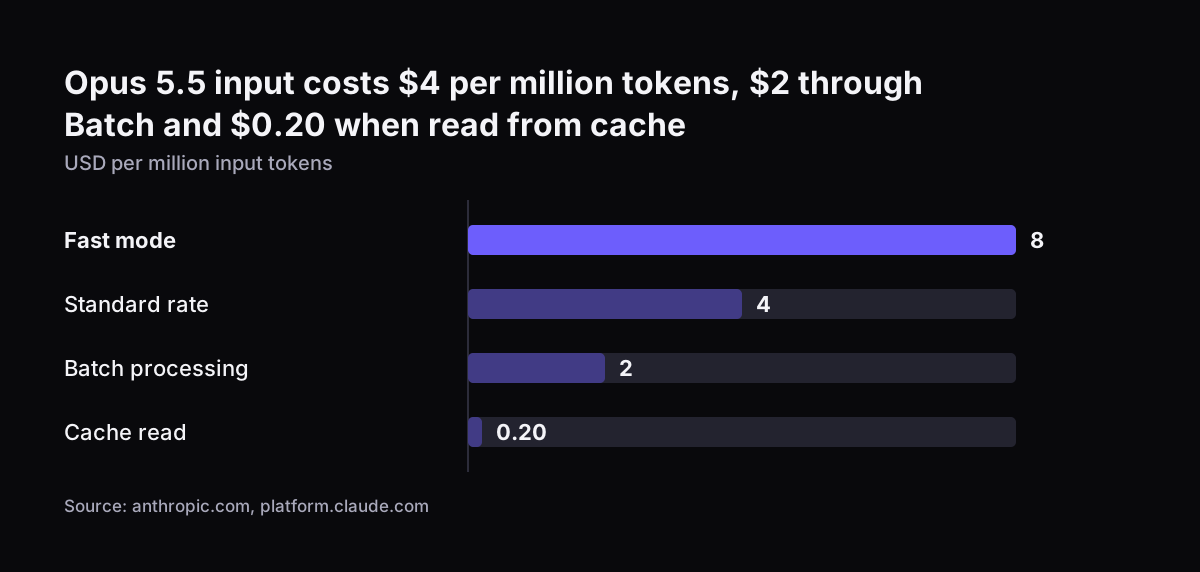
Claude Opus 5.5 costs $4 per million input tokens and $20 per million output tokens on Anthropic's published pricing. A token is a piece of text the model processes, roughly 4 characters or 0.75 words in English. Anthropic puts the input and output rates at 20% below Opus 5, which cost $5 and $25.

Two discounts matter for business use. The Batch API, which processes large volumes of requests asynchronously, halves the price to $2 and $10. Prompt caching reuses parts of a prompt you send repeatedly, such as a long set of instructions. Cache reads on Opus 5.5 cost $0.20 per million tokens, with 5-minute cache writes at $5 and 1-hour cache writes at $8.

Limits and settings

  • Context window: 1M tokens, so the model can read a very large amount of material in one request.
  • Maximum output: 128K tokens, or up to 300k on the Message Batches API with a beta header.
  • Thinking: adaptive thinking is always on and cannot be turned off.
  • Effort: the control for thinking depth, latency and cost, which defaults to medium on Opus 5.5.
  • Knowledge cutoff: June 2026.

Opus 5.5 is available on the Claude API as claude-opus-5-5, on Amazon Bedrock as anthropic.claude-opus-5-5, on Claude Platform on AWS, on Google Cloud and on Microsoft Foundry. Anthropic says it generates output more than 30% faster than Opus 5. It will not be retired sooner than 22 September 2027. With the launch, Anthropic is also raising five-hour usage limits on Pro, Max, Team and seat-based Enterprise plans of the Claude apps.

Opus 5.5 input costs $4 per million tokens, $2 through Batch and $0.20 when read from cache: Fast mode 8, Standard rate 4, Batch processing 2, Cache read 0.20 (USD per million input tokens)
Source: anthropic.com, platform.claude.com

Opus 5.5 compared with Fable 5.1, Sonnet 5 and Haiku 4.5

Opus 5.5 sits in the middle of Anthropic's current range on price: it costs twice as much as Sonnet 5 per token and 40% of what Fable 5.1 costs. The table sets out the published figures from Anthropic's models overview and pricing page.

ModelInput / output, USD per million tokensDefault effortContext / max outputAnthropic's description
Claude Fable 5.1$10 / $50High1M / 128KDemanding reasoning and long-horizon agentic work
Claude Opus 5.5$4 / $20Medium1M / 128KLong-running agentic coding and knowledge work
Claude Sonnet 5$2 / $10High1M / 128KThe best combination of speed and intelligence
Claude Haiku 4.5$1 / $5Not supported200K / 64KThe fastest model with near-frontier intelligence

Anthropic's guidance on Fable 5.1 is specific. Use it for demanding reasoning and long-horizon agentic work, or when your tests on Opus 5.5 at higher effort still fall short. In practice that makes Fable 5.1 the escalation route, not the starting point.

Claude Opus 5 has not been deprecated. Anthropic points anyone on Opus 5 or earlier to a migration guide for Opus 5.5. The price and speed figures give most businesses a reason to follow it, once the technical changes described later in this guide are handled.

Steps that need Opus 5.5: long agent runs, reports and hard analysis

Opus 5.5 earns its price on steps where a wrong answer is expensive and the work runs across many actions. Three kinds of step fit that description in a typical small business system.

  • Long agent runs. A task that calls several tools in sequence, checks the results and decides what to do next, such as reconciling open deals against invoices and drafting the follow-ups.
  • Reports that combine many sources. A monthly management report that reads weeks of tickets, notes and figures and has to draw the right conclusions from them.
  • Analysis a smaller model gets wrong. Any step where you have seen Sonnet 5 miss the point, mix up figures or lose the thread of a long document.

Context size alone is not the reason to choose Opus 5.5. Sonnet 5 and Fable 5.1 also read 1M tokens, which is roughly 750,000 English words. The difference is how reliably the model reasons over that material and how well it holds a multi-step plan together.

Test Opus 5.5 on your own work rather than on published scores. Anthropic itself says that at current capability levels, benchmark margins have become a less reliable guide to real-world differences. A set of twenty real reports or cases from your own records tells you more than any league table.

Steps that run as well on Sonnet 5 or Haiku 4.5

Short, well-defined, high-volume steps usually run as well on a smaller model, and faster. Classifying an incoming email, extracting a customer number, choosing a queue or summarising a single ticket rarely needs Opus 5.5.

Haiku 4.5 is the fastest and cheapest current model at $1 and $5 per million tokens. Its 200K-token context and February 2025 knowledge cutoff matter little when the data it works on comes from your own systems. It does not support the effort setting. Anthropic lists its retirement as not sooner than 15 October 2026, so plan a replacement for any step you build on it.

Sonnet 5 costs half the Opus 5.5 rate and defaults to high effort. It suits steps that need more judgement than Haiku 4.5 can give: drafting a customer reply from a knowledge base article, or checking that a form has been filled in correctly.

Forced tool use rules out Opus 5.5 for some routing steps

Forced tool use is an API setting that makes the model call a named tool every time. Many classification steps rely on it to guarantee structured output. Opus 5.5 does not support forced tool use: a request with tool_choice set to "any" or to a named tool returns a 400 error. A routing step built that way should stay on a smaller model or be rewritten.

The UK AI Security Institute's Frontier AI Trends Report makes a related point. It found that agents with the best externally built scaffolds, the tools and task structure around a model, reliably outperform the best base models at software engineering tasks. The design of the system matters as much as the model you choose.

Worked example: a Teams service desk in front of Zoho Desk, split across models

A service desk in Microsoft Teams that files and answers tickets in Zoho Desk shows how one system uses several models. Each step gets the cheapest model that does it correctly. The setup follows the pattern described in our post on a Teams service desk built on Zoho Desk.

StepModelReason
Read the Teams message and pick a categoryHaiku 4.5 or Sonnet 5Short input, high volume, structured output
Look up the user and open tickets in Zoho DeskSame model as aboveA single tool call with a clear answer
Draft a first reply from the knowledge baseSonnet 5Needs judgement, but the source text is short
Work a multi-step fix across systemsOpus 5.5 at medium effortMany tool calls, and the plan must hold together
Monthly trend report for managementOpus 5.5 on the Batch APIReads a month of tickets; no one waits for it

At Svennis we build every step on the smallest model first and move a step up to Opus 5.5 only when real tickets show the smaller model getting it wrong. The routing step almost never moves; the report and the multi-step fixes often do.

Two settings need attention on the Opus 5.5 steps. Call the model as claude-opus-5-5 and leave effort at medium until tests show a need for high. If the Teams bot shows progress messages while it works, set a thinking display value that returns the text, or the bot goes silent between tool calls. Our guide to connecting Claude in Microsoft 365 and Teams to the systems behind it covers the connection itself.

Cost of Opus 5.5 against the other models at published prices

The cost gap between models only matters once you multiply it by your volume. Two illustrations, using Anthropic's published USD prices and volumes chosen for the example, show the scale.

Illustration 1: sorting 1,000 tickets

Assume each ticket sends 2,000 input tokens and returns 100 output tokens. That is 2 million input tokens and 100,000 output tokens in total.

  • Haiku 4.5: $2.00 input plus $0.50 output, $2.50 in total.
  • Sonnet 5: $4.00 plus $1.00, $5.00 in total.
  • Opus 5.5: $8.00 plus $2.00, $10.00 in total.
  • Fable 5.1: $20.00 plus $5.00, $25.00 in total.

Illustration 2: one monthly report

Assume the report reads 200,000 input tokens and writes 10,000 output tokens. On Opus 5.5 that costs $0.80 plus $0.20, so $1.00. On the Batch API it costs $0.50, the same as Sonnet 5 at standard rates. Fable 5.1 would cost $2.50.

The lesson is plain. For a report that runs once a month, Opus 5.5 costs very little, so pay for the better answer. For a step that runs thousands of times a day, the multiplier is what you pay, so use the smallest model that is right. Prompt caching narrows the gap further on Opus 5.5, because cache reads cost 0.05 times the base input price.

Two billing details change the sums. US-only inference on the Claude API costs 1.1 times the standard rate. Claude Platform on AWS and Claude in Microsoft Foundry convert usage into Claude Consumption Units at $0.01 each.

Technical changes to handle before moving code to Opus 5.5

Code already running on Opus 5 meets four breaking changes on Opus 5.5, according to Anthropic's model documentation. Your developer should check each one before switching the model ID.

  1. Thinking cannot be disabled. A request that turns thinking off, or sets a manual thinking budget, returns a 400 error. Control depth with the effort parameter instead.
  2. Forced tool use returns an error. Requests that force a tool call fail, as described earlier in this guide.
  3. Thinking blocks are tied to the model and the conversation. Opus 5.5 reads thinking blocks from Opus 5 and earlier Opus, Sonnet and Haiku models, but not from Fable or Mythos models. The API drops blocks it cannot read, and dropped blocks are not billed. For accounts created on or after 31 August 2026, the API by default rejects replayed thinking blocks after earlier context has been changed.
  4. An older computer-use tool is rejected. The computer_20251124 tool no longer works on the Claude API and Google Cloud, although it still works on Amazon Bedrock.

The first three changes also apply to Claude Fable 5.1. A fifth change breaks nothing but can confuse users: text written between tool calls now arrives as thinking blocks, which are empty at the default display setting.

A lower-latency fast mode of Opus 5.5 is available as a research preview on the Claude API only. It costs $8 per million input tokens and $40 per million output tokens, double the standard rate. Keep it for the few steps where a person is waiting for the answer.

Where Opus 5.5 data goes for UK and EU companies

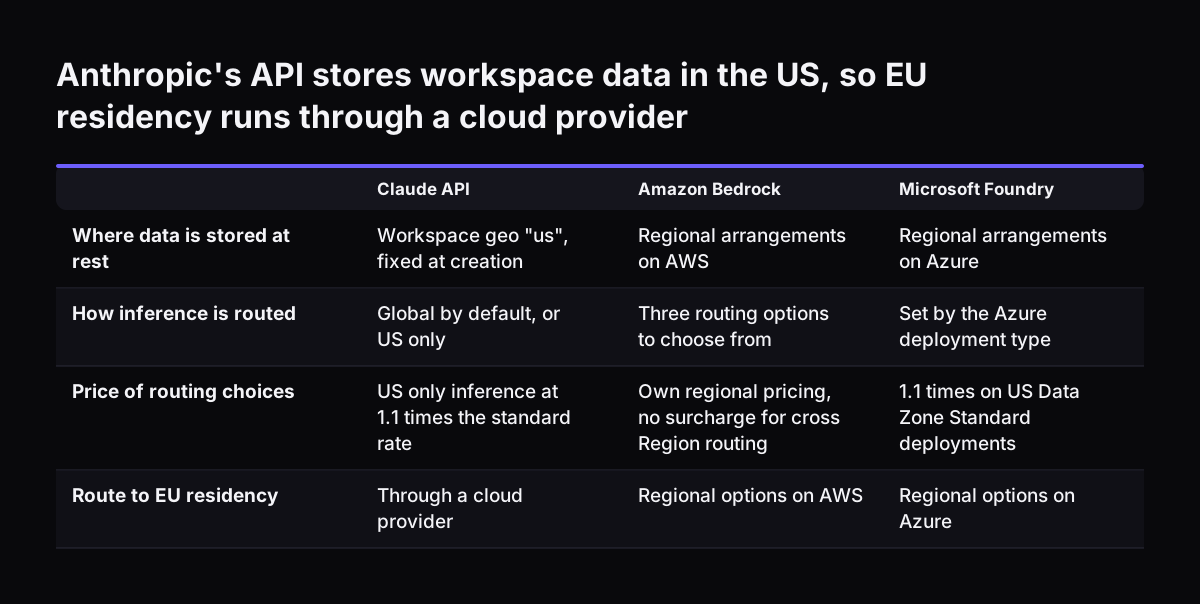
Anthropic's own API does not offer EU or UK data residency. Its data residency page lists "us" as the only available workspace geo, the setting that controls where data is stored at rest. That setting is fixed when a workspace is created and cannot be changed afterwards.

A second setting, inference geo, controls where the model runs. Its default is "global", meaning inference may run in any available geography. Setting it to "us" restricts inference to the US and costs 1.1 times the standard rate.

EU routes through the cloud providers

EU residency for Opus 5.5 comes through Amazon Bedrock, Google Cloud or Microsoft Foundry, each with its own regional arrangements and pricing. Bedrock offers three routing options:

  • In-Region: requests never leave the AWS Region you specify.
  • Geographic: requests go to a Region within a defined geography such as the EU, and prompts and outputs stay inside it.
  • Global: requests go to a supported commercial Region worldwide, sometimes at a lower per-token price.

For a UK or EU company, the EU geographic cross-Region profile is the route that keeps Opus 5.5 traffic inside the EU. Do not plan on in-Region inference in AWS London or in a single EU Region; check the Bedrock regional table for Opus 5.5 before you design around it. Bedrock charges no surcharge for cross-Region routing. Our GDPR checklist for European firms using Claude covers the contract and processing questions that sit alongside residency.

Anthropic's API stores workspace data in the US, so EU residency runs through a cloud provider. Claude API / Amazon Bedrock / Microsoft Foundry. Where data is stored at rest: Workspace geo "us", fixed at creation / Regional arrangements on AWS / Regi

Safeguards, zero data retention and the EU AI Act on Opus 5.5

Opus 5.5 is available with zero data retention and carries Anthropic's watermarking measures to comply with the EU AI Act. Both points belong in your supplier file if you operate in the EU or sell into it.

The model runs a biology safety classifier in addition to a cybersecurity one. When the model declines a request, the API returns HTTP 200 with stop_reason: "refusal" and a note naming the policy area. Build your system to catch that response, so a refused step is logged and passed to a person rather than treated as an empty answer.

Anthropic is open about the limits of its own testing. It says external evaluators tested Opus 5.5 before release. It also reports signs that Opus 5.5 often suspects it is being evaluated, which challenges its ability to assess how the model will act.

The UK AI Security Institute adds a caution that applies to every model. It found that more capable models do not necessarily have better safeguards, and it has found universal jailbreaks for every system it has tested. For a business, that argues for keeping a person in the loop on any step that changes records, sends money or contacts customers. Our overview of AI law in the UK and what applies to your business sets out the legal side.

Next steps: test Opus 5.5 on one step of your own system

The quickest way to decide where Opus 5.5 belongs is to test it on real work from your own records. A short, structured test answers the question for your business better than any comparison table.

  1. List the steps in one process, from the first message in to the last record written, for example a ticket moving from Teams into Zoho Desk or a lead moving into Zoho CRM.
  2. Mark each step as short and repetitive, or long and multi-step.
  3. Run twenty real examples of each long step on Sonnet 5 and on Opus 5.5 at medium effort, and compare the results side by side.
  4. Move a step to Opus 5.5 only where the smaller model gets it wrong, and to Fable 5.1 only where Opus 5.5 at higher effort still falls short.
  5. Price each step at your real monthly volume, and use the Batch API for anything no one waits for.
  6. Choose your data route, the Claude API or an EU profile on a cloud provider, before you build.

If you are still deciding where Claude fits at all, start with our guide to putting Claude to work inside the tools you already use. It covers the systems side before the model choice.

Sources

  1. 1. Anthropic: Models overview
  2. 2. Anthropic: Models overview (docs.anthropic.com)
  3. 3. Anthropic: Pricing
  4. 4. Anthropic: What's new in Claude Opus 5.5
  5. 5. Anthropic: Claude Opus 5.5 overview
  6. 6. Anthropic: Introducing Claude Opus 5.5
  7. 7. Anthropic: Newsroom
  8. 8. Anthropic: Data residency
  9. 9. Amazon Bedrock: Regional availability by models
  10. 10. UK AI Security Institute: Frontier AI Trends Report

Related articles