Skip to content
SVENNISAIWe speak Claude.
Blog · Claude

Claude on Google Vertex AI for Google Cloud firms: endpoints, limits and integrations

If your business already runs on Google Cloud, Claude on Vertex AI keeps billing, quotas and data handling in one place. This guide covers endpoints, regions, gaps and integrations.

10 min read

Book a 30-minute call · with a Claude Certified Architect from our team.

Article · 10 min read
Abstract cover of layered arcs converging on one central node, suggesting requests routed through a single cloud

Claude on Google Vertex AI for Google Cloud firms: the short answer

Claude on Google Vertex AI is Anthropic's Claude models served, metered and invoiced by Google Cloud, and for Google Cloud firms it is usually the right way in. Google manages your quotas, sends the invoice and governs data handling. You choose where requests are processed. Switching the model on is quick; connecting it to your CRM, helpdesk and accounting systems is the real work.

Anthropic's documentation calls this offering "Claude Models on Google Cloud (Google managed)". The same Claude models are also sold through the Claude API, Amazon Bedrock, Microsoft Foundry and Claude Platform on AWS, according to Anthropic's models overview. What differs between these routes is who bills you, which features are available and where your requests are processed.

This guide covers the parts a business owner or manager needs before deciding:

  • how requests reach Claude on Vertex AI
  • which models and regions you can use
  • which features the Vertex AI route leaves out
  • a worked example with real settings
  • when the Claude apps suit you better than Vertex AI

Every product fact comes from Anthropic's own pages. Check them again on the day you build, because Google and Anthropic both change their model and region lists over time.
How requests reach Claude on Vertex AI: SDK, endpoints and logs

Requests to Claude on Vertex AI go to a Google endpoint, not to Anthropic's own API. Anthropic's page on Claude Models on Google Cloud says each request goes to an Agent Platform endpoint URL ending in :rawPredict. Streaming requests use :streamRawPredict instead. Agent Platform is the name Google's documentation now uses for the Vertex AI serving layer.

Your developers do not have to write those calls by hand. Anthropic's client SDK supports the Vertex AI route through AnthropicVertex, a client class that sends requests to Google rather than to Anthropic. One tool does not work: Anthropic's ant command-line tool does not support Claude on Vertex AI. If your team uses it for testing against the Claude API, they need another method on Google Cloud.

Two practical limits apply to every request on Claude on Vertex AI:

  • Agent Platform limits request payloads to 30 MB, which matters when you send scanned documents or long email threads.
  • Anthropic recommends you keep at least the last 30 days of request and response logs.

The log recommendation is worth building in from day one. When an agent makes a wrong decision in a live system, the log is how you find out why. If you are new to the models themselves, our plain guide to what Claude is explains them before you go further.

Which Claude models Vertex AI serves, and who sets their retirement dates

Vertex AI serves the current Claude models, but Google, not Anthropic, sets their lifecycle dates there. Anthropic's Vertex AI page states that these dates can differ from the Claude API schedule. For example, Anthropic says Claude Opus 5.5 will not be retired on its own API sooner than 22 September 2027. On Vertex AI, check Google's date before you plan around it.

Anthropic's models overview gives a simple starting rule. If you are unsure, start with Claude Opus 5.5 for most workloads. The other current models fit narrower jobs:

  • Claude Fable 5.2 for demanding reasoning and long-horizon agentic work, or when Opus 5.5 still falls short in your tests.
  • Claude Sonnet 5.5, described as the best combination of speed and intelligence.
  • Claude Haiku 5.5 for high-volume, latency-sensitive tasks such as classification, extraction and routing.

All current models accept text and images, work in multiple languages and support tool use. Tool use is Claude's ability to ask your application to run a defined function, such as looking up a customer record. On Vertex AI, newer models including Claude Opus 4.6, Claude Sonnet 4.6 and Claude Haiku 5.5 get a 1M-token context window. Other Claude models there have 200k tokens. A token is a piece of text the model processes, roughly part of a word.

Availability also varies by region. Anthropic's page says different Claude models are offered in different regions, so the model you want decides where it can run.

Endpoint types on Vertex AI: global, multi-region and regional compared

Claude on Vertex AI offers three endpoint types, and your choice sets data location, available models and price. An endpoint type is the rule for which Google data centres may process your request. The table compares them using Anthropic's Vertex AI page.

Endpoint typeWhere requests goModels servedProvisioned throughputPrice
GlobalAny region with available capacityIncludes newer modelsNoBase price
Multi-regionAny region in the US (us) or the EU (eu)Includes newer modelsNo10 percent more than global
RegionalOnly the named region, such as europe-west1 or us-east5Claude Sonnet 4.6 and earlier onlyYes10 percent more than global

All three endpoint types accept pay-as-you-go traffic. Provisioned throughput, meaning capacity you reserve in advance, needs a regional endpoint. Anthropic recommends the global endpoint for maximum availability when data residency is flexible.

The trade-off is real. If you want Claude Haiku 5.5 or Claude Opus 5.5, you cannot pin requests to one named region. The eu multi-region endpoint is the tightest location control for those models. If you need reserved capacity in a single region, you are limited to Claude Sonnet 4.6 or an earlier model, and only where the region list shows it.

Quotas, billing and data handling sit with Google Cloud

On Vertex AI, Google Cloud manages rate limits and quotas for Claude, invoices you and governs data handling. That is the main reason a Google Cloud firm chooses this route. Your Claude spend appears on the same bill as your other Google Cloud services, under the same access controls and the same contract.

Quotas are the first thing to check before go-live. Because Google sets them, you raise or review them in your Google Cloud project, not with Anthropic. A support agent that works in testing can stall in production if the quota for that model and endpoint is too low for real ticket volumes.

Prices need care. Anthropic's pricing page lists Claude API prices in US dollars per million tokens:

  • Claude Fable 5.2: $8 input, $40 output
  • Claude Opus 5.5: $4 input, $20 output
  • Claude Sonnet 5.5: $2 input, $10 output
  • Claude Haiku 5.5: from $0.10 input, from $0.50 output

Those are Claude API figures. On Vertex AI, Google invoices you, so confirm your rate on Google's side. The one Vertex AI price rule Anthropic documents is the 10 percent premium for multi-region and regional endpoints over global. Also note that newer Claude models use a tokenizer that produces about 30 percent more tokens for the same text. Re-estimate costs when you move from an older model.

Features the Vertex AI route leaves out

Claude on Vertex AI does not offer everything the Claude API offers, and some gaps affect integrations directly. Anthropic's Vertex AI page lists the unsupported items.

These API endpoints are not available on Vertex AI:

  • the Message Batches API, so the 50 percent batch discount on the Claude API pricing page does not apply
  • the Models API, which on the Claude API reports each model's capabilities and token limits
  • the Admin API, the Compliance API, and the Usage and Cost API

These agent features are not available either:

  • Agent Skills, the open standard that gives AI agents specialised knowledge and workflows, according to the Anthropic newsroom
  • the MCP connector, which on the Claude API lets Claude call remote MCP servers directly
  • programmatic tool calling, where code Claude runs can call your other tools
  • Claude Managed Agents

The practical effect is that your own application does more of the work. Tool use still works, so Claude can still request a lookup or an update. Your code must receive that request, call the CRM or helpdesk, and return the result. On Vertex AI, cost reporting and compliance exports come from Google Cloud's own tools rather than Anthropic's APIs.

Worked example: an EU ticket-routing agent on Vertex AI

A worked example shows how these rules combine. Take a services company that hosts its applications on Google Cloud and runs support in Zoho Desk. It wants Claude to read each new ticket, pick the right department and write that choice back. Data must stay in the EU.

  1. Model. Routing is high-volume classification, which Anthropic positions Claude Haiku 5.5 for. Harder tickets could go to Claude Sonnet 5.5.
  2. Endpoint. Claude Haiku 5.5 is newer than Claude Sonnet 4.6, so a regional endpoint such as europe-west1 is not available for it. The team uses the eu multi-region endpoint and accepts the 10 percent premium over global.
  3. Capacity. Provisioned throughput needs a regional endpoint, so this setup runs pay-as-you-go. The team checks the Google Cloud quota against peak ticket volume.
  4. Integration. The application reads new tickets through the Zoho Desk API and calls Claude through AnthropicVertex with a tool definition for setting the department. When Claude requests that tool, the application makes the update in Zoho Desk.
  5. Backlog. Re-sorting old tickets overnight cannot use the Message Batches API on Vertex AI, so it runs as ordinary requests at ordinary rates.
  6. Records. Attachments over the 30 MB payload limit are skipped or summarised first. Request and response logs are kept for at least 30 days.

Each step uses only settings documented on Anthropic's pages. Check the region list on the day, because model availability per region changes.

Integrations with CRM, helpdesk and accounting are the real work

Turning on Claude in a Google Cloud project takes little effort; making it useful inside your business systems takes most of it. An agent that cannot read a customer record in Zoho CRM or check an invoice in Zoho Books can only give general answers. Each system needs a defined connection, defined permissions and a decision about what Claude may change.

At Svennis we confirm the endpoint type and region for each chosen model before we design any connection, because that choice settles capacity, location and cost. For each connection we then build a connector, an MCP server, a plugin or a skill, show the options with their cost, and the client chooses.

On Vertex AI that menu is narrower than on the Claude API. The MCP connector and Agent Skills are not supported there, so most connections become tool definitions handled by your own application. That is not a weakness, but it does mean more code you own and maintain.

Three questions shape every connection:

  • Which records does Claude need to read to do the task?
  • Which fields may Claude write, and which need a person to approve?
  • What happens when the system is unavailable or returns an error?

For examples of agents built this way, see our page on AI agents built and run in production.

When the Claude apps are a better choice than Vertex AI

Vertex AI is the better route when you are building an application, and the Claude apps are often better when people simply need to work with Claude. Vertex AI gives your developers model access inside Google Cloud. It does not give your staff a ready workspace with chat, Projects or desktop help on their own files.

Choose Vertex AI when most of these apply:

  • Claude runs inside an automated process, such as ticket routing or document extraction.
  • Your company wants Google to invoice and control quotas for all cloud spend.
  • You need requests to stay within the eu multi-region or a named region.
  • You have developers who will own the integration code.

Choose the Claude apps when most of these apply instead:

  • Staff want to draft, analyse and research with Claude day to day.
  • You want per-person seats rather than an application to maintain.
  • Your team has no developer time for tool handling and logging.

Many firms end up with both: an agent on Vertex AI for one process, and Claude Team for everyday work. Our guide to Claude Cowork for UK firms covers the desktop side, including plans and data.

What Claude on Vertex AI means for a UK company on Google Cloud

For a UK company, the main decision on Vertex AI is how tightly to control where requests are processed. Anthropic's Vertex AI page names two multi-region options, us and eu, and regional endpoints such as europe-west1. It names no UK-only multi-region option. If your policies require EU processing, the eu multi-region endpoint covers the newer models.

Compare this with the Claude API. Anthropic's pricing page describes US-only inference through the inference_geo parameter, at a 1.1x multiplier on all token prices. Models earlier than that feature return an error if you send the parameter. For a European-facing business already on Google Cloud, the eu endpoint on Vertex AI is the simpler location control.

Budget in the right currency. Anthropic publishes prices in US dollars, while your Google Cloud invoice follows your Google billing account. Confirm the currency and rate there before you sign off a business case.

Finally, write down your data-handling position. On Vertex AI, Google governs data handling for Claude. Your data protection officer should review Google's terms for this service, not Anthropic's API terms, and record which endpoint type you chose and why.

Next steps for a Google Cloud firm considering Claude

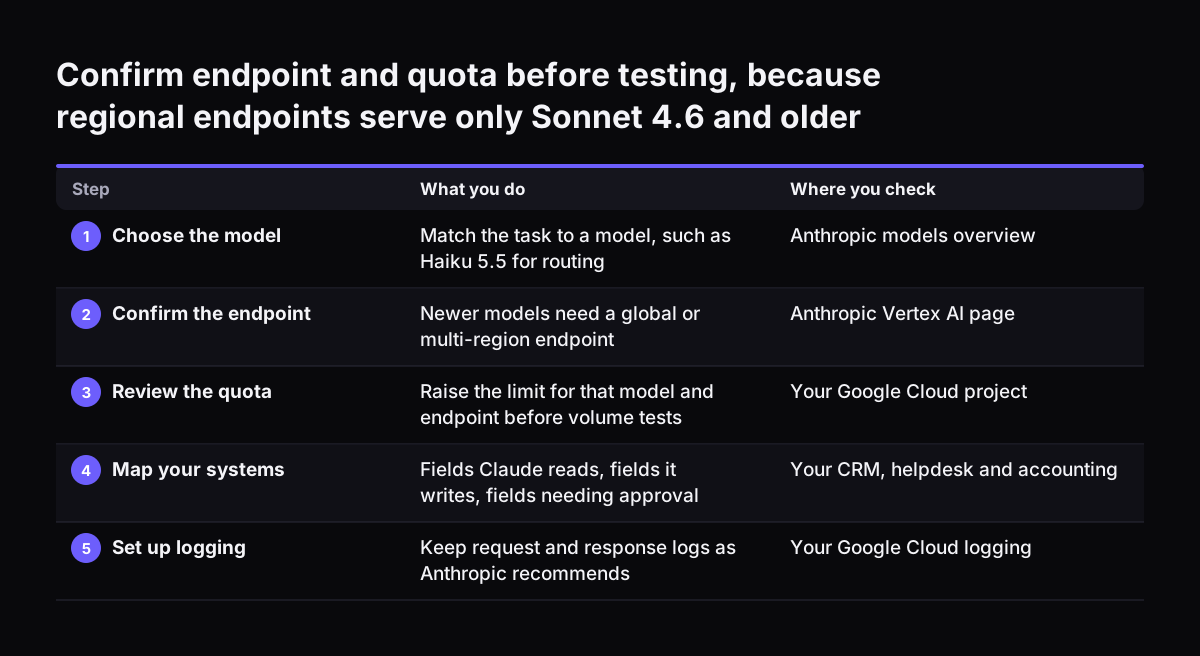
Start with one process, not a platform decision. Pick a task with a clear input and output, such as routing support tickets or extracting invoice fields. Then work through these steps:

  1. Choose the model for the task, using Anthropic's models overview.
  2. Check that the model is offered on the endpoint type and region you need.
  3. Review the Google Cloud quota for that model before testing at volume.
  4. List the systems Claude must read and write, and which fields need approval.
  5. Set up logging that keeps at least 30 days of requests and responses.
  6. Decide whether staff also need the Claude apps alongside the Vertex AI agent.

If you want help with the integration side, Svennis works in four steps: a Workshop, then Pilot Claude A (an AI agent on Claude for one process) or Pilot Claude B (Claude Team for the whole team), then the department Activation, then monthly operations. Our guide on what Claude for business costs and how to start sets out the prices. To see which processes others start with, browse AI by business task.

Confirm endpoint and quota before testing, because regional endpoints serve only Sonnet 4.6 and older. What you do / Where you check. 1. Choose the model: Match the task to a model, such as Haiku 5.5 for routing / Anthropic models overview; 2. Confir

Sources

  1. Claude Models on Google Cloud (Google managed), Claude Platform Docs
  2. Pricing, Claude Platform Docs
  3. Models overview, Claude Platform Docs
  4. Newsroom, Anthropic
Free, 30 minutes

Pick a time. Bring the process this article made you think of.

You leave with a clear yes or no on putting Claude on it, and the step that fits from our published prices. You speak to someone who builds the agents, not a salesperson.

Prefer to call? +44 7588 772736 · Not ready to talk? See it on your business first.

30 minutes · video call · free
  1. 1Time
  2. 2Details
  3. 3Booked