
Skip to content
SVENNISAIWe speak Claude.
Blog · Amazon Bedrock

Claude on Amazon Bedrock for a UK business: when it makes sense and how to set it up

A guide for UK businesses already on AWS: when Claude on Amazon Bedrock is the right route, which endpoint keeps data routing in the EU, and what to set up first.

10 min read

Book a 30-minute call · with a Claude Certified Architect from our team.

Article · 10 min read
Abstract layered planes with a single path routed through a bounded regional zone

Claude on Amazon Bedrock: when it beats calling Anthropic directly

Claude on Amazon Bedrock is the better route for a UK business that already runs on AWS. It suits a company that wants Claude inside its AWS account, under its existing access controls, with a regional endpoint that keeps data routing in the EU. Call Anthropic directly instead when you need server-side tools such as web search, because Bedrock does not support them.

Amazon Bedrock is the AWS-operated service through which you call Claude with your AWS credentials. Anthropic's own documentation says that calling Claude through Bedrock "slightly differs" from calling the Claude API directly. The model is the same family. The access, the feature set and the routing options are not.

A third route now sits between the two. Anthropic's models overview lists Claude Platform on AWS as a separate platform for its latest models. This guide compares all three routes and then sets out the choice of model and region.

The guide also covers what in-region use means for data location, and the IAM and logging work to finish before the first request. It ends with how to connect Claude on Bedrock to your CRM and helpdesk.

If you are new to the model itself, start with our plain guide to what Claude is, then come back here.
Three routes to Claude for an AWS customer, compared

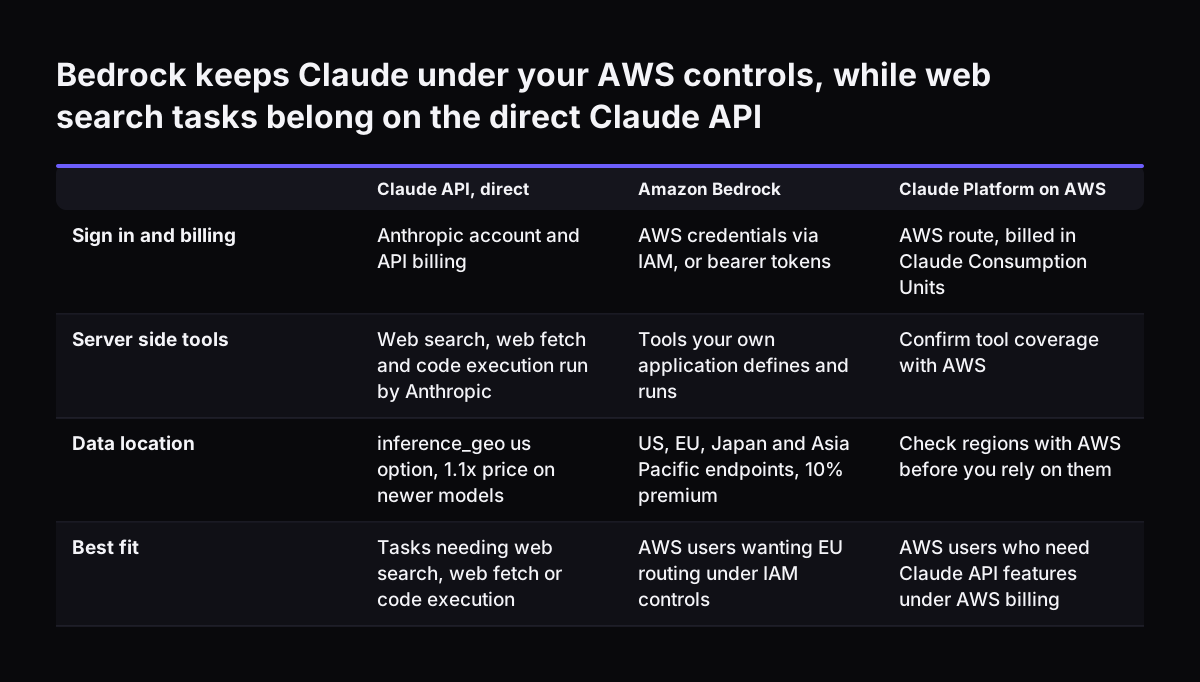
An AWS customer has three ways to run Claude: the Claude API from Anthropic, Amazon Bedrock, and Claude Platform on AWS. They differ in how you sign in and pay, which tools work, and how you control where data is processed.

RouteOperated bySign-in and billingServer-side toolsLocation controls
Claude API, directAnthropicAnthropic account and API billingWeb search at $10 per 1,000 searches; web fetch at no extra costinference_geo: "us", with a 1.1x price multiplier on newer models
Amazon BedrockAWSAWS credentials or bearer tokensNot supported: code execution, web search, web fetch, advisorRegional endpoints for the US, EU, Japan and Asia-Pacific, at a 10 percent premium
Claude Platform on AWSListed by Anthropic as a separate platformBilled in Claude Consumption Units at $0.01 eachCheck the platform documentation before you rely on themCheck its regions with AWS

The table shows the trade-off. Bedrock gives you the tightest fit with AWS and explicit regional routing, but fewer features. The Claude API gives you the full set of server-side tools, under an Anthropic account.

Claude Platform on AWS bills in Claude Consumption Units. A Claude Consumption Unit (CCU) is the billing unit into which token usage is converted, priced at $0.01 per CCU, according to Anthropic's pricing page.

Bedrock keeps Claude under your AWS controls, while web search tasks belong on the direct Claude API. Claude API, direct / Amazon Bedrock / Claude Platform on AWS. Sign in and billing: Anthropic account and API billing / AWS credentials via IAM, or b

Which Claude models Bedrock offers, and how to check your region

Bedrock offers Anthropic's current models, including Claude Fable 5.2, Claude Opus 5.5, Claude Sonnet 5.5 and Claude Haiku 5.5. Anthropic's models overview lists Amazon Bedrock as a platform for its latest models, alongside its own API. Availability still differs by place. The Bedrock documentation states plainly that "Anthropic model availability varies by region".

Anthropic's guidance on choosing a model maps well to business work:

  • Claude Opus 5.5 is the default when you are unsure which model to use.
  • Claude Fable 5.2 is for demanding reasoning and long-horizon agentic work.
  • Claude Haiku 5.5 is for high-volume, latency-sensitive tasks such as classification, extraction and routing.

Our post on when Claude Opus 5.5 is worth it for business goes deeper on that choice.

Lifecycle dates need a separate check on Bedrock. Anthropic says Claude Opus 5.5 will not retire sooner than 22 September 2027 on its own API. On Bedrock, "lifecycle dates on partner-operated platforms are set by the partner and can differ from the Claude API schedule." Read the AWS date, not the Anthropic one, when you plan a system's life.

Context windows also vary on Bedrock. The newer models have a 1M-token context window there. Older models such as Sonnet 4.5 and Sonnet 4 have 200k tokens, and both are deprecated. A deprecated model stays callable for organisations with existing access but is closed to new adopters.

Global and regional Bedrock endpoints, and the model IDs each needs

Bedrock offers two endpoint types for every Claude model from Sonnet 4.5 onwards: global and regional. The type you choose decides where requests may be processed, what you pay and which model ID you send.

Global endpoints

A global endpoint routes each request dynamically to whichever region has capacity. It gives maximum availability and carries no pricing premium. It gives no promise about which country processes your data.

Regional endpoints

A regional endpoint guarantees that data is routed through a specific geographic region. AWS calls this cross-region inference (CRIS): the request may move between regions, but only within the area you chose. The Bedrock documentation says regional endpoints are required for data residency and compliance requirements. They are available for the US, EU, Japan and Asia-Pacific. They cost 10 percent more than global endpoints.

Inference profile IDs

An inference profile ID is the base model ID with a regional or global prefix. Anthropic's models overview gives global.anthropic.claude-fable-5-2 as the global Bedrock ID for Claude Fable 5.2. AWS offers newer Claude models only through cross-region inference. A request that passes the base model ID, with no prefix, fails with an HTTP 400 error.

If your test call returns HTTP 400, check the prefix before you check anything else.

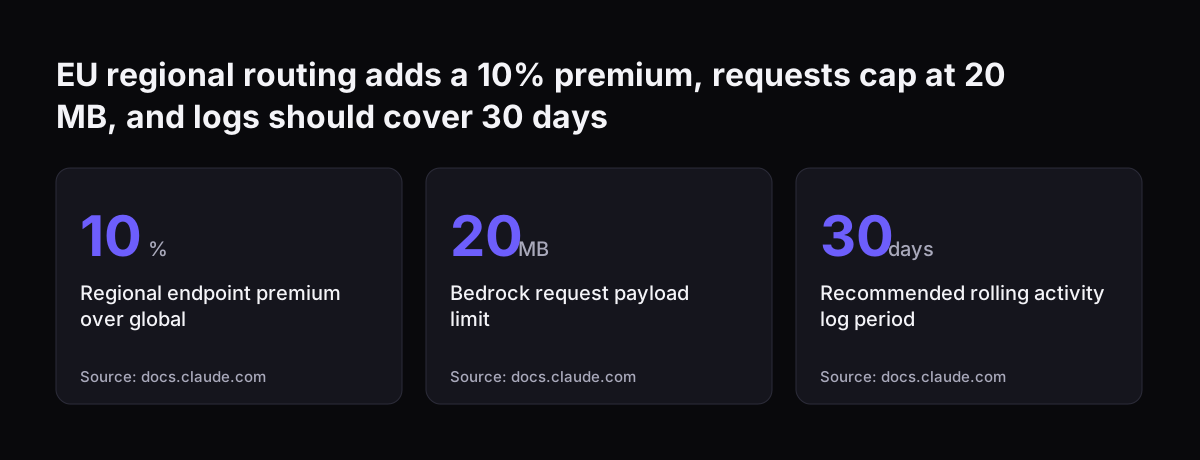
EU regional routing adds a 10% premium, requests cap at 20 MB, and logs should cover 30 days: Regional endpoint premium over global 10 %, Bedrock request payload limit 20 MB, Recommended rolling activity log period 30 days
Source: docs.claude.com

What in-region Bedrock use means for data location in a UK business

For a UK business, in-region Bedrock use means choosing the EU regional endpoint, so that requests are routed only through EU regions. The Bedrock documentation lists regional endpoints for the US, EU, Japan and Asia-Pacific. It does not list a UK-only endpoint. If your contracts or your data protection assessment require processing in the UK itself, Bedrock's documented options do not give you that.

Claude Platform on AWS is a separate route to weigh. Anthropic's models overview lists it as a platform for its latest models, but the documentation cited here does not list its regions. Ask AWS where it processes requests before you assume UK processing. Whoever leads data protection in your business, your DPO if you have one, should then weigh the routing options against your processing.

The global endpoint is the cheaper Bedrock option. It suits work that holds no personal data, such as drafting product copy from public information. For tickets, customer records or staff data, plan on the regional endpoint and its 10 percent premium from the start.

Routing is only one part of compliance. You still need a lawful basis, a record of processing and an assessment of the risk. The articles that apply are set out in our annotated guide to UK GDPR for AI. This post does not repeat them.

IAM access and logging to set up before the first Claude request on Bedrock

Set up access control and logging before anyone sends Claude a real record. Both are much harder to add once an agent is live and people depend on it.

Start with the tooling. Anthropic's Bedrock guide requires the AWS CLI at version 2.13.23 or newer. Then choose how the application will authenticate. Bedrock accepts your AWS credentials, managed through IAM, the AWS service that controls who may do what.

Bedrock also accepts bearer tokens instead of AWS credentials. IAM credentials fit the access controls your AWS team already runs. A bearer token is simpler but is one more secret to rotate and store.

Give each application its own identity with the narrowest permission it needs. A ticket-triage agent needs to call one model. It does not need to create or change anything else in your AWS account.

Then switch on logging. Anthropic recommends that you log your activity on at least a 30-day rolling basis, both to understand your usage and to investigate potential misuse. Keep those logs in the AWS logging you already operate, so your existing reviews cover Claude too.

At Svennis we write the access policy and switch on logging before the first test ticket goes through, not after. Teams that start without logs cannot later show what an agent read or changed when a customer asks.

Claude features that Bedrock does not offer, and how to work around them

Bedrock does not support Anthropic's server-side tools. The Bedrock documentation names four: code execution, web search, web fetch and advisor. A server-side tool is one that Anthropic runs for you inside the API call, so your own code does not have to.

The gap matters for some business tasks and not others. A research agent that searches the web for competitor news needs web search. On Bedrock, you would have to build the search step yourself or move that one task to the Claude API. A triage or extraction agent that works only on your own records loses nothing.

Documents are well supported. PDF support is available on Bedrock through both the Converse API and the InvokeModel API. One limit applies to everything you send: Bedrock caps request payloads at 20 MB. A long contract bundle or a ticket with large attachments can exceed that. Split the document or send only the pages Claude needs.

The rest of the core works the same way on every route. Anthropic states that all current models support text and image input, vision, multilingual use and tool use. Tool use is how Claude calls your CRM or helpdesk through code that you control. That is the basis of every integration later in this guide.

Worked example: a ticket-triage agent on Bedrock in front of Zoho Desk

A worked example makes the settings concrete. Take a UK company that runs on AWS and handles customer support in Zoho Desk. It wants Claude to read each new ticket, pick a category and team, and write that back to the ticket.

  1. Model. Claude Haiku 5.5, because Anthropic positions it for classification and routing at high volume.
  2. Region check. Confirm Claude Haiku 5.5 is offered on Bedrock where you plan to run it, since availability varies by region.
  3. Endpoint. The EU regional endpoint, because tickets contain names and email addresses. Budget the 10 percent premium.
  4. Model ID. The inference profile ID with the EU prefix, taken from the documentation on the day. A base model ID returns HTTP 400.
  5. Access. One IAM identity for the triage application, allowed to call that model and nothing else.
  6. Logging. At least 30 days of rolling logs, switched on before the first test.
  7. Tools. Two tools in your own code: one reads the ticket from Zoho Desk, one writes the category and team back.
  8. Attachments. PDFs go through the Converse API, within the 20 MB payload limit.

Nothing in that list needs a server-side tool, so Bedrock's gaps do not apply. Test with a week of past tickets before you let the agent write to live ones. Compare its routing with what your team actually did.

Connecting Claude on Bedrock to your CRM and helpdesk

Claude on Bedrock reaches your CRM and helpdesk through tool use. Your application defines the tools, runs them against the other system and returns the result to Claude. The connection lives in code or in a service you run.

There are two common patterns. The first is a set of tools written for one system, such as reading and updating deals in Zoho CRM. The second is an MCP server, a standard interface that exposes a system's actions to Claude.

An MCP server suits a company that wants several systems behind one interface that IT manages. If your staff use Cowork, our page on Claude Cowork for UK firms explains what it does.

When we connect Claude to a company's programs, we build one of four things for each connection: a connector, an MCP server, a plugin or a skill. We show you the options with their cost, and you choose. The choice usually turns on three questions:

  • How many systems Claude must reach.
  • Who will maintain the connection after launch.
  • Whether permissions must follow each user or one service account.

Budgeting Claude on Bedrock: the cost lines to check

Claude on Bedrock costs tokens, with a 10 percent premium if you use a regional endpoint. Tokens are the pieces of text that models process, counted on both input and output. Anthropic publishes its own API list prices per million tokens:

  • Claude Opus 5.5: $4 input, $20 output.
  • Claude Sonnet 5.5: $2 input, $10 output.
  • Claude Haiku 5.5: from $0.10 input, from $0.50 output.

Those are Anthropic's figures for its own API. Confirm Bedrock's rates for your chosen region in AWS before you commit to a budget.

Two further points change the count of tokens you pay for. Claude 4.7 and later models use a newer tokenizer that produces about 30 percent more tokens for the same text. An estimate built on an older model will come in low. Also, Claude 4.6 and later models include the full 1M-token context window at standard pricing, except Claude Haiku 5.5. Long documents therefore do not carry a separate long-context rate on those models.

Model choice moves the bill more than anything else. A triage agent on Claude Haiku 5.5 costs a fraction of the same agent on Claude Opus 5.5. For seat plans and API costs in pounds, see our Claude pricing guide for the UK.

Next steps for a UK business already on AWS

The next step is to decide which of your tasks need Bedrock and which do not. Most companies end up with a mix. Work through this order:

  1. List the tasks you want Claude to do, and mark which ones touch personal data.
  2. Mark any task that needs web search, web fetch or code execution. Those belong on the Claude API.
  3. For the rest, check model availability in your AWS region and pick global or EU regional endpoints.
  4. Set up IAM access and at least 30 days of rolling logs before the first test.
  5. Choose one process, such as ticket triage, and run it on past data for a week.
  6. Ask your data protection officer to review the routing against your UK GDPR assessment.

If you want help with the build, our work follows four steps. The Workshop maps your processes. Pilot Claude A puts an AI agent on Claude to work on one process, and Pilot Claude B rolls out Claude Team to the whole team. The department Activation follows, then monthly operations. Our guide to what Claude for business costs and how to start sets out each step.

Sources

  1. Claude on Amazon Bedrock, Claude Platform Docs (Anthropic)
  2. Pricing, Claude Platform Docs (Anthropic)
  3. Models overview, Claude Platform Docs (Anthropic)
Free, 30 minutes

Pick a time. Bring the process this article made you think of.

You leave with a clear yes or no on putting Claude on it, and the step that fits from our published prices. You speak to someone who builds the agents, not a salesperson.

Prefer to call? +44 7588 772736 · Not ready to talk? See it on your business first.

30 minutes · video call · free
  1. 1Time
  2. 2Details
  3. 3Booked