
Svennis AI
10 min read

Claude Haiku 4.5 for business: fast, cheap work and when to step up

Claude Haiku 4.5 handles ticket triage, field extraction and CRM summaries at $1 per million input tokens. Here is where it fits, what it costs and when to step up.

Abstract cover of many small shapes moving quickly along parallel paths toward one larger converging form

Claude Haiku 4.5 for business: fast, cheap work with clear rules

Claude Haiku 4.5 for business: fast, cheap work with clear rules is where it fits best. Use it to sort incoming tickets, pull fields out of invoices, draft first replies for a person to check and summarise long CRM threads. Step up to a larger Claude model when a job needs long multi-step reasoning, more than 200K tokens of input, or knowledge after early 2025.

Claude Haiku 4.5 is Anthropic's fastest and lowest-priced current model, and the latest in its Haiku line. Anthropic released it on 15 October 2025 and describes it as "the fastest model with near-frontier intelligence". It costs $1 per million input tokens and $5 per million output tokens on the Claude API.

At launch, Anthropic said it matched the coding performance of an older Sonnet model at one third of the cost and more than twice the speed. That comparison is with an earlier generation of Claude, not with today's Sonnet 5. It tells you the small model is capable, not that it replaces the current larger ones.

This guide comes from a team that builds Claude systems on top of Zoho. It covers the tasks Haiku 4.5 handles well, a worked example with real settings, a cost calculation from published prices, the point where you should switch models, and where your data goes if you are in the UK or the EU.
Claude Haiku 4.5 specifications: context, output, thinking and price

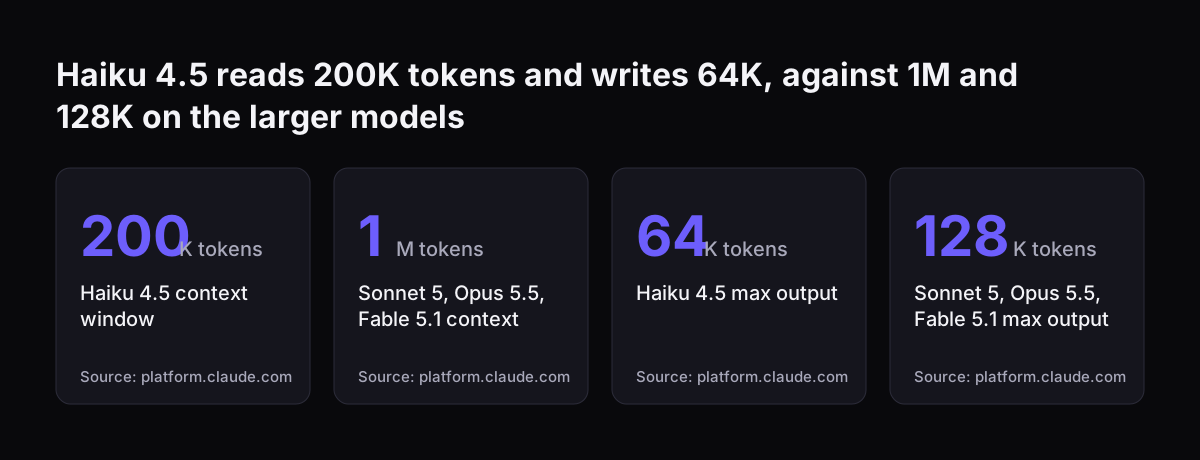
Claude Haiku 4.5 reads up to 200K tokens and writes up to 64K tokens per request. A token is a piece of text the model processes. In English, one token is roughly 4 characters or 0.75 words, so 200K tokens is around 150,000 words.

The model takes text and images as input and produces text. It supports extended thinking, which lets the model reason step by step before it answers, within a token budget you set. You switch this on manually with thinking.type: "enabled". Haiku 4.5 does not use adaptive thinking and does not support the effort parameter, the setting that trades intelligence for speed and cost on the larger models.

The table sets Haiku 4.5 against the other current models, using Anthropic's models overview.

ModelContext windowMax outputThinkingReliable knowledge cutoffInput / output per million tokens
Claude Haiku 4.5200K64KExtended (manual)February 2025$1 / $5
Claude Sonnet 51M128KAdaptiveJanuary 2026$2 / $10
Claude Opus 5.51M128KAdaptive (always on)June 2026$4 / $20
Claude Fable 5.11M128KAdaptive (always on)June 2026$10 / $50

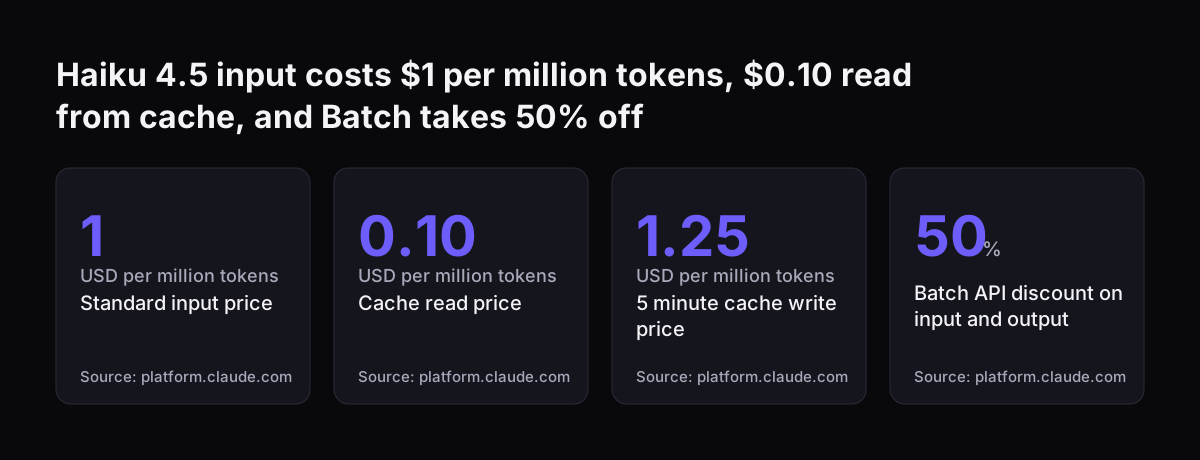
Two discounts apply to Haiku 4.5. The Batch API, which processes large volumes of requests asynchronously, halves both input and output prices. Prompt caching reuses a repeated part of a prompt across calls, and a cache read costs $0.10 per million tokens. All prices on Anthropic's pricing page are in US dollars.

Business tasks that Claude Haiku 4.5 handles well

Claude Haiku 4.5 suits high-volume jobs where the rules are clear and a wrong answer is cheap to catch. Anthropic's guide on choosing a model recommends starting with it for prototyping, tight latency, cost-sensitive work and high-volume straightforward tasks. The launch announcement names chat assistants and customer service agents.

In a small or mid-sized business, these jobs usually fit Haiku 4.5:

  • Classifying and routing incoming email or tickets to the right team, with a priority and a product tag.
  • Extracting fields from invoices, order forms or delivery notes, including scanned pages, since the model reads images.
  • Drafting first-line replies that a person reads and sends, not replies that go out unchecked.
  • Summarising long threads, such as a customer's history before a call or a ticket before handover.
  • Doing the bulk steps as a sub-agent while a larger model plans the work and makes the decisions.

Each of these jobs has a narrow input, a defined output and a person or a rule downstream. That structure is what makes a small model safe to use. The same model left to decide an open question on its own is a different proposition.

In a Zoho setup, the tickets usually live in Zoho Desk and the customer records in Zoho CRM. Haiku 4.5 works on the text these systems hold and hands structured results back to them.

Worked example: triaging Zoho Desk tickets with Claude Haiku 4.5

Ticket triage with Claude Haiku 4.5 means one call per incoming ticket, returning a department, a priority and a one-line summary. Here is how the pieces fit together.

  1. Trigger. A new ticket in Zoho Desk fires your integration, which collects the subject, the body and any attached screenshot.
  2. Fixed instructions. The prompt starts with the same block every time: your list of departments, what each one handles, your priority rules and the exact output format.
  3. Model call. The integration calls the Claude API with the pinned model id claude-haiku-4-5-20251001. Extended thinking stays off, because sorting a ticket against a fixed list rarely needs it.
  4. Structured answer. The model returns the department, priority, product and summary in the format you asked for.
  5. Write-back and fallback. The integration writes these fields to the ticket. If the answer does not match an allowed department, the ticket goes to a person.

The fixed instruction block matters for cost as well as quality. Because it is identical on every call, you can cache it and pay the cache read price instead of the full input price. The next section works out what that saves.

Routing is the step where triage succeeds or fails. We describe a production version in our guide to a Teams service desk in front of Zoho Desk, which covers the routing rules in more detail.

Cost of Claude Haiku 4.5 for 10,000 tickets a month

Triaging 10,000 tickets a month with Claude Haiku 4.5 costs about $30 at standard Claude API prices. This example assumes 2,000 input tokens per ticket, roughly 1,500 words of instructions and ticket text, and 200 output tokens per answer.

The arithmetic uses only Anthropic's published prices. Input is 20 million tokens at $1 per million, so $20. Output is 2 million tokens at $5 per million, so $10.

SetupInput costOutput costMonthly total
Standard API$20.00$10.00$30.00
Batch API (50% off both)$10.00$5.00$15.00
Standard, 1,500-token instructions cached$6.50$10.00$16.50 plus cache writes

The cached row splits input into 15 million cached tokens at $0.10 per million ($1.50) and 5 million uncached tokens at $1 ($5). Each time the cache is refreshed you pay a write at $1.25 per million tokens for a five-minute cache. The Batch API suits work that can wait, such as overnight summaries, not live triage.

The same volume at standard prices would cost $60 on Claude Sonnet 5, $120 on Claude Opus 5.5 and $300 on Claude Fable 5.1. Anthropic's pricing page also notes that the tokenizer in newer models produces about 30% more tokens for the same text. On those models the real gap may be wider.

Haiku 4.5 input costs $1 per million tokens, $0.10 read from cache, and Batch takes 50% off: Standard input price 1 USD per million tokens, Cache read price 0.10 USD per million tokens, 5 minute cache write price 1.25 USD per million tokens, Batch AP
Source: platform.claude.com

When to step up from Claude Haiku 4.5 to a larger Claude model

Move off Claude Haiku 4.5 when the task needs judgement across many steps, input beyond 200K tokens, output beyond 64K tokens, or knowledge from after February 2025. Price is rarely the reason to stay small if the answers are wrong. A cheap wrong answer that a person must fix costs more than a correct one.

TaskStart withReason
Routing tickets or email to a fixed listClaude Haiku 4.5Narrow input, defined output, high volume
Extracting fields from invoices or formsClaude Haiku 4.5Reads text and images, output is checked against a schema
Summarising one customer's threadClaude Haiku 4.5Fits well inside 200K tokens
Everyday drafting and analysis across toolsClaude Sonnet 51M context and more recent knowledge
Long-running agentic work across systemsClaude Opus 5.5Built for long-running agentic coding and knowledge work
Demanding reasoning where Opus 5.5 falls shortClaude Fable 5.1Anthropic's most capable model open to all customers

Anthropic's own models overview says that if you are unsure, most workloads start with Claude Opus 5.5. Its choosing guide adds that an efficiency-first approach starting with Haiku 4.5 can be optimal for high-volume, straightforward work. Both are true: pick by task, not by habit.

For the middle ground, read our guide to Claude Sonnet 5 as the everyday business model. For the heavier steps, our post on when to use Claude Opus 5.5 covers which work justifies it.

Haiku 4.5 reads 200K tokens and writes 64K, against 1M and 128K on the larger models: Haiku 4.5 context window 200 K tokens, Sonnet 5, Opus 5.5, Fable 5.1 context 1 M tokens, Haiku 4.5 max output 64 K tokens, Sonnet 5, Opus 5.5, Fable 5.1 max output
Source: platform.claude.com

Pairing Claude Haiku 4.5 with a larger model as a sub-agent

A sub-agent is a smaller model that carries out individual steps while a larger model plans the work and decides what happens next. Anthropic calls these multi-model strategies. Most tokens are billed at the lower rate, while the hard decisions still go to the stronger model.

Anthropic's choosing guide names two common patterns:

  • Executor and advisor. The lower-cost model does the work and escalates to a frontier model when a case is unclear.
  • Orchestrator and workers. The frontier model splits a problem into steps and delegates them to lower-cost workers.

The Haiku 4.5 announcement describes the second pattern directly. A larger model breaks a complex problem into multi-step plans. It then orchestrates several Haiku instances to complete the subtasks in parallel.

In business terms, picture a month-end review of open support tickets. Haiku 4.5 summarises each ticket and extracts the product, the customer and the age. A larger model reads those short summaries, groups the recurring problems and drafts the report for a manager.

The executor pattern fits triage well. Haiku 4.5 handles the clear tickets. Anything it cannot place with confidence goes either to a larger model or straight to a person, depending on how much a wrong route costs you.

Claude Haiku 4.5 knowledge cutoff: give it current facts in the prompt

Claude Haiku 4.5 has a reliable knowledge cutoff of February 2025, the point up to which Anthropic says its knowledge is dependable. Its training data runs to July 2025. Anything newer, and some things older, the model either does not know or may get wrong.

That gap matters for three kinds of business content:

  • Products. Your own catalogue, and any software release since early 2025.
  • Prices. Your price list, supplier costs and exchange rates.
  • Rules and law. Regulations, tax rates and internal policies that have changed.

The fix is to supply the facts in the prompt rather than rely on the model's memory. For triage, that means your current department list and product names sit in the fixed instruction block. For drafted replies, it means the relevant help article or price record is passed in with the ticket.

The larger current models have later cutoffs: January 2026 for Claude Sonnet 5 and June 2026 for Claude Opus 5.5 and Claude Fable 5.1. Even so, the principle holds for every model. If a figure or a rule must be right, it belongs in the prompt, pulled from the system that owns it.

Claude Haiku 4.5 lifecycle: pin the model id and plan for the successor

Claude Haiku 4.5 is listed as Active (latest), and Anthropic says it will not be retired sooner than 15 October 2026. That is a floor, not a scheduled date. Anthropic gives at least 60 days' notice before it retires a publicly released model, and requests to a retired model fail.

A successor is on the way. Anthropic's Opus 5.5 announcement, published on 22 September 2026, says a new Haiku model will follow in the coming weeks. It gives no date.

Three habits keep you ready:

  • Pin the dated id. The alias claude-haiku-4-5 resolves to the snapshot claude-haiku-4-5-20251001. Using the dated id makes the model you run explicit.
  • Keep the prompt portable. Put instructions, lists and output formats in one place, so a new model runs the same prompt.
  • Know where the model is used. The Claude Console Usage page exports a CSV broken down by API key and model.

At Svennis we keep a set of real, anonymised tickets with the correct department next to every triage prompt we build. When a new model arrives, switching becomes a test run against that set, not a guess. Anthropic's choosing guide makes the same point: a good evaluation set is the most important step in deciding whether to change models.

Retirement dates on Anthropic's page apply to the Claude API, Claude Platform on AWS and Microsoft Foundry. Amazon Bedrock and Google Cloud set their own schedules.

Where Claude Haiku 4.5 processes data for UK and EU businesses

On Anthropic's own Claude API, your Claude Haiku 4.5 data is stored at rest in the US. The workspace geo setting controls where data is stored, and "us" is currently the only option. Anthropic does not offer EU or UK residency itself.

Inference, the step where the model actually runs, defaults to "global" on the Claude API. That means it may run in any available geography. The inference_geo parameter, which restricts this, is not supported on Haiku 4.5; a request that includes it returns a 400 error.

For EU processing, the route is a cloud provider. Amazon Bedrock offers three routing options:

  • In-Region: requests never leave the AWS Region you specify.
  • Geographic: requests stay within a defined geography, such as the EU, and prompts and outputs may move within it but not outside.
  • Global: requests may go to any supported commercial Region worldwide.

Check the Amazon Bedrock regional availability page for which options it lists for Haiku 4.5 before you build. The geographies it names are the US, EU, Japan and Australia, with no UK geography, so a UK business should not assume data stays in the UK. Bedrock cross-Region inference is priced at source Region rates with no routing surcharge.

Before any personal data goes through the model, work through our GDPR checklist for Claude. For the wider legal picture, see what AI law applies to a UK business.

Next steps: test Claude Haiku 4.5 on one task you already run

Start with one task you already do by hand, at volume, with a clear right answer. Ticket routing and invoice field extraction are the usual candidates. Leave open-ended judgement for later.

  1. Collect examples. Pull a sample of real tickets or documents and record the correct answer for each.
  2. Write the fixed instructions. List the allowed categories or fields and the exact output format, using your current names and rules.
  3. Run Haiku 4.5 on the sample. Use the pinned id claude-haiku-4-5-20251001, extended thinking off, and compare its answers with yours.
  4. Decide on the evidence. If the error rate is acceptable, keep Haiku 4.5. If it fails on hard cases, add an escalation step or run the same set on Claude Sonnet 5.
  5. Settle where the data goes. Choose the Claude API or a cloud route before real customer data flows.

Then connect the result to the system that holds the work, so the answer lands on the ticket or record without copying and pasting. Our guide to putting Claude inside the tools you already use shows how that connection works for a small team.

Sources

  1. 1. Introducing Claude Haiku 4.5 (Anthropic)
  2. 2. Claude Haiku 4.5 (Claude Platform Docs)
  3. 3. Models overview (Claude Platform Docs)
  4. 4. Choosing the right model (Claude Platform Docs)
  5. 5. Pricing (Claude Platform Docs)
  6. 6. Model deprecations (Claude Platform Docs)
  7. 7. Data residency (Claude Platform Docs)
  8. 8. Introducing Claude Opus 5.5 (Anthropic)
  9. 9. Regional availability by models (Amazon Bedrock)

Related articles