
Svennis AI
10 min read

Claude Fable 5.1: most capable model and its limits inside Zoho and Teams

Fable 5.1 costs $10 and $50 per million tokens, always thinks before it answers and stores API data in the US. What those limits change when it runs inside Zoho Desk and Teams.

Abstract layered shapes rising in steps, one tall form above two lower ones, suggesting a tiered set of models

Claude Fable 5.1 is Anthropic's most capable model, with practical limits

Claude Fable 5.1 is Anthropic's most capable generally available model. Anthropic released it on 1 September 2026 for demanding reasoning and long-horizon agentic work. Its limits are practical ones. It costs $10 per million input tokens and $50 per million output tokens.

Fable 5.1 always thinks before it answers. It is not on the Free plan, and Anthropic's own API stores data in the US.

This post is one of three on the current Claude models. Claude Opus 5.5 for business covers the model Anthropic recommends starting with for most workloads. Claude Sonnet 5 as the everyday business model covers the cheaper workhorse. Fable 5.1 sits above both of them.

Anthropic's models overview gives a clear rule for when to reach for Fable 5.1. You use it when your evals on Opus 5.5 at higher effort still fall short. Evals are your own tests of a model on your real tasks, with answers you can check.

This guide looks at Fable 5.1 from the delivery side rather than from benchmark tables. It covers what its limits change when the model sits inside Zoho, Microsoft Teams and the other systems a business already runs.
Fable 5.1, Opus 5.5 and Sonnet 5 compared on price, effort and knowledge cutoff

Fable 5.1, Opus 5.5 and Sonnet 5 share a 1M-token context window and a maximum output of 128K tokens, so size does not separate them. Price, default effort and knowledge cutoff do. A token is a piece of text of roughly four characters, or 0.75 words, in English. All prices below are in USD, per million tokens.

ModelInputOutputDefault effortReliable knowledge cutoff
Claude Fable 5.1$10$50highJune 2026
Claude Opus 5.5$4$20mediumJune 2026
Claude Sonnet 5$2$10highJanuary 2026

Effort is the setting that controls how deeply the model reasons before it answers. Adaptive thinking is the only thinking mode on Fable 5.1, and it is always on. You steer its depth with effort, which defaults to high.

Anthropic's newsroom states that Opus 5.5 performs at the level of Fable 5.1 on most work. That one sentence is the strongest reason to treat Fable 5.1 as the exception in your systems rather than the default. At Fable 5.1 prices, output costs two and a half times the Opus 5.5 rate and five times the Sonnet 5 rate.

What Fable 5.1 costs per token, and how batching and caching lower it

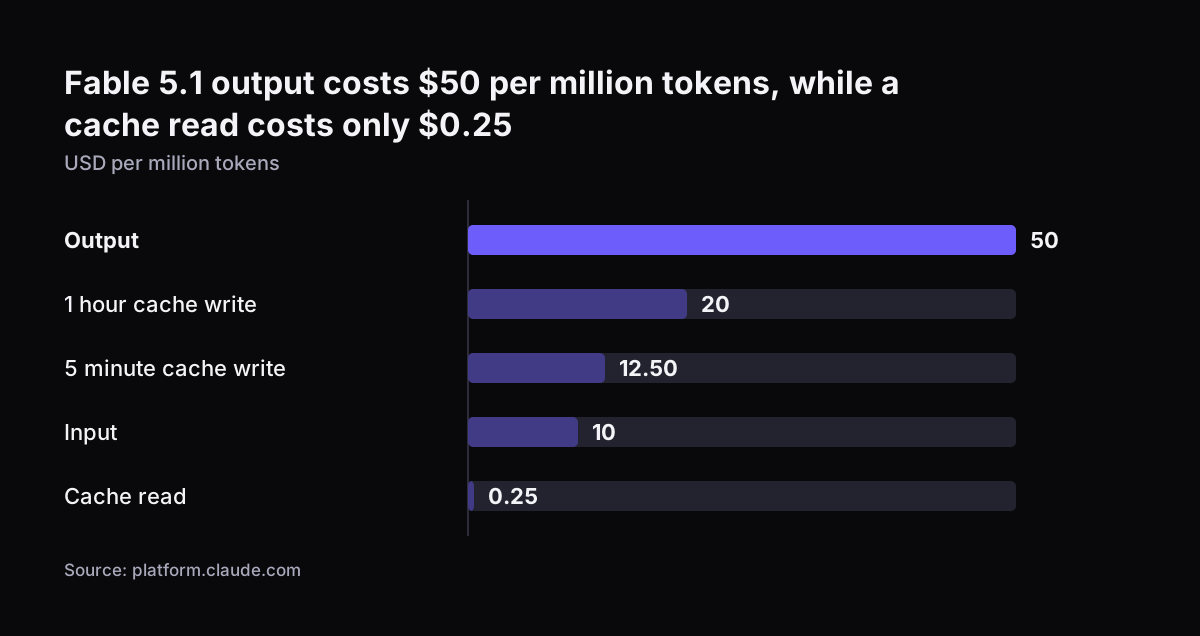
Fable 5.1 costs $10 per million input tokens and $50 per million output tokens on the Claude API. These are the same input and output prices as the previous Fable model. The change is in cache reads, which now cost $0.25 per million tokens, 75% less than before.

Prompt caching is a feature that reuses already processed parts of a prompt across API calls. A 5-minute cache write for Fable 5.1 costs $12.50 per million tokens, and a 1-hour write costs $20. A service desk sends the same long instructions and knowledge base with every request. For that kind of system, caching is where most of the saving sits.

The Batch API processes large volumes of requests asynchronously at a 50% discount on input and output. It suits work that can wait for results, such as an overnight analysis. It does not suit a live chat in Teams, where someone waits for an answer.

Anthropic puts the saving against the previous Fable model at around 25% for typical workloads. For complex coding and highly agentic tasks it says the saving could reach around 45%.

One surcharge matters for European buyers. If you pin inference to the US with inference_geo: "us", every token category costs 1.1 times the standard rate. That covers input, output, cache writes and cache reads.

Fable 5.1 output costs $50 per million tokens, while a cache read costs only $0.25: Output 50, 1 hour cache write 20, 5 minute cache write 12.50, Input 10, Cache read 0.25 (USD per million tokens)
Source: platform.claude.com

Worked example: a Teams service desk on Zoho Desk that saves Fable 5.1 for one step

A Teams service desk is the clearest case for using Fable 5.1 on one step only. Picture an assistant in Microsoft Teams that turns staff messages into tickets in Zoho Desk. Routing each message is short and repetitive. Sonnet 5, at $2 input and $10 output per million tokens, handles it well.

Once a month, the team wants a review of every ticket. It should find recurring faults, gaps in the knowledge base and routing rules that need changing. That is multistep research over a large set of documents. Anthropic's Fable 5.1 documentation names multistep research as one of the areas where the model is stronger.

The setup, step by step:

  1. Route live Teams messages on Sonnet 5 at its default high effort.
  2. Export the month's tickets and send the review job through the Batch API.
  3. Cache the fixed instructions so each run reads them at the cached rate.
  4. Run the review on Opus 5.5 first, and keep it configured as the fallback.
  5. Switch the review to Fable 5.1 only if Opus 5.5 misses findings your team can name.

To put rough numbers on it, suppose the review reads 1 million tokens and writes 100,000. On Fable 5.1 that is $10 for input plus $5 for output, so $15. Through the Batch API it halves to $7.50. The same job on Opus 5.5 costs $6 before any discount. The gap is small for one monthly job and large for anything that runs on every ticket.

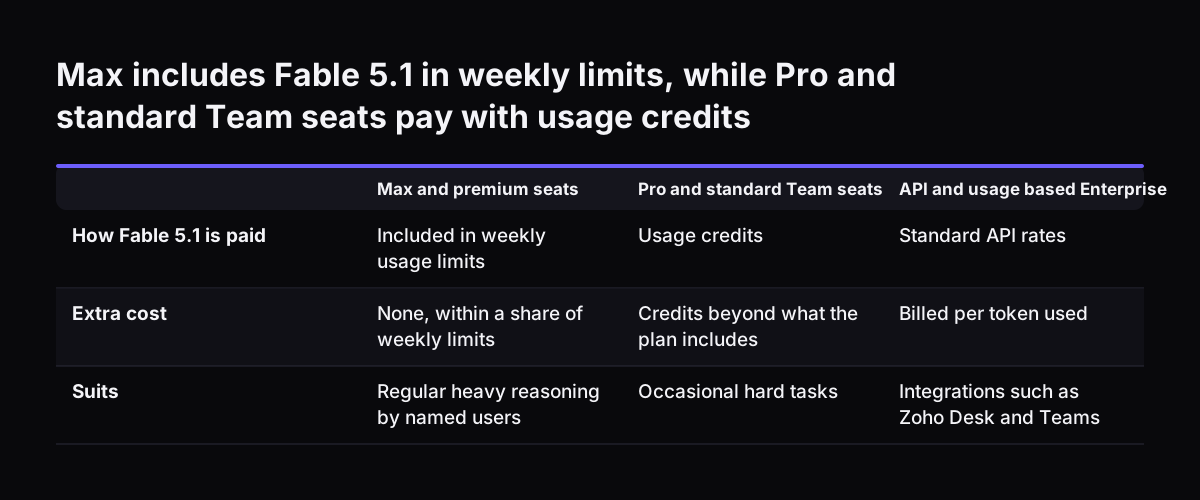
Fable 5.1 on Claude plans: included on Max, usage credits on Pro and Team

Fable 5.1 is available on the paid Claude plans: Pro, Max, Team and Enterprise. The Free plan is not among them. How you pay depends on the plan and the seat type. Usage credits are credits that let you pay for usage beyond what your plan includes.

The Claude Help Center sets out four cases:

  • Max plans, and premium seats on Team and seat-based Enterprise plans: included, up to 50% of weekly usage limits at no extra cost.
  • Pro plans and standard seats on Team plans: not in the usage limits, so Fable 5.1 runs on usage credits.
  • Standard seats on seat-based Enterprise plans: only if the organisation has enabled usage credits.
  • Usage-based Enterprise plans and the Claude API: billed at standard API rates.

Fable models also use up weekly limits faster than other Claude models. A heavy Fable 5.1 user on a Max plan will reach the limit sooner than a colleague on Sonnet 5. A launch promotion for the previous Fable model ended on 19 July 2026 and never covered Fable 5.1, so do not plan around it.

Fable 5.1 is available in Claude on the web, Mobile, Desktop, Cowork, Code, Design, Claude for Microsoft 365 and Claude Tag. Claude Code needs version 2.1.255 or later. If your staff work mainly in Outlook and Teams, our guide to connecting Claude in Microsoft 365 and Teams covers the systems behind it.

Max includes Fable 5.1 in weekly limits, while Pro and standard Team seats pay with usage credits. Max and premium seats / Pro and standard Team seats / API and usage based Enterprise. How Fable 5.1 is paid: Included in weekly usage limits / Usage cr

Fable 5.1 integration limits: forced tool use, thinking blocks and edited turns

Fable 5.1 brings three breaking changes for integrations, according to Anthropic's documentation. A tool is a function the model can call, such as "create ticket" in Zoho Desk or "look up contact" in Zoho CRM. The changes affect how those calls work:

  • Forced tool use returns an error. An integration that forces the model to call one specific tool must let the model choose instead.
  • Earlier models cannot read Fable 5.1's thinking blocks. A thread that hands over to an older model needs its own handling.
  • Editing earlier turns invalidates thinking blocks. Rewriting conversation history mid-thread breaks the reasoning trail.

Anthropic also closed a door for new API accounts. Accounts created from the Fable 5.1 announcement onwards can no longer manually edit Claude's prior context while keeping the transcript of its earlier thinking. The practical rule is simple: design flows that append to a conversation rather than rewrite it.

Some of the additive changes help business systems directly. Per-message effort, in beta, lets you change effort partway through a conversation without invalidating the prompt cache. Routine lookups can then run at low effort and one hard judgement at high effort. Readable progress updates between tool calls, also in beta, give staff something to watch during long agentic runs.

Security work: Fable 5.1 finds vulnerabilities but will not build exploits

Fable 5.1 can be used to discover software vulnerabilities, but not to develop exploits for them. Anthropic redirects penetration testing, exploit generation and binary-based vulnerability scanning to itsOpus models. Dual-use cybersecurity tasks are tasks that might have helpful or harmful applications, and this is where the safeguards sit.

Claude Mythos 5.1 is the same model as Fable 5.1 with different levels of safeguards. Mythos 5.1 is available only through Anthropic's trusted access programmes, by invitation as part of Project Glasswing. Anthropic says it is currently available only to a set of US organisations. For a UK or EU business, Fable 5.1 is the version you can actually use.

The practical effect is easy to state. An IT team reviewing its own code for weaknesses can use Fable 5.1 for that review. A request to prove a flaw by exploiting it will be refused or rerouted. Anthropic says Claude Code users can expect around 60% fewer interventions per session from its cyber safeguards, but fewer is not none.

Any security workflow built on Fable 5.1 therefore needs a refusal path. Decide in advance what happens when the model declines: a human picks up the task, or the step moves to another tool your team already trusts.

The June 2026 suspension shows why you keep a second Claude model configured

On 12 June 2026, Anthropic disabled the previous Fable model and its Mythos counterpart for all customers. In Anthropic's statement on the suspension, the company said the US government, "citing national security authorities", had issued an export control directive to suspend all access to both models by any foreign national. Anthropic wrote that it "must abruptly disable" them "for all our customers to ensure compliance". It added that access to all its other models would not be affected.

Anthropic's follow-up post on redeploying the previous Fable model says access was restored on 1 July 2026. For almost three weeks, any workflow wired only to that model had nothing to call. Workflows with another Claude model behind them kept running.

The lesson for a business is to keep a second model configured, so work does not stop if one becomes unavailable. At Svennis we set up every Claude integration with a named second model and test the switch before go-live, so a suspension, an outage or a refusal reroutes the work instead of stopping it.

Anthropic's Fable 5.1 documentation covers the same need under "refusals and fallback": handle classifier refusals and retry on another Claude model. One detail matters here. Earlier models cannot read Fable 5.1's thinking blocks, so the fallback should restart the step from the original input rather than continue the thread.

Where Fable 5.1 data goes for UK and EU businesses

Anthropic's own API stores data in the US and offers no EU or UK data residency itself. Two independent settings govern this on the Claude Platform. Workspace geo controls where data is stored at rest and where endpoint processing, such as code execution, happens. Inference geo controls where the model runs, request by request.

Currently "us" is the only available workspace geo, and you cannot change it after the workspace is created. Inference geo defaults to "global", meaning inference may run in any available geography. Setting it to "us" keeps inference in the US at 1.1 times the standard rate. Neither setting offers a European option.

Retention is a separate question from location. Until Enterprise Frontier Safeguards (EFS) are available, eligible customers can use Fable 5.1 with zero data retention. EFS lets customers store their data on their own cloud infrastructure rather than on Anthropic's systems. Anthropic says EFS will roll out in phases starting this autumn, on platforms including the Claude Platform, Amazon Bedrock, Claude Platform on AWS, Google's Agent Platform and Microsoft Foundry.

Fable 5.1 also runs on Amazon Bedrock, Google Cloud, Microsoft Foundry and Claude Platform on AWS. Bedrock and Google Cloud set their own regional pricing. Before you rely on a cloud route for EU residency, confirm which region actually serves Fable 5.1, and whether it is a regional or a global endpoint. Our GDPR checklist for European firms using Claude lists the other checks to run.

Fable 5.1 watermarks and disclosure duties: EU AI Act Article 50 and the UK position

Anthropic adds an invisible watermark to the outputs of models released after 2 August 2026, and Fable 5.1 is one of them. Anthropic describes the watermark as "a numerical way of determining the likelihood that Claude was involved in writing a piece of text". It added the watermark under the EU AI Act's Code of Practice on Transparency of AI-Generated Content, to meet its own duty as a provider under Article 50.

The watermark covers Anthropic's duty, not yours. Article 50(4) places a separate duty on deployers, the businesses that use an AI system. A deployer that publishes AI-generated text to inform the public on matters of public interest must disclose that the text is AI-generated. The exception is text that a person has reviewed or edited, where the business takes editorial responsibility for publishing it. A business using Fable 5.1 to draft such public text in the EU without that review still carries the duty, watermark or not.

The UK has no AI Act of its own. A UK firm therefore does not face a UK equivalent of Article 50. A UK firm that publishes into the EU should still check how the EU rules reach it. Our overview of AI law in the UK and what applies to your business sets out the position for UK companies.

In practice, decide who in your organisation labels published AI-drafted text, and write that rule into your content process. Do not treat the watermark as the label.

When the Fable 5.1 price is worth paying, and when it is not

Fable 5.1 earns its price on a narrow band of work. The table maps common business tasks to a starting model, based on Anthropic's own guidance and the prices above.

TaskStart withReason
Routing tickets and short classificationsSonnet 5Short and frequent, at $2 input and $10 output
Long agentic coding or multistep researchOpus 5.5Anthropic's recommended starting point for most workloads
The same research where Opus 5.5 at higher effort still falls shortFable 5.1Anthropic's stated use case for the model
A monthly analysis that can wait overnightFable 5.1 through the Batch API50% off input and output
Penetration testing or exploit workNot Fable 5.1Redirected to Anthropic's Opus models

Fable 5.1 is not worth paying for when a task is short and frequent, or when Opus 5.5 already passes your evals. It is also hard to justify when the work cannot use batching or caching. It is worth paying for when a wrong answer is costly, the task runs long, and you have measured the gap.

Treat the choice as a decision per step, not per company. Anthropic states that Fable 5.1 will not be retired sooner than 1 September 2027, so a step built on it has at least a year of runway.

Next steps for trying Fable 5.1 in your own systems

A trial of Fable 5.1 should start from one step that fails today, not from the model. The order below keeps the cost and the risk small:

  1. List the steps in one workflow and mark the step where current output falls short.
  2. Write a small set of real test cases for that step, with answers your team agrees are right.
  3. Run the tests on Opus 5.5 at higher effort first.
  4. Run them on Fable 5.1 only if Opus 5.5 still falls short, with caching and, where possible, the Batch API.
  5. Configure a second model and test the fallback before any live traffic.
  6. Check where the data is stored and processed, and who labels published text, before you use real customer data.

Check your integration code for forced tool use and for any step that rewrites conversation history. Both break on Fable 5.1 and are cheaper to fix before a trial than during one.

If your first candidate is a service desk, start with our walk-through of Claude for business in a Teams service desk in front of Zoho Desk. It shows where the routing sits and where a larger model could take the one hard step.

Sources

  1. 1. Claude Fable 5.1 - Claude Platform Docs
  2. 2. Introducing Claude Fable 5.1 and Claude Mythos 5.1, Anthropic
  3. 3. Models overview - Claude Platform Docs
  4. 4. Models overview - Claude Platform Docs (platform)
  5. 5. Pricing - Claude Platform Docs
  6. 6. Data residency - Claude Platform Docs
  7. 7. Claude Fable models on your plan, Claude Help Center
  8. 8. Statement on the directive to suspend Fable 5 access, Anthropic
  9. 9. Redeploying Claude Fable 5, Anthropic
  10. 10. Newsroom, Anthropic

Related articles