
Skip to content
SVENNISAIWe speak Claude.
Blog · AI adoption

ChatGPT for business? AI adoption in a small company: what it means and who leads it

Part 1 of our Claude Team adoption series: what AI adoption means for a small company, which problems it solves, who it fits, and why the process owner should lead it.

10 min read

Book a 30-minute call · with a Claude Certified Architect from our team.

Article · 10 min read
Abstract lines converging into one steady path, suggesting a single workflow led by one owner

AI adoption in a small company works when the process owner leads it

If you searched for ChatGPT for business, the question underneath is usually how a small company adopts AI and who leads it. AI adoption in a small company works when the person who owns a real business process leads it. That person starts with one workflow, such as support or sales. Adoption stalls when the job goes to whoever is best with technology.

This post is part 1 of a three-part series on Claude Team adoption. It covers what adoption is and who it fits. Part 2, How to get a team to actually use Claude: the adoption steps, covers the method. Part 3, Shadow AI: why staff on personal AI accounts is the risk to fix first, covers a risk many small companies already carry.

The argument fits in three points. A process owner knows what good output looks like. The same person can change how the work is done. And they answer for the result, so they notice when it slips. Technical skill helps with setup, but setup is the smaller part of adopting AI.
What AI adoption means: AI doing measured work inside a business process

AI adoption is the organisational decision to acquire, integrate and operationalise AI capabilities within business processes, products or services in ways that generate measurable value. That definition comes from a review of AI adoption research by Dr. Heidrich Vicci. The words that matter are "within business processes" and "measurable value".

A colleague asking a chatbot to tidy an email is using AI. That alone is not adoption.

UK figures collected by Business & Industry show the gap between use and adoption. 54% of businesses use AI overall, but only 11% use it extensively (Shotgun). Among micro and small firms, 21% use AI regularly when embedded tools count. Only 6% have AI embedded into daily work (Shotgun). The same article warns that some of the latest figures date from 2025 and are out of date, so read them as a direction.

Part of the gap is invisible use. AI built into Microsoft 365 or accounting software counts in some surveys and not in others. Many owners do not realise the tools they use are AI-driven. For a small company, AI adoption means moving from background use to deliberate use on a named process, with someone checking that it pays. Our guide on how any company can use AI shows where that first process tends to sit.

ChatGPT for business or Claude Team: the tool is the smaller decision

Choosing between ChatGPT for business and Claude Team matters less than choosing who leads and which process comes first. Research describes a "pilot trap": organisations show AI value in controlled experiments but fail to turn it into wider change. A product bought before those two decisions is easy to pilot and hard to scale.

This series uses Claude Team, Anthropic's plan for companies. Two facts from the Svennis service page matter to a business owner. Anthropic's commercial terms say it does not train its models on content from Claude Team accounts. Check the current terms before you rely on this. Claude seats are billed directly by Anthropic, in pounds.

Whatever tool you pick, the same three adoption questions apply:

  • Which process will AI work in first?
  • Who owns that process today?
  • What does correct output look like for that process?

Answer those first. The product choice then becomes a question of fit: which of your systems it can connect to, where your data goes, and what the seats cost. Those are questions a process owner can judge with help, because they know what the work needs.

The problems AI adoption solves for a small company: workload, not headcount

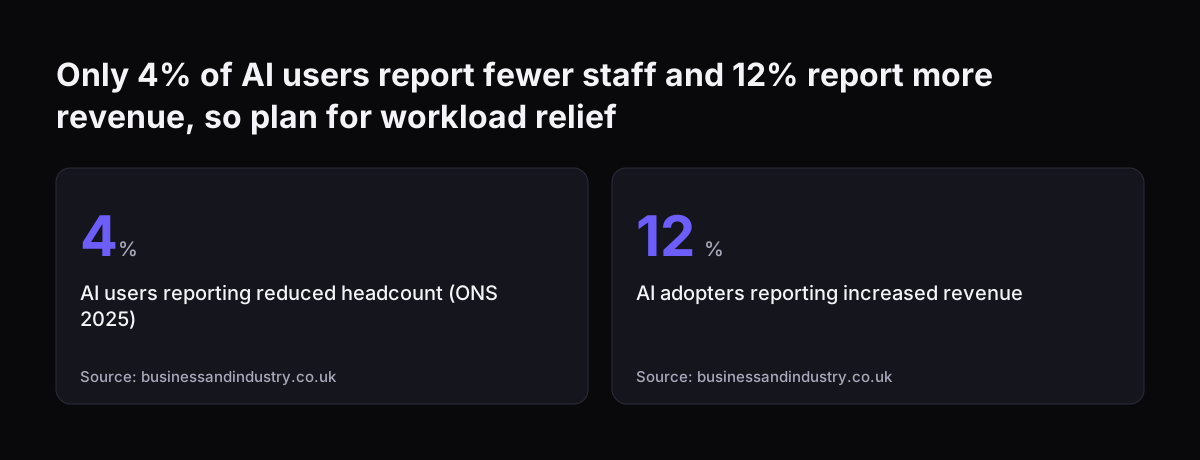
Small companies adopt AI mainly to absorb workload, not to cut staff. Business & Industry reports that sole traders and one-director companies use AI for content creation, cutting admin time and communicating with customers. For micro firms, the same piece says, AI supplements labour rather than replacing it. Only 4% of AI-using businesses report reduced headcount (ONS, 2025).

Problems that suit a first AI workflow in a small company include:

  • A support inbox where every message is read, sorted and answered by hand.
  • Sales follow-up that slips because nobody has time to write the next email.
  • Weekly admin that repeats: summaries, status reports, routine replies.
  • Customer replies that must stay consistent across several people.

The returns are not automatic. Only 12% of adopters report increased revenue so far. Non-adopters worry about data security and return on investment. Both points argue for starting narrow.

One workflow with an owner gives you a result you can measure before you spend more. You can browse AI by business task to see how AI applies to each common process.

Only 4% of AI users report fewer staff and 12% report more revenue, so plan for workload relief: AI users reporting reduced headcount (ONS 2025) 4 %, AI adopters reporting increased revenue 12 %
Source: businessandindustry.co.uk

Why the process owner should lead AI adoption, not the most technical person

The process owner should lead because AI adoption fails on the work, not on the technology. IBM (2023), cited in the LinkedIn review, found 77% of organisations deploying or exploring AI. Only 35% had scaled AI beyond pilot projects.

The obstacles researchers cite are about ownership and direction. Bughin et al. (2017) named lack of AI strategy as the most cited obstacle. Insufficient data infrastructure, talent scarcity and change management failure followed.

An MIT Sloan Management Review and BCG survey found organisations with a clear AI strategy and sustained C-suite sponsorship were 2.5 times more likely to achieve expected value. In a small company, the sponsor is often the owner, and the strategy can be one process done well.

A process owner brings three things the most technical colleague often lacks. They know what a correct answer looks like. They can change the routine, the template or the handover. They feel it when quality drops.

At Svennis we start each workshop by asking who answers for the process today, and that person leads. Where a company handed the project to its most technical colleague instead, we have seen skills built that the team never worked into its day.

The technical colleague still matters. Their best role is supporting the owner, as the next section shows.

Who should lead AI adoption: four candidates compared

Four people are usually proposed to lead AI adoption in a small company. The table compares them on what adoption needs and suggests the role each one fits best.

CandidateKnows what good output looks likeCan change how the work is doneBest role
Process owner (support lead, sales manager)YesYesLead
Most technical colleagueSometimesRarelyClaude ambassador
Owner or managing directorPartlyYesSponsor who signs off the AI policy
Outside consultantLearns it from youNoBuilds connections, trains, hands over

A Claude ambassador is a colleague who uses Claude well and helps the others. The ambassador shows good examples, answers questions and collects the questions that repeat. According to the Svennis service page, the role takes about an hour a week. That suits a technical colleague who has a day job elsewhere.

An AI policy is the company's policy on what data may go into Claude and which actions need approval. The owner signs the AI policy. The process owner applies it every day, because they know which data the workflow touches.

Worked example: AI adoption that starts with support in Zoho Desk

Take a small distributor whose customer questions arrive in Zoho Desk. The support lead owns that process, so the support lead leads the adoption. The colleague who is best with technology becomes the Claude ambassador. The managing director sponsors it.

  1. Name the workflow and the standard. The support lead picks one workflow: sorting incoming tickets and drafting replies. They mark real past tickets that show what a correct reply looks like.
  2. Write the AI policy. The owner and support lead agree what may go into Claude and what stays out. They decide which actions need approval, such as sending a reply or issuing a refund.
  3. Connect Claude to Zoho Desk. The connection can be a connector, an MCP server (a small program that gives Claude controlled access to another system), a plugin or a skill. Each option has a cost, and the company chooses.
  4. Build skills for the repeat tasks. A skill is a routine Claude carries out the same way every time, with instructions, test cases and an owner. Here the skills classify a ticket, draft a reply and summarise a long thread for handover.
  5. Review every week. The support lead checks drafts against the marked examples. The ambassador collects repeat questions from the team.

When support runs well, sales can follow. The sales manager, working in Zoho CRM, repeats the same five steps for follow-up emails. A new process means a new owner leading, not the first owner stretching further.

Which companies and roles AI adoption fits, and which it does not

Process-led AI adoption fits a company with a named process, a system where that work already lives, and someone with authority over it. It fits poorly where any of those three is missing.

Process-led adoption fits well for:

  • Teams under 250 users, the size Svennis's Claude Team Adoption is designed for.
  • Support, sales, admin and finance processes with repeat work and a clear standard.
  • Roles such as support leads, sales managers, office managers and finance leads.

Process-led adoption fits poorly for:

  • A process that nobody owns, or that changes every week.
  • A plan whose main goal is a quick headcount cut, since small firms report AI supplementing labour.
  • Work whose data is scattered or missing, since preparing data is often the largest part of an AI project.
  • Decisions about people that nobody reviews; government research from 2024, cited by the ICO, found 91% of digitally disengaged people see decisions made without human input as a major risk.

Sector pages show how this plays out by role. A sales manager can read about AI for lead management. A practice partner can read about AI for accountants, process by process.

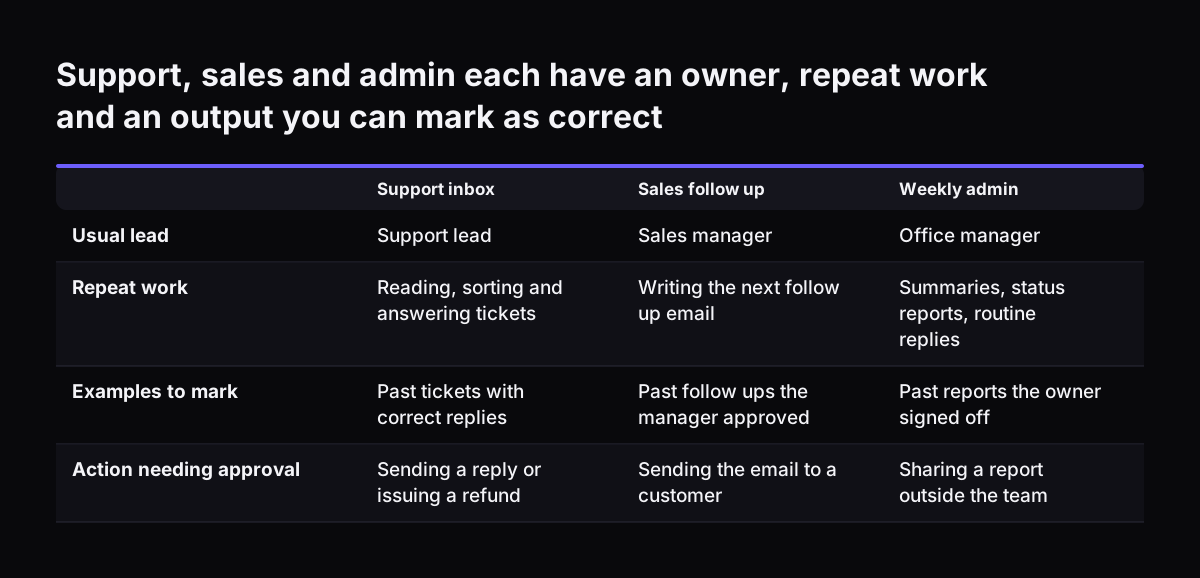
Support, sales and admin each have an owner, repeat work and an output you can mark as correct. Support inbox / Sales follow up / Weekly admin. Usual lead: Support lead / Sales manager / Office manager; Repeat work: Reading, sorting and answering tic

What AI adoption means for a UK small company: data protection and trust

For a UK small company, AI adoption means planning for data protection from the first workflow. "Small company" also has a legal meaning in the UK. The Small Companies and Groups (Accounts and Directors' Report) Regulations 2008 apply to companies in the small companies regime under Part 15 of the Companies Act 2006. This guide uses the term in its everyday sense: small enough that one person can own a whole process.

Data protection is the concern UK regulators hear most. The ICO states that concerns about data protection and privacy regulation can be a barrier to AI adoption. In a 2024 FCA and Bank of England survey of 118 financial services firms, 33% cited data protection as a constraint. At an FCA and ICO roundtable, many firms, especially smaller ones, wanted clearer examples of what good looks like. The ICO is now required by law to produce a statutory code of practice on AI and automated decision making, and is developing it.

Two practical steps follow for a UK company on Claude Team. First, record where the data goes. According to the Svennis service page, Anthropic stores Claude Team data in the US and may process it in the US, Europe, Asia or Australia. Check Anthropic's current terms and note what covers the transfer, because sending personal data to a provider outside the UK is a restricted transfer.

Second, let the process owner list the personal data in the workflow. That list shapes the AI policy, because the owner knows which fields customers actually send.

Next steps: choose one process, name its owner, then decide on help

The next step for AI adoption in your company is to pick one process and one owner this week. You need no tool decision to do that. Work through these four steps in order:

  1. Write down the one workflow where repeat work costs the most time, such as support replies or sales follow-up.
  2. Name the person who owns that workflow as lead, and the owner or managing director as sponsor.
  3. Ask the lead to mark a handful of real examples of correct output.
  4. Draft the AI policy: what data may go into Claude, and which actions need approval.

If you want help from there, Svennis does this work. Our Claude Team Adoption service is for teams under 250 users. One lead from Svennis puts the team to work in two weeks, with three skills on the team's tasks. It takes about half a day of your team's time over those two weeks. The service page carries the published prices, and you pay for seats directly to Anthropic.

Part 2 of this series, on the adoption steps, covers how to get a team to actually use Claude. Part 3 covers shadow AI, and why staff on personal AI accounts are the risk to fix first.

Sources

  1. Svennis AI: Claude Team Adoption
  2. Business & Industry: Small businesses adopt AI to manage growing workloads
  3. Dr. Heidrich Vicci: Artificial Intelligence Adoption in Business
  4. ICO: Why we need to act
  5. ICO: Tech, Trust and Teamwork: How the FCA & ICO are Helping Innovation Take Off
  6. legislation.gov.uk: The Small Companies and Groups (Accounts and Directors' Report) Regulations 2008
Free, 30 minutes

Pick a time. Bring the process this article made you think of.

You leave with a clear yes or no on putting Claude on it, and the step that fits from our published prices. You speak to someone who builds the agents, not a salesperson.

Prefer to call? +44 7588 772736 · Not ready to talk? See it on your business first.

30 minutes · video call · free
  1. 1Time
  2. 2Details
  3. 3Booked