

Skip to content
SVENNISAIWe speak Claude.
Blog · AI implementation

AI implementation: when an AI rollout stalls, what a relaunch is and who needs one

A stalled AI rollout is rarely a model problem. This guide defines a relaunch, shows the three things it resets, and helps you judge whether your company needs one.

10 min read

Book a 30-minute call · with a Claude Certified Architect from our team.

Article · 10 min read
Abstract lines that slow, break apart and then realign into one steady forward path

When an AI rollout stalls: what a relaunch is and who needs one

When an AI rollout stalls, the cause is rarely the model. Most stalled AI implementation fails on three things: scope, integration and ownership. A relaunch is a planned second start of an AI rollout. It measures how people really use the tool, fixes those three things, and only then puts the assistant back in front of the team.

This guide covers what a relaunch is and who needs one. It is part 1 of 3 in a series on Claude Relaunch. Part 2 covers how to relaunch Claude in a company: diagnosis, fixes and a second rollout. Part 3 covers why a stalled AI rollout costs more than it seems, and how to measure the return.

The guide assumes your company has already paid for Claude. A seat is one paid user licence on a Claude business plan, either Claude Team or Claude Enterprise. A stalled rollout is one where those seats exist but daily use is low. It is also stalled when the work Claude does cannot be trusted or repeated.

The order of work matters. Changing the assistant first, with new prompts, a new model or a fresh training session, leaves the cause in place. A relaunch starts from evidence of use and ends with one team that works differently.
A stalled AI rollout shows as paid licences, low use and missed targets

A stalled AI rollout is common enough to have a name. Writing in Business Reporter, Dvir Hoffman, CEO of CommBox, calls it the implementation plateau. He cites CommBox research on AI in customer service: only 45% of deployments meet their targets in the first year. Over 30% face security and compliance setbacks.

The gap between plans and use is wide. In the same CommBox survey, 90% of brands planned to integrate AI across their service function. Only 15% used the technology extensively. Security concerns were the most cited barrier, at 32%.

Money spent does not close that gap. In a LinkedIn article on trust and AI adoption, Sujata Raman describes a global professional services firm that audited its AI programme twelve months after launch. It had spent over $4 million on licences, change management consultants and executive communications. Frontline adoption stood at 29%.

Training lags behind use, too. A survey shared by Lifewire found that 74% of full-time workers use AI tools such as ChatGPT and Gemini. Only 33% have had formal training. In a stalled company rollout, you usually see the same pattern in miniature:

  • seats paid for every month, with a minority signing in;
  • a pilot that worked for its champion and never spread;
  • staff using their own tools alongside the approved one.

Why a stalled AI implementation is rarely a model problem

A stalled AI implementation is rarely fixed by switching models, because the current models share the core abilities a business needs. Anthropic's models overview states that all current Claude models support text and image input, text output, multilingual capabilities, vision and tool use. Its advice when you are unsure is to start with Claude Opus 5.5 for most workloads. Choosing a model is a short decision.

The hard parts sit around the model. Hoffman names legacy systems, data silos and incompatible technologies as friction that turns a simple deployment into a slow one. He adds that the usual barrier is a lack of integration to do back-end tasks securely, such as authentication or sensitive data integration.

Vendors report the same. Kully Kooner of Lemmata, a software company, writes that enterprise customers raise three pain points. The AI they deployed is not deployable in the analytics workflows that matter, not trusted and not repeatable. Ask the same question a few times, he writes, and you can get conflicting answers and basic data errors.

Settings can also block a capable model. Anthropic's documentation notes that an organisation's settings can make a request fail even when the model supports the tool. An administrator can disable web search, for example. A team that meets that failure blames the assistant, when the cause is a configuration choice nobody explained.

Scope, integration and ownership are the three things a relaunch resets

A relaunch resets scope, integration and ownership because each one, left loose, can stall a rollout on its own. The sources in this guide describe the same three failures from different angles.

Scope: one task per team, not everything at once

Broad scope stalls rollouts. Hoffman writes that scaling AI beyond first tasks into scheduling, account management and purchasing presents significant challenges. Simon Lesch, in a LinkedIn article on unofficial AI use, suggests each team picks one use case that could save at least an hour a week and runs a four-week experiment on it.

Integration: stable data before clever prompts

Srini Annamaraju describes a logistics firm whose procurement assistant ran during an SAP S/4HANA migration. It kept drafting purchase orders against the old schema and routing approvals to people who no longer had delegation. Finance spotted the errors three weeks later at month-end. His rule: run both only if the AI is pinned to a frozen, versioned dataset and stable interfaces until the migration settles.

Ownership: a named person behind every output

Raj Goodman Anand names governance as the main weakness, with AI agents working on fragmented data without clear ownership of decision rights. Ownership also means visible use: in Raman's example, staff asked why they should use a tool their manager did not. At Svennis we write no skill until a named person in the team agrees to own it. When that step slips, the skill drifts out of date as soon as the process behind it changes.

Claude Relaunch runs two weeks of measurement, then two weeks of fixes

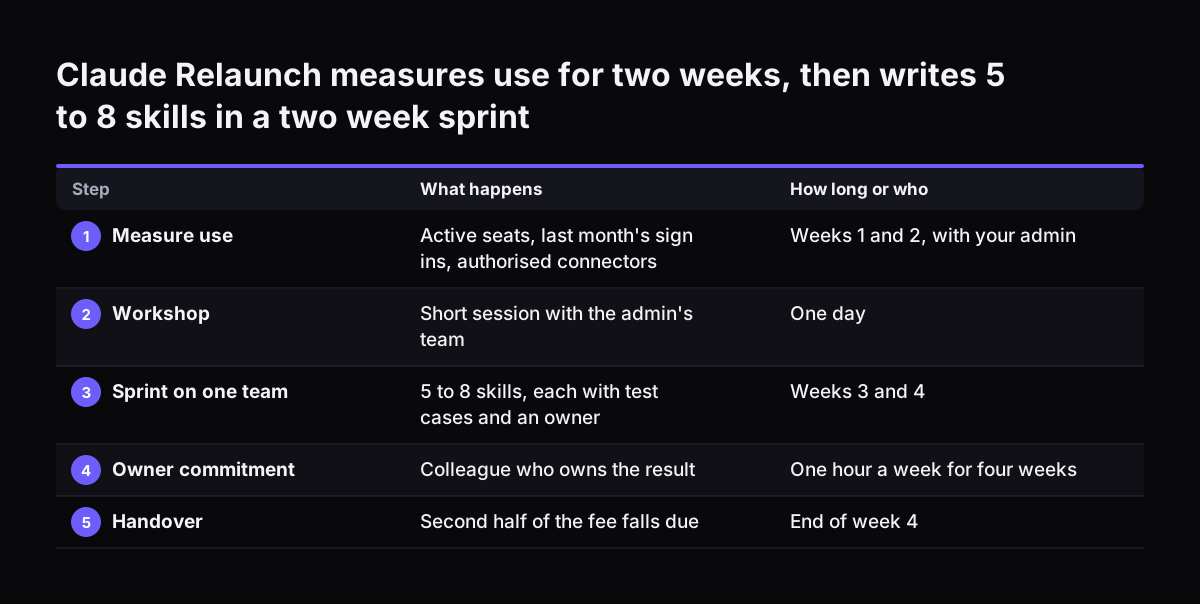
Claude Relaunch is the Svennis service for companies whose Claude seats are paid for but underused. It applies to seats on Claude Team or Claude Enterprise. It runs four weeks: two weeks of measurement, then two weeks of fixes.

Measurement starts in the Claude admin console. The console shows three things: the active seats, who signed in last month, and which connectors are authorised. A connector is the link between Claude and one of your systems, Microsoft 365 or Xero for example. On Claude Enterprise, sign-in with the company account and the user roles are also checked in week one.

The fixes run as a sprint. A sprint is two weeks of work on one team, with a clear start and end. In it, 5 to 8 skills are written, each with test cases and an owner, tested on real cases, and the team is trained. A skill here means a written set of instructions Claude follows for one repeatable task.

Two rules keep the sprint honest:

  • The sprint goes to the team that uses Claude least, not the keenest one.
  • A colleague who owns the result gives an hour a week for the four weeks.

Where Claude needs a new connection to one of your programs, Svennis builds it as a connector, an MCP server, a plugin or a skill. Svennis shows you the options with their cost, and you choose. An MCP server is a small program that lets Claude read from and act in a system through an open standard.

Claude Relaunch measures use for two weeks, then writes 5 to 8 skills in a two week sprint. What happens / How long or who. 1. Measure use: Active seats, last month's sign ins, authorised connectors / Weeks 1 and 2, with your admin; 2. Workshop: Shor

Worked example: a sales team with a CRM connector it does not use

A worked example shows how the three resets apply to one team. Picture a company on Claude Team whose sales team works in Zoho CRM. The company bought seats for sales and finance some months ago. Finance uses Claude most days. Sales hardly signs in.

The relaunch would run in this order:

  1. Read the admin console. Compare active seats with paid seats, list who signed in last month, and note which connectors are authorised. Here the CRM connector is authorised, but sales sessions are rare.
  2. Pick the team. Sales uses Claude least, so the sprint goes to sales, not finance.
  3. Narrow the scope. Choose one task that could save each person at least an hour a week, such as a pre-call summary of an account drawn from its CRM record.
  4. Check the integration. Confirm the connector reads live records. If the CRM is mid-migration, pin the work to stable data first.
  5. Name the owner. The sales manager owns the skills and gives an hour a week.
  6. Run the sprint. Write 5 to 8 skills with test cases, test them on real accounts, and train the team.

Nothing in that sequence changes the model. The assistant the sales team meets at the end is the same Claude. What changed is the task it does, the data it reads and the person who answers for it.

Who needs a relaunch, and who needs something else first

A relaunch fits a company that has paid Claude seats and low or uneven use. It does not fit a company that has not started, or one whose core systems are in flux. The table sets out the common situations.

Your situationDoes a relaunch fit?What to do instead, or first
Seats on Claude Team or Claude Enterprise, few active usersYesMeasure use, then run a sprint with the least-used team
Team under 250 users, seats bought or being bought, not yet startedNo, there is nothing to relaunchA first rollout, such as Claude Team Adoption for a new team
One process needs an agent rather than more seatsNoPilot Claude A, an AI agent on Claude for one process
Staff use unapproved tools and there is no AI policyNot yetWrite a one-page policy on what the tools are for and what data stays out
A core system such as the ERP is mid-migrationLaterPin AI work to frozen, versioned data until the migration settles
Adoption under half at the end of a twelve-week rollout planYes, before you expandFix the current departments before adding new ones

The policy row matters more than it looks. Lesch cites WalkMe's 2025 survey, in which 78% of employees used unapproved AI tools at work. The last row follows a playbook by Liam Lawson, shared on LinkedIn's collection on AI rollout challenges: if adoption is under 50% at week 12, do not expand yet.

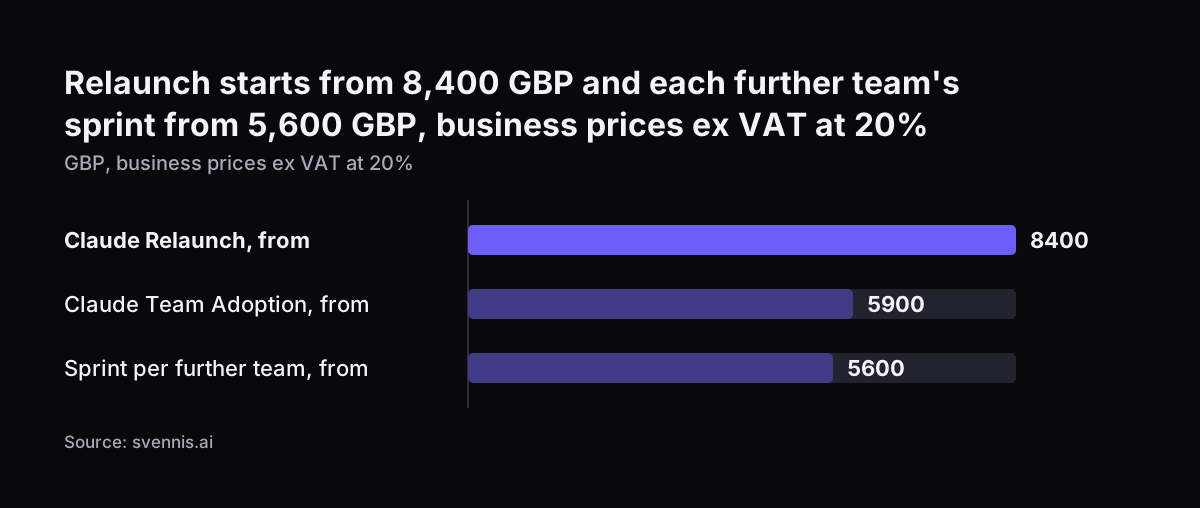
Relaunch starts from 8,400 GBP and each further team's sprint from 5,600 GBP, business prices ex VAT at 20%: Claude Relaunch, from 8400, Claude Team Adoption, from 5900, Sprint per further team, from 5600 (GBP, business prices ex VAT at 20%)
Source: svennis.ai

What a relaunch means for a UK company: billing, currency and regulation

For a UK company, a relaunch touches two bills in two currencies. Claude seats are billed directly by Anthropic, in pounds. You set the number of seats with Anthropic, under its own terms. An agent's model usage is billed by Amazon Web Services in US dollars, on use, and is not capped unless you set a budget.

That split shapes the relaunch decision. Fixing low seat use changes nothing on the seat bill until you change the seat count with Anthropic. Adding an agent to the relaunch adds a usage bill in dollars. Set a budget on it before it runs.

Regulation is moving towards AI use, with human checks kept in place. The Regulatory Innovation Office's one-year report says RIO was set up in October 2024, with AI in healthcare among its four priorities. With RIO funding, the MHRA is piloting AI-assisted tools for scientific advice, clinical trial assessments and licensing, keeping all decisions in human hands. RIO also awarded £3.6 million through its AI Capability Fund to help regulators adopt tools like AI.

The same principle suits a business relaunch. Each skill has a named owner who checks its output. For the rules that apply to your sector, see what AI law in the UK means for your business before you widen use.

Next steps if your Claude rollout has stalled

You can start diagnosing a stalled Claude rollout this week, without outside help. The steps below use only what you already have:

  1. Open the Claude admin console. Note the active seats, who signed in last month and which connectors are authorised.
  2. Name the team that uses Claude least. That team, not the keenest one, shows you where the rollout broke.
  3. Ask that team for one task that could save each person an hour a week.
  4. Check whether Claude can reach the data for that task through a working connector.
  5. Name one person who will own the result and give it an hour a week.
  6. If there is no AI policy, write one page on what the tools are for, what they are not for and what data never goes in.

If the console shows paid seats and little use, Svennis does this work as a four-week service. The Claude Relaunch service page sets out the two weeks of measurement and two weeks of fixes, the published prices and a free 30-minute call. If you want to see which tasks suit Claude in your function first, browse AI by business task.

Sources

  1. Claude Relaunch: paid Claude seats put to work
  2. Models overview, Claude Platform Docs
  3. The AI implementation plateau is holding businesses back, Business Reporter
  4. Your AI Rollout Is Failing And It's Not a Tech Problem. It's a Trust Problem.
  5. Your AI Rollout Already Happened. You Missed It.
  6. Why AI-Based Business Insights Are Stalling After Deployment
  7. Scheduling challenges in AI rollout, LinkedIn
  8. Regulatory Innovation Office: One Year On, GOV.UK
Free, 30 minutes

Pick a time. Bring the process this article made you think of.

You leave with a clear yes or no on putting Claude on it, and the step that fits from our published prices. You speak to someone who builds the agents, not a salesperson.

Prefer to call? +44 7588 772736 · Not ready to talk? See it on your business first.

30 minutes · video call · free
  1. 1Time
  2. 2Details
  3. 3Booked