
Skip to content
SVENNISAIWe speak Claude.
Blog · Claude Managed Agents

Claude Managed Agents: when a company should let Anthropic host its agent

Claude Managed Agents lets Anthropic run the agent loop, sandbox and session state for you. This guide sets out the parts, the costs, the data limits and when it beats your own loop.

10 min read

Book a 30-minute call · with a Claude Certified Architect from our team.

Article · 10 min read
A horse already fitted with a harness and hitched to a cart, beside a tangled heap of loose straps

Claude Managed Agents in short: Anthropic hosts the agent loop for you

Claude Managed Agents is Anthropic's hosted harness for running Claude as an agent. You configure the agent, and Anthropic runs the loop, the sandbox and the session state. A company should let Anthropic host its agent when the work runs for a long time, needs a sandbox for code or commands, and does not need Zero Data Retention.

Anthropic's Managed Agents overview describes two ways to build with Claude. The first is the Messages API, where your code sends each request and handles each reply. The second is Claude Managed Agents, a "pre-built, configurable agent harness that runs in managed infrastructure".

Two terms need defining. An agentic loop is the pattern in which the model reasons, acts, observes the result and reasons again. An agent harness is the code that runs that loop: it calls the model, executes the tools Claude asks for and feeds the results back. With the Messages API you write and host the harness yourself. With Claude Managed Agents, Anthropic supplies it.

The rest of this guide covers the four parts of the product, what the harness does for you, a worked example, the cost model, one independent benchmark, a decision table, the data points that matter for a UK company and the beta status. If Claude itself is new to you, start with a plain guide to what Claude is.
Agent, Environment, Session and Events: the four parts of Claude Managed Agents

Claude Managed Agents is built around four concepts, and every setup uses all four. Anthropic's documentation defines them as follows:

  • Agent: the model, system prompt, tools, MCP servers and skills.
  • Environment: the configuration for where sessions run, either an Anthropic-managed cloud sandbox or a self-hosted sandbox on your own infrastructure.
  • Session: a running agent instance within an environment, performing a specific task and generating outputs.
  • Events: the messages exchanged between your application and the agent, such as user turns, tool results and status updates.

The Agent is the reusable definition, and a Session is one run of it. The Environment decides where that run happens. The Events are how your own software talks to it while it works.

Inside a Managed Agents environment, Claude can read files, run commands, browse the web and run code. The built-in tools are Bash for shell commands, file operations (read, write, edit, glob and grep), web search and fetch, and MCP servers. MCP, the Model Context Protocol, is an open protocol developed by Anthropic that standardises how agents talk to external tools and data sources. A skill is a packaged set of instructions and workflows the agent can call on for a specific job.

The sandbox choice matters most for a business. The cloud sandbox means Anthropic runs everything. The self-hosted sandbox keeps the place where commands and code execute on your own infrastructure, while Anthropic still provides the harness.

What the hosted harness does that your own agent loop would have to do

The hosted harness takes over the plumbing that every agent needs and nobody wants to maintain. Writing on Medium, developer Joe Njenga lists what otherwise falls to you: "the agent loop, tool execution, context management, sandboxing, and session handling". In his words, Anthropic "is now handing us the runtime" instead of another API to wrap a loop around.

Anthropic's documentation names the specific features the harness provides:

  • Built-in prompt caching, which reuses already processed parts of a prompt at a fraction of the input price.
  • Compaction and other performance optimisations, so long sessions keep working as context grows.
  • Results streamed back through server-sent events (SSE), a standard way for a server to push updates to your application.
  • Event history persisted on Anthropic's side, which you can fetch in full.
  • Scheduled execution, meaning recurring agent runs on a cron schedule through scheduled deployments.

MindStudio, a software company that builds on these tools, adds that the platform handles OAuth token exchange, refresh cycles and consent flows. It also describes a credential vault that stores secrets and hands them to agents at runtime.

Each of these is a job your own team would otherwise build, test and keep running. A hosted harness removes that work. It does not remove the work of connecting the agent to your systems, writing good instructions or deciding what the agent may change. Those stay with you whichever route you take.

A worked example: a weekday ticket review agent on Zoho Desk

A weekday ticket review agent shows how the four parts of Claude Managed Agents fit together. Picture a support manager who wants a short morning summary of tickets in Zoho Desk that have waited too long, with a suggested next step for each.

  1. Define the Agent. Choose the model: Anthropic's models overview says to start with Claude Opus 5.5 for most workloads if you are unsure. Write the system prompt: "Review open tickets past their agreed response time, group them by cause and draft a summary for the support manager." Add an MCP server that reads Zoho Desk, plus file operations for writing the summary.
  2. Choose the Environment. Pick the Anthropic-managed cloud sandbox, or a self-hosted sandbox if your security team wants execution on your own servers.
  3. Schedule it. Set up a scheduled deployment on a cron schedule for weekday mornings, so a new Session starts each day without anyone pressing a button.
  4. Read the Events. Your application receives the streamed results, and the full event history stays available on Anthropic's side.
  5. Tidy up. Delete old sessions, and separately any uploaded files, through the API once they are no longer needed.

Every request in this setup carries the beta header managed-agents-2026-04-01. Access is enabled by default for all API accounts.

The MCP server for Zoho Desk is the part that takes real thought. For each connection, Svennis builds a connector, an MCP server, a plugin or a skill, shows the options with their cost, and the client chooses. The agent should only read tickets in this example, so the connection grants read access and nothing more.

Claude Managed Agents costs: tokens plus a runtime fee per session-hour

Claude Managed Agents is billed on two dimensions: tokens and session runtime. Anthropic's pricing page sets session runtime at $0.08 USD per session-hour. Tokens are charged at the normal rate of the model the agent uses.

ModelInput, USD per million tokensOutput, USD per million tokensAnthropic's positioning
Claude Fable 5.2840Demanding reasoning and long-horizon agentic work
Claude Opus 5.5420Long-running agentic coding and knowledge work
Claude Sonnet 5.5210Best combination of speed and intelligence
Claude Haiku 5.50.100.50High-volume classification, extraction and routing (price for prompts up to 100,000 tokens)

The runtime fee is small for short runs. A session of 15 minutes each weekday, over 20 working days, adds up to 5 session-hours, or $0.40 USD of runtime. Tokens usually make up most of the bill. A Reddit user reviewing the launch put it the same way: short tasks cost little extra, but an agent working several hours a day "starts to cost real money".

Three pricing rules change the sums. The Batch API's 50 percent discount does not apply to Managed Agents sessions. Web search costs $10 USD per 1,000 searches plus tokens. Prompt caching helps, because a cache hit costs at most 10% of the standard input price, and 5% on Claude Opus 5.5 and Claude Sonnet 5.5. A Hacker News commenter adds a quieter cost: tool definitions also consume tokens.

Claude Team, Max and Ultra plans now include monthly API credits that cover Claude Managed Agents, according to the Claude Help Center. For the wider picture of seats and usage, see what Claude costs a business and how to start.

Hosted against self-built in one benchmark: same pass rate, higher cost

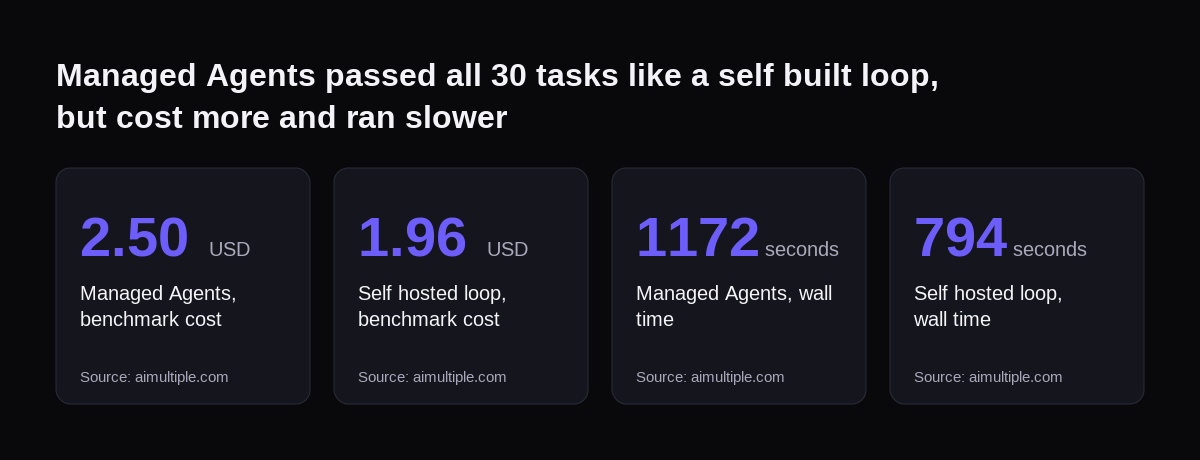
One independent benchmark found that Claude Managed Agents finished every task but cost more and ran slower than a self-built loop on the same model. AIMultiple tested four agent platforms in May 2026 on 10 coding tasks, three runs each, plus harness features and cost.

The useful comparison for this decision is AIMultiple's "control". The control was the Claude Messages API with a local tool loop, using the same Claude model as the Managed Agents run. Any difference between the two therefore comes from the harness, not the model.

  • Claude Managed Agents: 30 of 30 tasks passed, 1,172 seconds, $2.50 USD.
  • Self-hosted control: 30 of 30 tasks passed, 794 seconds, $1.96 USD.
  • Google's Vertex AI Agent Engine: 30 of 30 tasks passed, 1,447 seconds, $1.45 USD.

AIMultiple also ran tests that only Managed Agents could take part in. Injecting events into a running session and disconnecting then reconnecting had no equivalent on two of the other platforms.

Read this result with care. It covers coding tasks, not business processes, and one benchmark is not a verdict. It does show the trade clearly: the hosted harness saves you building and running the loop, and you pay for that in money and some speed. A Hacker News commenter made the related point that custom agents built on low-level APIs tend to do better on complex problems. That is one opinion, but it matches what the control figures suggest.

Managed Agents passed all 30 tasks like a self built loop, but cost more and ran slower: Managed Agents, benchmark cost 2.50 USD, Self hosted loop, benchmark cost 1.96 USD, Managed Agents, wall time 1172 seconds, Self hosted loop, wall time 794 secon
Source: aimultiple.com

When a hosted harness beats your own agent loop: the decision table

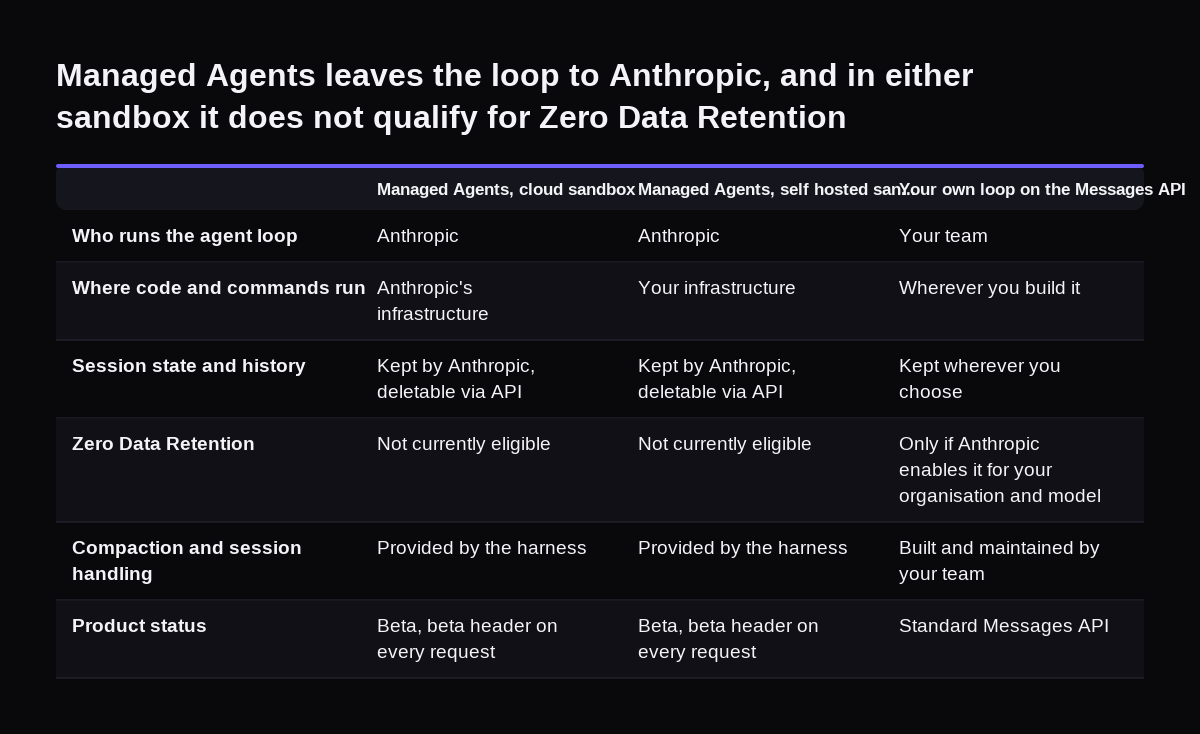
A hosted harness beats your own agent loop when the hard part of the job is running the agent, not shaping it. The table compares the three realistic options across the points that decide most cases.

QuestionManaged Agents, cloud sandboxManaged Agents, self-hosted sandboxYour own loop on the Messages API
Who runs the agent loopAnthropicAnthropicYour team
Where commands and code executeAnthropic's infrastructureYour infrastructureWherever you build it
Session state and event historyKept by Anthropic, deletable via APIKept by Anthropic, deletable via APIKept wherever you choose
Zero Data Retention or HIPAA BAANot currently eligibleNot currently eligibleSet by your own API terms
Batch API discountDoes not applyDoes not applyAvailable for asynchronous work
Scheduled runs, caching, compactionBuilt inBuilt inYou build them
Best fitLong-running tasks, small engineering teamLong-running tasks with an execution-location ruleShort, high-volume or tightly controlled tasks

Two signals point clearly to your own loop. One is a need for Zero Data Retention, unless you run the whole service yourself, as described below. The other is a short, high-volume task such as classifying incoming email, where Batch pricing and a smaller model like Claude Haiku 5.5 matter more than a sandbox.

At Svennis we list every system the agent must touch, and the access each connection needs, before we compare harnesses. In our delivery the connections, not the loop, decide most of the effort and most of the risk, so that list usually settles the choice.

Managed Agents leaves the loop to Anthropic, and in either sandbox it does not qualify for Zero Data Retention. Managed Agents, cloud sandbox / Managed Agents, self hosted sandbox / Your own loop on the Messages API. Who runs the agent loop: Anthropic / Ant

Data retention, deletion and policy limits for a UK company using Claude Managed Agents

Claude Managed Agents is not currently eligible for Zero Data Retention or a HIPAA Business Associate Agreement. Anthropic gives the reason in its documentation: the product is stateful by design. Event history is persisted server-side so sessions can continue and be fetched in full.

There is one exception for Zero Data Retention: self-hosted Claude Managed Agents, where the whole service runs on your own infrastructure and you store the session data yourself. Anthropic does not publish a price for it; you ask its account team.

For a UK company, that means session history sits with Anthropic until you delete it. You can delete sessions, and separately any uploaded files, at any time through the API. Build that deletion into the process from the first day, with a set retention period for each type of task. Your data protection review should record what the agent reads, what it stores and when it is removed.

The self-hosted sandbox changes where commands and code run, not where event history is kept. That makes it useful when a rule covers execution location, but it does not turn the product into a zero-retention service.

Location of processing is a separate setting. The pricing page says that requesting US-only inference through the inference_geo parameter adds a 1.1x multiplier to all token prices on newer models. It does not describe a UK or EU option.

Anthropic's usage policy for agents also applies. Agents may not monitor or track people's online activity or movements without notice or consent. They may not build profiles from protected attributes, sensitive characteristics or personal circumstances, use facial recognition or other biometric identification, or access someone's account with stored credentials without authorisation. Anthropic says these are examples, not a complete list. For the account, data and legal side in more depth, read how Claude runs in your company under UK law, and see how to keep Claude agents safe from prompt injection before an agent reads outside content.

Claude Managed Agents beta status: what can still change

Claude Managed Agents is in beta, and every request needs the managed-agents-2026-04-01 beta header. Access is enabled by default for all API accounts, so you do not need to apply to start testing. The product launched in April 2026, according to Medium's launch coverage, with Notion, Rakuten and Asana named as launch partners in a Reddit review.

Some features sit further back. MCP tunnels and dreaming are in a more limited research preview within the beta, and you have to request access to enable them. Plan any process around the generally available features, not the preview ones.

AIMultiple notes that behaviour "may refine between releases" during the beta. For a business, that has three practical consequences:

  • Pin the beta header in one place in your code, so a change is a single edit.
  • Keep a short test set of real tasks and rerun it whenever Anthropic updates the beta.
  • Avoid making a critical process depend on one feature that only exists in this product.

The product is also Claude-only. AIMultiple contrasts this with platforms that support several model providers. If your company has a policy of keeping more than one model supplier, the hosted harness ties that agent to Anthropic. Within Claude, you can still move between models, for example from Claude Opus 5.5 to Claude Sonnet 5.5, as cost and quality require.

Next steps: test one process before you choose a harness

The quickest way to decide on Claude Managed Agents is to test one real process, not to debate the architecture. Pick a task that runs for minutes rather than seconds and needs files, commands or several systems. A morning report or a document review fits well.

  1. Write down every system the agent must reach and the access it needs in each one.
  2. Check the data points: does this process need Zero Data Retention, and how long may session history stay with Anthropic?
  3. Estimate the cost from the model's token price plus $0.08 USD per session-hour, and check whether your Team or Max plan's API credits cover the test.
  4. Run the same task on Managed Agents and, if you have a developer, on a simple loop of your own. Compare result quality, time and cost.
  5. Decide, and set the deletion schedule before the agent goes live.

If you want help with that first process, Svennis works in four steps: the Workshop, then Pilot Claude A (an AI agent on Claude for one process) or Pilot Claude B (Claude Team for the whole team), then the department Activation, then monthly operations. The page on Claude Pilot A explains how a single agent goes from scoping to production.

Sources

  1. Claude Managed Agents overview, Claude Platform Docs
  2. Pricing, Claude Platform Docs
  3. Models overview, Claude Platform Docs
  4. Use the Claude Agent SDK with your Claude plan, Claude Help Center
  5. Using Agents According to Our Usage Policy, Claude Help Center
  6. Anthropic Managed Agents: A Hosted Runtime for Claude + MCP, MindStudio
  7. Anthropic Launches Claude Managed Agents, Medium
  8. Claude Managed Agents just launched, r/Anthropic
  9. Claude Managed Agents Overview, Hacker News
  10. AI Agent Platforms Benchmark, AIMultiple
  11. Self-hosted Claude Managed Agents, Claude Platform Docs
Free, 30 minutes

Pick a time. Bring the process this article made you think of.

You leave with a clear yes or no on putting Claude on it, and the step that fits from our published prices. You speak to someone who builds the agents, not a salesperson.

Prefer to call? +44 7588 772736 · Not ready to talk? See it on your business first.

30 minutes · video call · free
  1. 1Time
  2. 2Details
  3. 3Booked