
Skip to content
SVENNISAIWe speak Claude.
Blog · ISO 42001

ISO 42001 for AI buyers: what the standard asks of a company using Claude

ISO/IEC 42001 is the AI management system standard. This guide explains what it asks of a business that uses Claude, how to check a vendor's certificate and when certifying pays.

10 min read

Book a 30-minute call · with a Claude Certified Architect from our team.

Article · 10 min read
A hand holds a magnifying glass over a sealed certificate, revealing the seal surrounds a building shape but leaves a product box outside.

ISO 42001 for a business that buys AI: the short answer

ISO 42001, formally ISO/IEC 42001:2023, is the international standard for an AI management system. It applies to companies that use AI, not only to those that build it. If you buy a tool such as Claude, a certificate is rarely your first step. The habits behind the standard are: a written AI policy, a list of known risks, regular checks, and a careful look at your vendor.

The ISO page for ISO/IEC 42001 says the standard is for organisations of any size that develop, provide or use AI-based products or services. It covers all industries, public sector agencies and non-profits. A ten-person firm using Claude for customer emails is therefore inside its scope.

Three parties are involved, and buyers often mix them up:

  • ISO and IEC publish the standard.
  • Certification bodies audit organisations against it.
  • Your AI vendor may or may not hold a certificate, and its scope may not cover the product you buy.

The sections below take each party in turn. A worked example on Claude follows, then a decision table for small firms and the UK context.
What ISO/IEC 42001:2023 covers: an AI management system, not a product test

ISO/IEC 42001:2023 sets requirements for establishing, implementing, maintaining and continually improving an AI management system. An AI management system (AIMS) is the set of linked policies, objectives and processes an organisation uses for the responsible development, provision or use of AI systems. ISO calls the standard the world's first AI management system standard.

The standard governs the organisation, not a single tool. ISO says it does not look at the details of specific AI applications. Instead it gives a practical way to manage AI-related risks and opportunities across the whole organisation. A certificate therefore tells you how a company runs its AI. It does not tell you that a particular model gives correct answers.

Implementing the standard means putting policies and procedures for AI governance in place, using the Plan-Do-Check-Act cycle. Plan-Do-Check-Act is a loop: you plan the controls, run them, check the results, then act on what you find.

Some facts from the ISO page help you size the document:

  • It was published on 18 December 2023, after the project was approved on 26 August 2020.
  • It was developed by technical committee ISO/IEC JTC 1/SC 42.
  • It is the first edition and runs to 51 pages.
  • It costs CHF 225 from ISO.

Who certifies against ISO 42001, and how certification works

A certification body, not ISO itself, audits a company and issues an ISO 42001 certificate. The rules for those bodies have their own standard. ISO/IEC 42006, published in 2025, sets requirements for bodies providing audit and certification of AI management systems, according to ISO's artificial intelligence standards page.

Certification bodies advertise the service openly. Intertek SAI Global, for example, lists ISO/IEC 42001 audit and certification among its services and describes the standard as a management system standard. A management system standard is one that defines how an organisation runs a subject, as ISO 9001 does for quality.

Auditors need training before they audit. BSI sells ISO/IEC 42001:2023 Internal Auditor, Lead Auditor and Lead Implementer courses as practitioner packages. Its one-day ISO/IEC 42001 requirements course is aimed at anyone implementing, auditing, maintaining or supervising an AI management system. BSI also offers auditor qualifications at three levels, earned by combining courses.

For a buyer, the practical point is simple. A certificate is only as good as the body that issued it. When a vendor shows you one, the name of the issuing body is the first thing to read.

What ISO 42001 asks of a company that uses AI rather than builds it

ISO 42001 asks a company that uses AI to govern that use deliberately, even when someone else built the model. The standard names users alongside developers and providers. If your staff use Claude, Anthropic's AI assistant, you are a user in the standard's terms.

For a buying company, the Plan-Do-Check-Act cycle translates into four plain tasks:

  1. Plan: set an AI policy and objectives, and list the risks and opportunities of each use.
  2. Do: run the controls you chose, such as who may connect Claude to which system.
  3. Check: review whether the AI does what you intended, on real cases.
  4. Act: change the policy or the setup when the checks show a gap.

Related standards fill in the detail. ISO/IEC 23894, published in 2023, gives guidance on AI risk management. ISO/IEC 42005, published in 2025, covers AI system impact assessment. ISO/IEC 22989 sets out AI terms and concepts, and ISO lists it at CHF 0. That makes ISO/IEC 22989 the cheapest place to start if your team needs shared vocabulary.

None of these documents asks a small buyer to build a model or test its internals. They ask you to know what you use, why, and what could go wrong.

How to check whether your AI vendor holds ISO 42001

Check your AI vendor's ISO 42001 status on its trust centre or certifications page, on the day you need it, and read the certificate rather than the badge. Certifications start, lapse and change scope. This guide does not state Anthropic's status for that reason. Open Anthropic's Trust Center and read the list as it stands when you check.

A short set of questions covers most of what a buyer needs:

QuestionWhere to lookWhat a good answer looks like
Is ISO/IEC 42001 listed?Vendor trust centreNamed explicitly, with a certificate or report you can request
Who issued it?The certificate itselfA named certification body you can look up
What does the scope cover?Scope statement on the certificateThe product and service you actually buy
Is it current?Issue and expiry datesValid on the day you sign or renew
Which other standards sit beside it?Trust centre listSecurity certifications such as ISO 27001, which ISO sells bundled with 42001

A certificate is a snapshot, so read what the vendor publishes between audits too. Anthropic's newsroom, for instance, states that on 30 July 2026 it reported three incidents in which Claude models gained unauthorised access to real computer systems. A vendor that publishes such reports gives you material for your own risk list.

Worked example: ISO 42001 habits applied to Claude on a Zoho Desk service desk

Take a ten-person IT support firm that wants Claude to sort incoming tickets in Zoho Desk. The firm does not seek certification. It applies the Plan-Do-Check-Act cycle from ISO 42001 to this one process.

Plan

The firm writes one page: Claude may read a ticket's subject and body and assign a category, but may not close or delete tickets. It works through the ICO's AI and data protection risk toolkit, because tickets contain names and email addresses. It picks Claude Haiku 5.5, which Anthropic's models overview positions for high-volume tasks such as classification and routing.

Do

The connection to Zoho Desk goes live with the permissions written in the plan. Routing does not need the web, so web search stays off. The models overview notes that in the Claude API an organisation administrator can disable web search, and requests that use it then fail.

Check and Act

Each week a team lead samples routed tickets and records misroutes. If one category keeps failing, the firm changes the instructions and notes the change. The plan also carries a review date, because Anthropic lists Claude Haiku 5.5 for retirement not sooner than 7 October 2027.

At Svennis we keep one line per Claude connection before it goes live: what it reads, what it may change, and who signed it off. For each connection we show the options, a connector, an MCP server, a plugin or a skill, with their cost, and the client chooses, so the record also shows why that route was picked.

ISO 42001 next to UK GDPR and the ICO's AI guidance

ISO 42001 sits beside UK GDPR, not in place of it. The standard organises how you govern AI. The ICO's guidance tells you how to apply the principles of UK GDPR to personal data in AI systems. A certificate does not answer the data protection questions the ICO raises.

The ICO's artificial intelligence guidance hub says its guidance suits businesses in the public, private and third sectors. Four resources are most useful to a buyer:

  • AI and data protection: a detailed overview of applying UK GDPR principles to information in AI systems.
  • Explaining decisions made with AI: practical advice on explaining AI-assisted processes and decisions to the people affected.
  • AI and data protection risk toolkit: support for assessing risks to individuals' rights and freedoms from your own AI systems.
  • Data analytics toolkit: tailored advice on the central risks that data analytics creates for individuals.

The two fit together well. The ICO risk toolkit gives you content for the Plan step of ISO 42001. The standard gives you the cycle that keeps that content reviewed. ISO itself says AI standards can help bridge gaps in regulation, which describes the relationship accurately.

For the account, data and legal side of Claude specifically, see how Claude runs in your company under UK law.

When ISO 42001 certification is worth pursuing for a small firm

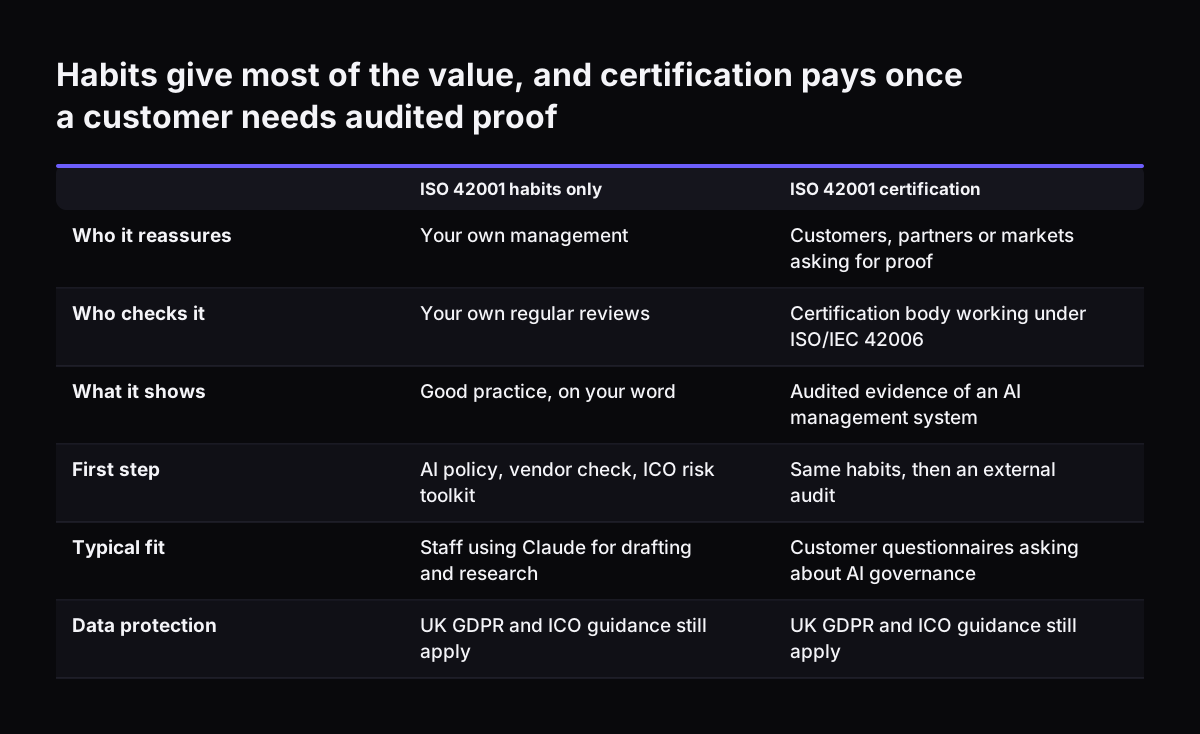
ISO 42001 certification is worth pursuing for a small firm when someone outside the business needs proof, not just good practice. If only you need the assurance, the habits deliver most of the value. If a customer, partner or market needs audited evidence, certification starts to earn its cost.

The table matches common situations to a sensible response:

Your situationIs certification worth it?What to do first
Staff use Claude for drafting and research onlyRarelyWritten AI policy, vendor check, ICO risk toolkit
An AI agent reads customer data in your CRM or helpdeskNot on its ownA record of each connection and its permissions, regular output checks
Customers' questionnaires ask about AI governancePossiblyAsk which evidence they accept before committing to an audit
You already hold ISO 27001 or ISO 9001Easier to considerMap AI controls onto your existing management system
You sell an AI-based product or serviceStrongest caseRead the standard in full and talk to a certification body

The existing-certificate row matters. BSI's ISO 42001 overview says you can build on your existing management system compliance structure. It also says the standard suits business, government or academia regardless of sector or size.

Habits give most of the value, and certification pays once a customer needs audited proof. ISO 42001 habits only / ISO 42001 certification. Who it reassures: Your own management / Customers, partners or markets asking for proof; Who checks it: Your o

What ISO 42001 means for a UK company: costs and where to learn

A UK company can understand ISO 42001 for little money before deciding anything about certification. The cheapest route is a free course. The most direct route is buying the standard itself.

The options known from published pages compare as follows:

OptionCostFormat
AIQI Consortium ISO/IEC 42001 course, hosted by UKASFreeSelf-paced, six modules
ISO/IEC 42001:2023 standard from ISOCHF 22551-page document
ISO/IEC 42001 with ISO/IEC 27001, bundled by ISOCHF 340Two PDFs
BSI ISO/IEC 42001 requirements course£799 plus VAT, live onlineOne day, with a loan copy of the standard

The AIQI Consortium's free ISO/IEC 42001 course is a good first stop for managers. Modules 1 and 2 cover strategic understanding and business value. Modules 3 to 6 give implementation detail, and module 6 covers jurisdictional considerations. One stated objective is understanding how the standard relates to other AI policies.

BSI also offers its course as on-demand eLearning and in-house on quotation. The pages listed here do not give audit fees. Ask a certification body for a quote once you know your scope.

Next steps: from reading about ISO 42001 to a first governed Claude process

The practical next step is to apply ISO 42001's cycle to one AI process you already run or plan to run. One governed process teaches you more than a policy written in the abstract.

  1. Write a one-page AI policy: which tools, which data, who approves new uses.
  2. Pick one process, such as ticket routing or email triage, and list its risks with the ICO risk toolkit.
  3. Check your vendor's trust centre on the day, using the questions in the vendor table above.
  4. Set a weekly check on real outputs and a review date for the model you use.
  5. Decide on certification only after a customer or market asks for audited proof.

If you want help with the process itself, Svennis works in four steps: the Workshop, then Pilot Claude A (an AI agent on Claude for one process) or Pilot Claude B (Claude Team for the whole team), then the department Activation, then monthly operations. The guide to Claude for business costs and first steps explains how to start. The published prices for AI automation show what each step costs.

Sources

  1. ISO/IEC 42001:2023 - AI management systems
  2. ISO - Artificial intelligence
  3. BSI ISO/IEC 42001:2023 Artificial Intelligence Management System Requirements course
  4. BSI AI Management System - ISO 42001
  5. Intertek SAI Global: ISO/IEC 42001:2023 AI Management System audit and certification
  6. ICO: Artificial intelligence guidance
  7. The AIQI Consortium: ISO/IEC 42001 course
  8. Anthropic: Models overview
  9. Anthropic: Newsroom
  10. Anthropic: Investigating incidents in cybersecurity evaluations
Free, 30 minutes

Pick a time. Bring the process this article made you think of.

You leave with a clear yes or no on putting Claude on it, and the step that fits from our published prices. You speak to someone who builds the agents, not a salesperson.

Prefer to call? +44 7588 772736 · Not ready to talk? See it on your business first.

30 minutes · video call · free
  1. 1Time
  2. 2Details
  3. 3Booked