
Svennis AI
11 min read

Building an AI-native sales team with Claude on top of your CRM

An AI-native sales team writes its best methods down as skills everyone can run, on CRM data Claude can read. Here is how a company of 10 to 50 people can start.

Abstract layered blocks rising in steps from one shared base, suggesting a team building on common methods

An AI-native sales team is one whose best methods Claude can run

Building an AI-native sales team with Claude means two things. You write your best sellers' methods down as skills the whole team can run. You also connect Claude to the CRM, email and calendar it needs to read. Buying licences does not make a team AI-native. People keep the deal decisions, and the whole approach depends on clean CRM data.

An AI-native sales team is a sales team whose working methods are written down where everyone can run them, and whose systems Claude can read. A skill is a saved set of instructions and context that Claude follows for one job, such as drafting a reply to an enquiry. A plugin bundles several skills, so a whole team gets them at once.

Anthropic's guide Building an AI-native revenue organization, published on 15 September 2026, names the gap this closes. Revenue leaders report that half the team barely uses the AI it already has. The best sellers build skills and prompts that no one else uses. Leadership has no visibility into usage and spend.

Anthropic wrote that guide with large revenue teams in mind. The rest of this post translates it for a company of 10 to 50 people. That means one owner instead of a steering group, two or three pilot users instead of a department, and one CRM that has to be tidy before Claude touches it.
Reported results from Cox, Cyera, Workato and Anthropic's own sellers

Anthropic's customer stories report large gains, each measured by the company concerned. None of them is a forecast for your business. They show what becomes possible once Claude can read the systems and follow the methods.

Cox Communications reported a 7x return in its first year of AI investment, according to Anthropic's revenue guide. The same guide says Cox cut the cost of validating and enriching sales leads by 86%. Lead accuracy rose from 18% to 97%.

Cyera reached 88% weekly active usage of Claude across roughly 1,500 employees, according to its customer story. After a brief pilot, its AI team rolled out Claude Cowork to the entire company in 17 days. Claude Cowork is Anthropic's desktop product that brings agentic capability to staff who are not developers. It works across local files, connected apps such as Slack and Google Drive, and the browser.

Workato reports that deal preparation for its sales team fell from three or four hours to 45 minutes. Employee adoption of Claude rose by more than 700% after the company connected Claude to its internal business systems.

Anthropic's own sales leadership offers the most personal example. Travis Bryant, Head of US Mid-Market GTM, is responsible for 4,000 accounts. He saves about 90 minutes a day through small daily wins, and Claude Cowork scored every account in his book overnight.

The four stories share a pattern. Each company connected Claude to real systems first, then wrote down methods that more than one person could run.

Four stages from personal tasks to overseen sales processes

A sales team usually adopts Claude in four stages, and each stage needs the one before it. Anthropic's Cowork deployment guide describes its own five-level maturity model, from chat Q&A to department-wide plugins. The exact number of levels matters less than the order.

Stage 1: individual tasks

One seller uses Claude for their own work, such as call preparation. Anthropic's revenue guide notes that sellers can spend thirty minutes preparing for fifteen minutes of conversation. They collect context from the CRM, email, call recordings and Slack.

Stage 2: team workflows as shared skills and plugins

A method that works for one person becomes a skill the team runs. Anthropic's business development team promotes a skill into its shared plugin once reps use it consistently in their daily work. At Cyera, business development reps draft outreach with a skill built from the top performers' best work.

Stage 3: department metrics

Claude starts producing the numbers the team is managed on. Travis Bryant's Friday forecast skill pulls opportunity records and commits from Salesforce. It saves him about three hours a week.

Stage 4: critical processes with a person overseeing

Claude runs a whole process and a person reviews the output. In one overnight task, Claude researches every account in a rep's book. Each morning the rep opens a brief, a score and an outbound play for each account.

Clean CRM data comes before any Claude sales work

Claude reads your CRM exactly as it finds it, so clean records have to come first. It does not matter whether the system is Zoho CRM, HubSpot or Salesforce. A brief built on a duplicate contact or a deal with no stage is a confident brief about the wrong thing.

The large customers treated data as groundwork. Before rollout, Cyera ran data-mapping exercises. These covered which systems Claude would connect to, which held production data and how the company would keep observability. Cyera's data engineering team also built a semantic layer of 40 documented tables by department, paired with a skill on company-specific definitions.

Claude can also help keep the data clean once it is connected. Anthropic's business development team runs a skill that checks Salesforce against its opportunity-stage guidance and against activity in Gmail and Gong. Claude proposes each Salesforce update with the evidence behind it and waits for approval.

At Svennis we check the CRM before any Claude sales work starts: duplicate contacts, deals with no stage or next step, and fields each seller fills in differently. Where those are left as they are, Claude's briefs and forecasts inherit the same gaps and sound just as sure of themselves.

Qualification, call notes and follow-ups: where Claude helps and people decide

Claude takes the repetitive work around a deal, and people keep the decisions and the sends. Anthropic's business development team shows how that split works in practice. A business development rep (BDR) sits at the start of the sales process, qualifying inbound demand and building outbound pipeline.

Lead qualification and inbound replies

BDR John Albert says he once spent around 5 hours a day answering inbound interest by hand. The team now keeps a sales knowledge base: a document of common questions and the best answers. An inbox skill runs every hour, reads that document and drafts replies for the rep to read, edit and send.

Call notes

Anthropic's Sales plugin includes a /call-summary command. It turns call notes or transcripts into structured summaries with action items and draft follow-ups. The BDR team also runs a call coach skill that scores Gong transcripts against its discovery call playbook.

Follow-ups

Another skill watches Gmail and Google Calendar and alerts the rep when a meeting is a no-show or a prospect goes quiet. The rep then follows up quickly.

The rule behind all three is stated plainly: keep a person on every send. Travis Bryant describes the same pattern in Claude Cowork, where Claude proposes and he approves before anything ships. For a small team, that rule protects customer relationships while people learn what Claude gets right.

Five setup decisions to make before the sales pilot starts

Anthropic's revenue guide lists five decisions to settle before any pilot: owners, connectors, IT and security, success metrics and spend visibility. A company of 10 to 50 people can make all five in a single meeting. The table shows what each decision means at that size.

DecisionWhat to settleAt 10 to 50 people
OwnerOne person accountable for the pilot and the scale decisionThe sales manager or the owner, not a committee
ConnectorsWhich systems Claude can readCRM, email and calendar first; other tools later
IT and securityWhich connected systems hold production or personal dataA written list, in the spirit of Cyera's data mapping
Success metricsWhat counts as success, with a baseline taken firstOne activity metric and one revenue metric
Spend visibilityWho sees usage, and which limits applyLimits per user or group, with usage read weekly

Connectors come first because they drive use. Workato saw usage spike once it activated connections for Gong, Salesforce and internal data systems. A seller who has to paste every record into Claude will stop within a week.

Pick pilot users on purpose. Two or three motivated sellers who asked for the work tell you more than a scattered group of volunteers. Motivated users also become the champions the rest of the team learns from.

Worked example: a two-person pilot with the Sales plugin

Take a hypothetical 20-person wholesaler with six sellers working from one CRM. The sales manager owns the pilot and picks the two sellers who asked for it. The tool is Anthropic's Sales plugin. It helps with prospecting, outreach, pipeline management, call preparation and deal strategy.

The plugin fits a small team because every command works on its own with web search and your input. It becomes more useful when you connect your CRM, email and other tools via MCP, the Model Context Protocol that links Claude to other systems. Without a connection, sellers can paste notes, upload CSV files or describe the situation. Our guide to the Claude plugins directory for a small team covers which other plugins to add alongside it.

The two pilot sellers follow a weekly rhythm:

  1. After each call, they run /call-summary on their notes, edit the draft follow-up, send it and log the action items in the CRM.
  2. On Monday, they run /pipeline-review, which flags risks such as stale deals and produces a weekly action plan.
  3. On Friday, the manager runs /forecast on a pipeline export to get best, likely and worst scenarios, then compares it with their own call.
  4. Before important meetings, the call prep skill activates on its own and suggests an agenda and discovery questions.

Two settings will vary by company: the pipeline fields in the export and the discovery questions your team already uses. When one seller's way of running a step works better than the other's, write it down as a skill the whole team runs.

Measure the pilot side by side and lead the budget case with expansion

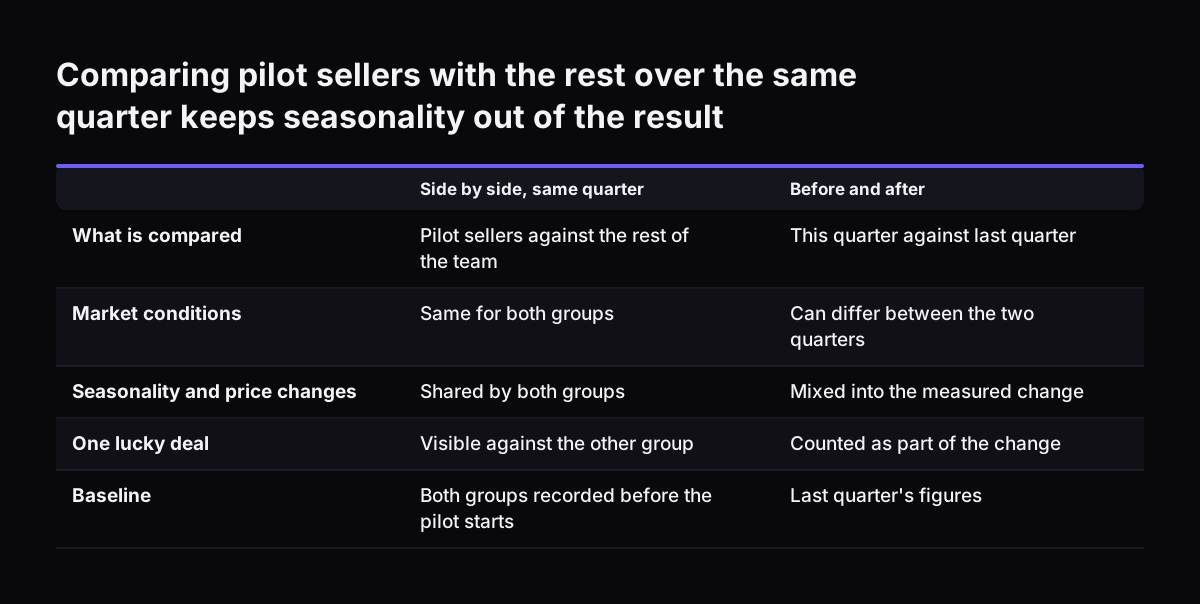
Compare the pilot group with the rest of the team over the same quarter, not this quarter against last. A before-and-after comparison mixes Claude's effect with seasonality, price changes and one lucky deal. Side by side, both groups face the same market and the difference is easier to trust.

Take the baseline before anyone starts. Record your activity metric and your revenue metric for both groups. Then read both again at the date you set for the scale decision.

Anthropic's revenue guide measures return in three groups: efficiency, expansion and new capabilities. Lead the budget case with the last two. A finance director can only value saved hours at what those hours cost, so an hours-saved case reads small. Extra pipeline and work you could not do before read as growth.

The customer stories show what new work looks like. Cyera used Cowork to build a 3,500-person Salesforce list for a New York event, and registrations went from 105 to more than 400 overnight. Travis Bryant says account scoring that once took hundreds of hours across several departments took him one night.

Keep efficiency figures in the case, but as support. Time saved on call notes matters most when you can show where the seller spent it.

Comparing pilot sellers with the rest over the same quarter keeps seasonality out of the result. Side by side, same quarter / Before and after. What is compared: Pilot sellers against the rest of the team / This quarter against last quarter; Market c

Three ways a sales AI rollout stalls, and how to avoid them

Most stalled rollouts fail in one of three predictable ways. Each one has a simple guard that costs little to put in place at the start.

A pilot with no end date

A pilot without a deadline never produces a decision. Put the scale decision in the diary on the day the pilot starts, with the owner's name next to it.

Scaling seats without champions

Licences without people who show others how to use them go unused. Cyera found that most go-to-market staff taught to use Claude Code stalled at the command line. Its company-wide rollout included a full day of livestreaming, twice-weekly office hours and 20 sessions for specific departments. In a small company, the pilot sellers become the champions and run short sessions for colleagues.

Ignoring spend until the first invoice

Set limits and read usage from week one. In Claude Enterprise, admins can set hard spend caps for the whole organisation, a group or individual users, and caps take effect straight away. Usage analytics break spend down by person, team and model. Anthropic's guide to cost visibility and control adds a warning on model choice. Giving a cheaper model complex reasoning often makes the finished task more expensive, because of retries and extra human correction.

What this means for a UK company of 10 to 50 people

For a UK company of 10 to 50 people, the limit is time and attention, not technology. There is rarely a RevOps team, so the owner or sales manager does the setup alongside their day job. That is why the pilot stays at two or three people and the first connectors stay at CRM, email and calendar.

Budget in dollars if you build on the API. Anthropic lists Claude Sonnet 5 at $2 per million input tokens and $10 per million output tokens. Batch processing runs jobs that do not need an immediate answer at half price. Prompt caching can cost 10% of the normal input rate on cache hits, which suits a sales knowledge base that Claude reads before every draft.

Map your data before you connect anything. List which systems hold customer records and personal data, as Cyera did before its rollout. Then agree with whoever handles data protection in your business what Claude may read.

Many small UK firms run on Microsoft 365 rather than Gmail and Google Calendar. The same pattern applies there, and our guide to Claude in Microsoft 365 and Teams explains how to connect it. If you sell into Europe, all current Claude models support multilingual work, so one skill can draft follow-ups in your customers' languages.

Next steps for starting an AI-native sales team on Monday

Starting an AI-native sales team takes a short list of decisions, not a project plan. You can work through these steps in order:

  1. Name one owner for the pilot and the scale decision.
  2. Clean the CRM: merge duplicates, fill in deal stages and set a next step on every open deal.
  3. List which systems hold personal data, and agree with whoever handles data protection in your business what Claude may read before you connect anything.
  4. Then connect the CRM, email and calendar within those limits, or agree a weekly export if a connection is not ready.
  5. Choose one activity metric and one revenue metric, and record the baseline for every seller.
  6. Pick two or three motivated sellers and install the Sales plugin for them.
  7. Set spend limits and read usage every week.
  8. Put the scale decision on a date, and compare the pilot group with the rest over the same quarter.
  9. Write the best seller's method down as a skill once it works.

Once call notes and follow-ups run reliably, move to the next piece of sales work. A quote generator that uses your CRM prices is a natural second step. If you would rather see which sales and back-office processes are worth automating first, start with AI automation for growing businesses. You can also browse AI by business task to find the workflow closest to yours.

Sources

  1. 1. Anthropic: Building an AI-native revenue organization
  2. 2. Anthropic: How Anthropic's business development team uses Claude to run inbound and outbound at scale
  3. 3. Anthropic: How an Anthropic sales leader uses Claude Cowork to run a 4,000-account book
  4. 4. Anthropic: Sales plugin
  5. 5. Anthropic: Workato customer story
  6. 6. Anthropic: Cyera customer story
  7. 7. Anthropic: A guide to cost visibility and control in Claude
  8. 8. Anthropic: Deploying Claude across the enterprise with Claude Cowork
  9. 9. Anthropic: Models overview

Related articles