
Svennis AI
10 min read

Learning Claude through the Anthropic Academy and what it leaves out for business

A plain guide to the Anthropic Academy tracks, their length and cost, a one-week plan for a small team, and the three gaps teams hit when they build a real system.

Abstract layered paths branching from a single line into separate routes that rejoin further along

Learning Claude through the Anthropic Academy: what it is and who it serves

Learning Claude through the Anthropic Academy is the most direct way for you and your staff to understand how Claude works, because the material comes from Anthropic itself. The Academy is Anthropic's online training platform. Its courses are hosted at anthropic.skilljar.com, and they are also listed in Anthropic's own documentation.

Anthropic describes the offer as "structured learning paths with video lessons and assessments" covering AI collaboration, Claude development and MCP. MCP stands for Model Context Protocol, the standard way to connect Claude to other software, such as your CRM or helpdesk. You will meet it again below.

The courses serve three broad groups. Everyday users learn to work with Claude in the chat window and in Claude Cowork, Anthropic's product for handing off multi-step tasks. Administrators learn how to roll Claude out across an organisation. Developers learn the API, Claude Code and MCP.

This guide sets out each track, what it costs and how long it takes, and how a small team can get through the essentials in a week. It then covers what the courses do not teach. A working business system on Claude also needs routing, data access and a clear handover to people. Those are the gaps teams hit after they finish the courses, and they decide whether the system is useful in daily work.
The tracks, who each one is for and how long it takes

The catalogue changes over time, so check the courses page in Anthropic's documentation before you plan. The table below uses the lesson counts and durations Anthropic publishes there and on its learning page.

CourseBest suited toPublished length
Claude 101Anyone using Claude for everyday work13 lessons, 1 quiz, 2.5 hr
AI Fluency: Framework and foundationsEveryone; teaches the 4D framework14 lessons, 1 quiz, 4 hr
AI Fluency for small businessesOwners and staff of small firms9 lessons, 1 quiz
AI capabilities and limitationsManagers who need a realistic view of the model13 lessons, 1 quiz, 3.5 hr
Introduction to Claude CoworkStaff handing off multi-step work14 lessons, 1 quiz, 2.5 hr
Introduction to Claude TagTeams working in Slack11 lessons, 1 quiz, 2.5 hr
Deploying Claude Enterprise with confidenceAdministrators planning a rollout14 lessons, 1 quiz, 2.5 hr
Building effective human-agent teams (beta)Team leads5 lessons, 1 quiz, 45 min
Introduction to agent skillsPeople writing reusable instructions6 lessons, 1 hr
Claude Code 101Developers12 lessons, 1 quiz, 1.5 hr
Introduction to Model Context ProtocolDevelopers who write Python10 lessons, 1 quiz, 1 hr
Building with the Claude APIDevelopers building products67 lessons, 8 quizzes, 9 hr
Claude with Amazon Bedrock / Google Cloud's Vertex AITeams already on those clouds8 hr / 8.5 hr

The 4D framework in the AI Fluency course stands for Delegation, Description, Discernment and Diligence. There is also a Claude Platform 101 course for developers who have only used Claude through a chat window.

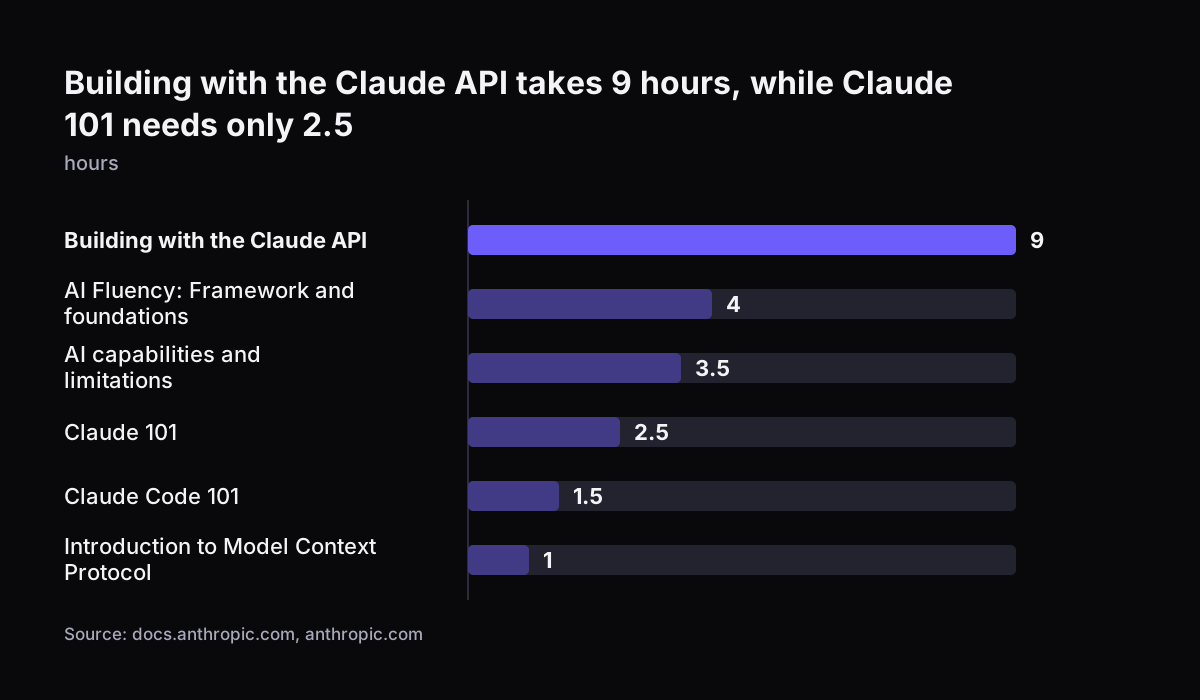
Building with the Claude API takes 9 hours, while Claude 101 needs only 2.5: Building with the Claude API 9, AI Fluency: Framework and foundations 4, AI capabilities and limitations 3.5, Claude 101 2.5, Claude Code 101 1.5, Introduction to Model Cont
Source: docs.anthropic.com, anthropic.com

What is free, what needs an account and what you get

The courses cost nothing. An independent guide to the Academy states that "the courses are free and no payment method is required to enrol". You sign up with an email address at anthropic.skilljar.com. One widely shared LinkedIn post about the courses notes that you do not need an Anthropic account to start, only that email sign-up.

That separation matters for a business. Your staff can take the courses before you have bought any Claude seats. You can test whether the material suits your team without committing to a licence first.

Most courses end with a quiz and a completion badge, as Anthropic's courses page shows. Keep one distinction clear. A completion badge shows that someone finished a course. It is not an examined certification. The same independent guide points out that a separate certification exam, called CCA-F, is paid, and that the courses alone do not replace proper preparation for it.

For hiring or supplier decisions, treat badges as evidence of familiarity, not of competence in building systems. A person who finished Building with the Claude API has seen tool use and retrieval explained. That does not mean they have connected Claude to your live customer records and kept those records safe.

What a person can do after each track

The everyday tracks change how staff write requests. Claude 101 covers everyday work tasks and core features. The AI capabilities and limitations course explains next-token prediction, knowledge, working memory, steerability and context limits. After those two, your team should know why Claude sometimes gets things wrong and how to give it better context.

Claude Code 101 gives developers working habits. Anthropic's help centre kit for Claude Code champions, published in Italian among other languages, lists several of them:

  • Plan mode. Press Shift+Tab and Claude proposes exactly what it intends to change. Nothing is modified until you approve.
  • CLAUDE.md. Run /init and Claude Code generates a CLAUDE.md file from your repository, where you record team conventions and test commands.
  • Skills. Save a SKILL.md file in .claude/skills/<name>/ and the whole team gets a /name command. Skills are plain Markdown, so colleagues can adopt them at once.

The MCP course teaches the three core primitives: tools, resources and prompts. The API course goes further, covering tool calling, retrieval pipelines, and deterministic workflows alongside flexible agent systems. It also explains Anthropic's two ways to build: the Messages API, where you write every turn and your own tool loop, and Claude Managed Agents, a pre-built agent harness that runs in Anthropic's managed infrastructure.

Worked example: a five-person team works through it in a week

Take a firm with five people: an owner, an operations lead, an office manager, a customer service agent and one developer. The goal is a shared baseline by Friday, without taking anyone off their normal work for more than an afternoon.

  1. Monday. Everyone takes Claude 101 (2.5 hours). The owner adds AI Fluency for small businesses.
  2. Tuesday. The operations lead takes Introduction to Claude Cowork (2.5 hours). The office manager takes Introduction to agent skills (1 hour) and drafts one skill for a task the team repeats weekly.
  3. Wednesday. The developer takes Claude Code 101 (1.5 hours), installs Claude Code in the terminal, which the help centre kit puts at about two minutes, runs /init on one repository and tries plan mode on a small change.
  4. Thursday. The developer takes Introduction to Model Context Protocol (1 hour). If you plan to buy Claude Enterprise, the owner takes the Enterprise deployment course (2.5 hours).
  5. Friday. Everyone takes Building effective human-agent teams (45 minutes), then meets for an hour to agree one first task.

Most staff spend about three and a quarter hours on courses. The developer spends under six. The help centre kit also suggests offering a single fifteen-minute pairing session to anyone starting, which fits well on Wednesday afternoon. For the setup that follows, our guide to Claude Projects and Skills for a small team shows how to organise shared instructions.

The Friday meeting should produce three written answers: which requests go where, which data Claude may read, and who takes over when Claude should stop. Those three answers are the gaps covered next.

Gap one: routing requests to the right place

Routing means deciding where each incoming request goes: which queue, which team, which person. In a service desk, a password reset, a billing dispute and a faulty device each belong somewhere different. Get it wrong and the request waits in the wrong inbox while the customer waits too.

The Academy covers routing as a technique. The agents and workflows module of Building with the Claude API, as its course listing describes, includes conditional routing, operation chaining and parallel execution. What no course can supply is your routing table: your categories, the departments in Zoho Desk or whatever helpdesk you run, and the rules for requests that fit two categories at once.

At Svennis we write the routing table with the people who own each queue before we write any prompt, because only they know which categories overlap and which ones customers describe in their own words. That table becomes the test set: real past requests, each with the queue it should have reached.

Measure routing on first-time-right placement, not on how fluent the reply sounds. A polished answer in the wrong queue still has to be moved by hand. Our post on Claude in Slack for internal support works through the same problem for internal tickets.

Gap two: data access and what Claude may read

A business system is only as good as the data it can reach. Claude on its own knows nothing about your customers, prices or open orders. The help centre champion kit says it plainly: made-up answers are usually a context problem rather than a model problem.

MCP is how you give Claude that context. The Introduction to Model Context Protocol course teaches you to build MCP servers and clients in Python. The advanced course covers sampling, notifications, file system access and transport mechanisms. After both, a developer can connect Claude to a system such as Zoho CRM.

The courses do not decide the scope for you. Before anyone writes a server, answer these questions in writing:

  • Which records and fields does Claude need to read, and which should it never see?
  • Can it write, or only read? If it writes, which fields?
  • Whose permissions does it act under: one service account or the logged-in user?

Anthropic's own introduction gives two concrete rules for credentials. Set an expiration when you create an API key, and keep the key out of source control, client-side code and prompts. Check whether your workload can use Workload Identity Federation instead of a static key. For a structured way to scope the connection, read our guide to scoping an MCP server for your own internal system.

Gap three: a clear handover to people

Handover is the point where Claude stops and a person takes over. It happens when a request falls outside the rules, when a customer is upset, or when an action carries risk. Without a defined handover, staff either check everything, which removes the time saved, or check nothing, which removes the safety.

The Academy points in the right direction. Building effective human-agent teams, a 45-minute beta course, covers moving "from single-player to multiplayer AI" and preparing a team for the shift. Claude Code's plan mode is a small model of good handover: Claude proposes, a person approves, and nothing changes until then.

The champion kit shows another pattern worth copying. When staff ask a champion about security or data handling, the champion refers them to the administrator, because the organisation's policy is already configured. That is a handover rule written down in advance, with a named recipient.

For your own system, define three things:

  1. The trigger. Which conditions make Claude hand over, for example low confidence in the category or a refund above a set level.
  2. The recipient. A named queue or role, not "someone".
  3. The context. What the person receives, so they do not start again: the original request, what Claude found and why it stopped.
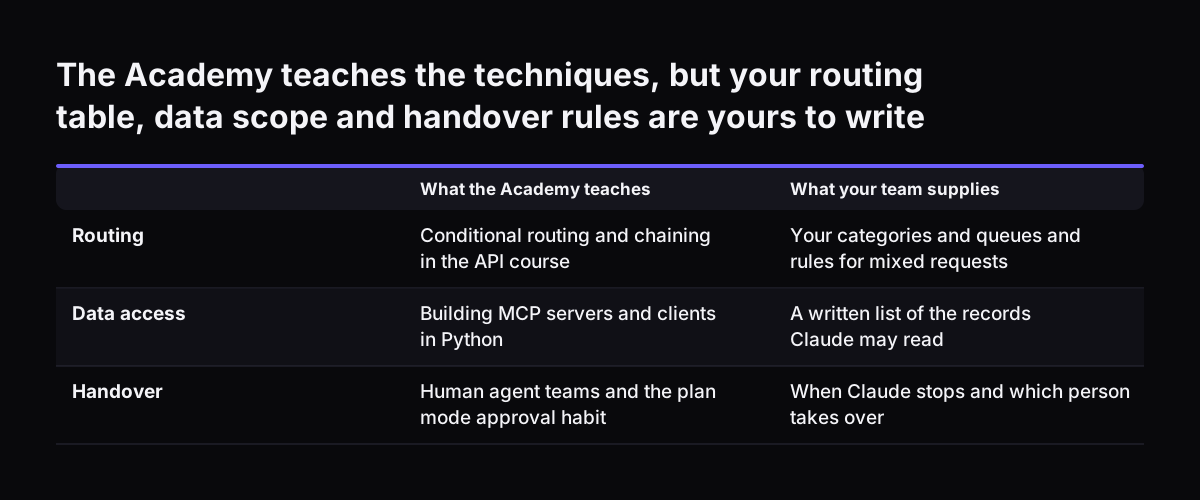
The Academy teaches the techniques, but your routing table, data scope and handover rules are yours to write. What the Academy teaches / What your team supplies. Routing: Conditional routing and chaining in the API course / Your categories and queues

What this means for a company in the UK and Europe

The courses teach the product. They do not teach your legal duties as a business in the UK, Germany, Romania or Italy. Treat the Enterprise deployment course as the bridge. Its five rollout decisions are Structure and Identity, Access, Governance, Spend and Visibility. Governance and Access are where your data protection obligations meet the tool.

Before a system built on Claude touches customer data, work through our checklist on whether Claude is GDPR compliant, and read our overview of AI law in the UK and what applies to your business. The Academy will not tell you what to record in a data protection impact assessment. Your own adviser and policy will.

Your existing cloud contracts also matter. Anthropic's documentation lists Claude as available on Amazon Bedrock, Google Cloud and Microsoft Foundry. If your company already runs on one of these, the matching Academy course, Claude with Amazon Bedrock or Claude with Google Cloud's Vertex AI, may be the better technical track for your developer than the general API course.

Language is a practical point for teams outside the UK. Some of Anthropic's help centre material, such as the Claude Code champion kit, is published in Italian as well as English. Check what is available in your team's language before you schedule the week.

Practical next steps

You can start this week at no cost. The steps below take you from courses to a first working system without skipping the parts the courses leave out.

  1. Enrol the team. Sign everyone up at anthropic.skilljar.com with their work email and assign Claude 101 first.
  2. Pick the technical track. Give your developer Claude Code 101 and Introduction to Model Context Protocol. Add Building with the Claude API or the cloud course that matches your provider for the following week.
  3. Choose one process. Pick a single, high-volume task, such as sorting incoming support requests. Avoid starting with three.
  4. Write the routing table. List the categories and the queue each one belongs to, with the people who own those queues. Collect real past examples for testing.
  5. Scope the data. Write down which systems, records and fields Claude may read or write, and how its credentials are stored and expired.
  6. Define the handover. Name the trigger, the recipient and the context for every case where Claude should stop.
  7. Check the data terms first. Before any real customer request goes through the system, confirm you have a data processing agreement with your provider, a lawful basis for the processing, and a transfer mechanism such as UK adequacy regulations, the IDTA or the UK Addendum for any personal data that leaves the UK. Or use test examples anonymised so that no one can be identified.
  8. Test before you widen access. Run the past examples through the system and check where each one landed.

To see how routing, data access and handover fit together in one live system, read our post on Claude for business, from a Teams service desk to Zoho Desk. It shows the decisions from steps four to six made for a real service desk.

Sources

  1. 1. Anthropic: Courses (Claude Academy documentation)
  2. 2. Anthropic Courses on Skilljar
  3. 3. Anthropic: Claude Academy, learn to work and build with Claude
  4. 4. Anthropic: Intro to Claude, Claude Platform Docs
  5. 5. Anthropic: Claude Platform Docs home
  6. 6. Anthropic Help Center: Kit campione Claude Code
  7. 7. Class Central: Building with the Claude API from Anthropic Academy
  8. 8. AI Cloud Architect: Anthropic Academy, where should you start?
  9. 9. Paymaun Rezai on LinkedIn: Anthropic Academy free AI courses

Related articles